
Execution doesn't stop at your four walls.
Your real supply chain spans suppliers, forwarders, brokers, customs authorities and banks — companies that share no system and no workflow. Multi-Enterprise Execution is the framework for running all of it as one operation.
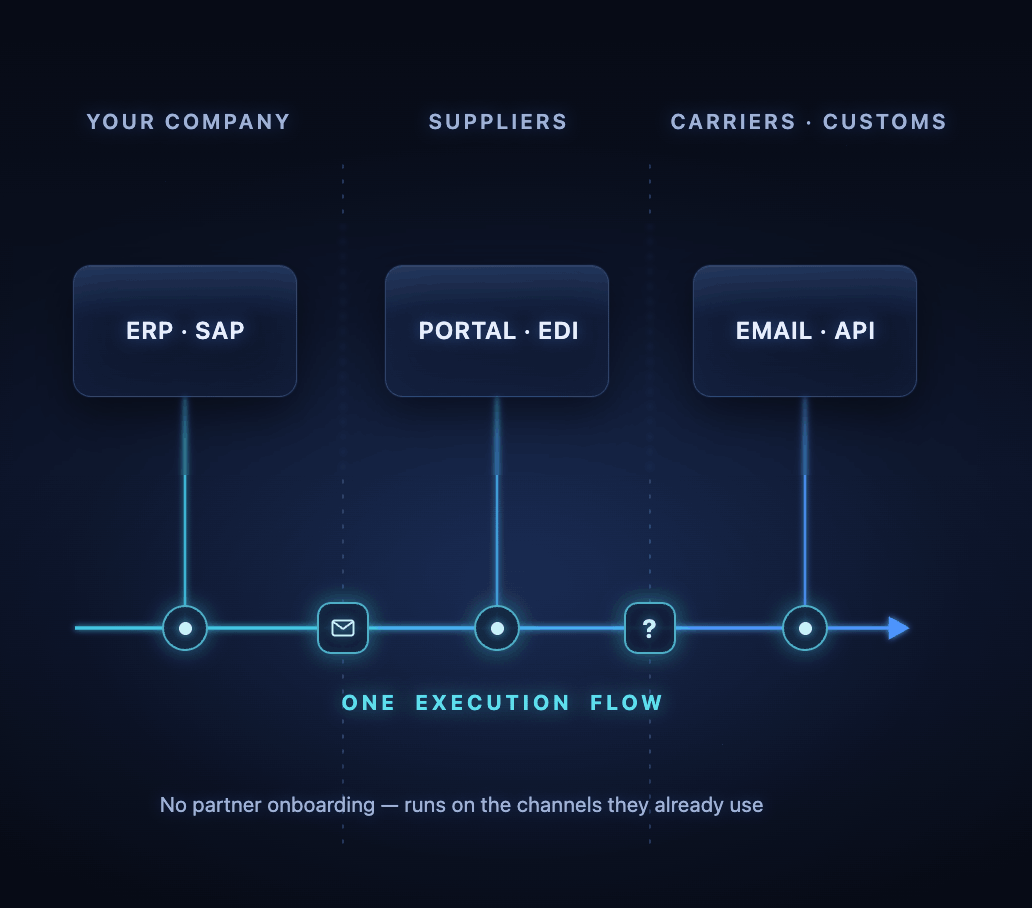

Planning tools assume one company's data. Execution lives across many.
A system of record keeps the ledger.
A system of execution runs the work.
SAP, Oracle, Dynamics, Tally. Master data, financials, compliance. It stays exactly where it is — the source of truth for what was recorded.
An agent mesh that runs the work between records — across every connected company and system — and writes the outcome back to your ERP, hands-free.
Context-based field mapping to SAP/Oracle/Dynamics/Tally and to partner systems — no custom code, live in 60 days.
Procurement, logistics, EXIM and finance agents that collaborate across company lines — a supplier delay auto-triggers freight and finance response.
Every company, document, event and outcome connects — so the system learns "when X happens, Y follows," and gets smarter with each node.
The reason this works where networks stall:
nobody has to join anything.
Most never do. Lasya meets each partner on the channel they already use, reads and acts on it,
and hands you one clean execution flow across all of them.
Email, EDI, carrier & port APIs, supplier portals, WhatsApp, PDFs and scans — parsed and understood, structured or not.
Confirms the PO, books the freight, files the customs entry, chases the document — on the partner's terms, no login required of them.
Every partner's response lands as one coordinated execution flow, written back to your ERP — so the handoff closes itself.
Zero partner onboarding is the unlock. It's why a multi-enterprise operation can go live in 60 days instead of stalling for years on everyone else's IT roadmap.
Anyone can ship an agent. No one can manufacture your operational history.
Assume every competitor has equivalent AI in 24 months. What survives that assumption? Not the agents. Three things that only accumulate with years of real work across companies — and that's the foundation Settyl is built to own.
When the PO change, the booking, the customs release and the approval happen inside Lasya, this becomes your record of truth — not a copy. Removing it means rebuilding history, not swapping software.
Which supplier slips, which lane performs, which broker clears fastest, which exceptions cascade. Institutional memory your ERP never held — and that a better model can't fabricate. It only accrues with volume.
Lasya owns the decision to pay — 4-way match, approval, reconciliation, write-to-GL — not the money movement itself. Once financial controls run through it, removal needs CFO sign-off, not an ops call.
Neutral. Networked. Deep.
An ERP-owned execution layer is a conflict for everyone not on that ERP. Multi-enterprise coordination has to be neutral across every system and partner — structurally not what a single ERP is built to be.
Once suppliers, forwarders and brokers transact through the layer, each new participant makes the next onboarding cheaper. A network effect the planning tools never had.
EXIM execution across 47 country profiles — eWay, GST, customs, native. Too regional and specialized for a megacap roadmap, exactly where the wedge is.
The framework runs live inside regulated, multi-party industrial supply chains today.





Isn't this just a supply-chain network?
and still require everyone to onboard. Multi-Enterprise Execution runs the cross-functional handoff, with no onboarding at all.
Proof · in their words

“One of a kind service”
Lorem ipsum dolor sit amet consectetur adipiscing elit ultrices scelerisque mi sed interdum lacus tellus in mi orc, netus nisl laoreet phasellus. Pellentesque non nunc placerat mi quis vitae.

“The best service”
Lorem ipsum dolor sit amet consectetur adipiscing elit ultrices scelerisque mi sed interdum lacus tellus in mi orc, netus nisl laoreet phasellus. Pellentesque non nunc placerat mi quis vitae.


Security & AI governance
Enterprise-grade — and built to be trusted with autonomy.
Lasya acts inside your live operation, so the controls around it matter as much as the capability itself. Settyl is certified and governed to enterprise standard.
Independently audited information-security management — the access governance, data-protection and operational controls enterprise InfoSec teams require before they'll sign.
We follow the NIST AI Risk Management Framework — appropriate controls around AI risk, data privacy, transparency, accountability and human oversight on every agent action.
Lasya co-exists with SAP, Oracle and Dynamics — never replacing them. Your data stays yours, every action is logged and auditable, and a human stays in the loop wherever you set the threshold.
Multi-enterprise, answered.
The foundation the outcome is built on.
See the execution graph form in your first 60 days.
We'll connect one corridor of your supply chain — and show you the transactions, memory
and control that start compounding the moment work runs through it.


See the execution graph form in your
first 60 days.
We'll connect one corridor of your supply chain — and show you the transactions, memory and control that start compounding the moment work runs through it.