
From supplier commitment to verified delivery. One continuous execution.
Lasya AI carries the physical transaction from supplier readiness through carrier booking, dispatch, multimodal movement, customs, warehouse receipt and delivery proof — while ERP and specialist systems remain Systems of Record.
Verified Supplier Commitment
Supplier · quantity · promise date · pickup origin · shipment constraints
Carrier commitment · milestones · customs events · delivery proof · actual freight evidence
Your ERP can record the shipment. People still keep it moving.
ERP,WMS and carrier portals store records. The work between those records still travels through EDIs, email, calls, WhatsApp, spreadsheets, broker updates and manual follow-up.
One transaction state across every mode.
Road
FTL · LTL · parcel
Ocean
FCL · LCL · intermodal
Air
Express · deferred
Rail
Intermodal · bulk
EXIM
Customs · duty · documents
A smarter TMS still cannot own the transaction before or after transportation.
The last software era digitized commercial commitment, transportation, customs, warehousing and finance as separate functions. Each application can become more intelligent. The physical transaction still crosses every boundary between them.
Eight execution states. One verified delivery.
Ready
Supplier commitment becomes pickup-ready state.
Plan
Mode, lane, capacity and SLA determined.
Book
Carrier or forwarder selected and confirmed.
Dispatch
Vehicle, container or flight movement initiated.
Move
Transit monitored against required milestones.
Clear
Customs and EXIM requirements completed.
Receive
Warehouse or consignee acknowledges receipt.
Verify
Delivery proof and execution evidence finalized.
One Shipment. Every execution state connected.
Lasya carries the shipment through assignment, pickup, yard, dock, movement, delivery, proof and settlement dependencies — not just visibility.
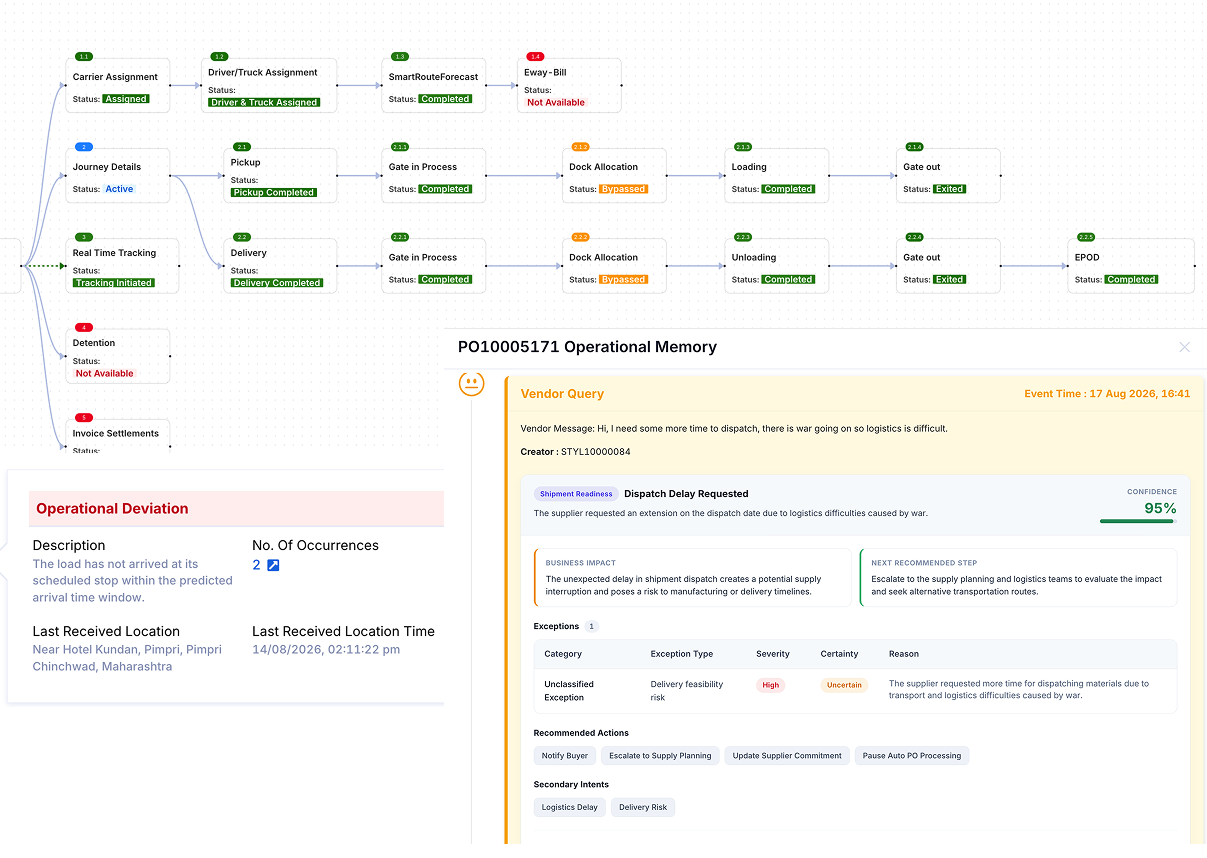
A shipment record is not shipment execution.
ERP
Shipment created · planned route · booking record · ETA field · customs record · delivery record
Lasya AI
Carrier commitment · actual movement · booking confirmation · recovery decision · clearance execution · proof verification
Plan → Commit → Move → Close
Plan
Shipment planning, consolidation, mode, lane and capacity.
Commit
Carrier sourcing, tendering, booking and pickup confirmation.
Move
Dispatch, tracking, ETA, yard, customs and disruption recovery.
Close
ePOD, actual freight evidence and finance-ready execution package.
Carriers, forwarders and brokers should not need another portal to participate.
Lasya meets each participant through the channels already used to execute freight, while preserving one shipment transaction state.
Carrier
Email · WhatsApp · API · EDI
Forwarder
Email · portal · documents
Broker
Email · customs portal
Driver
Mobile · voice · messaging
Autonomous freight is proven when movement deviates from plan.
Movement breaks
Carrier rejects tender, ETA slips, customs blocks release, pickup fails or capacity disappears.
Understand impact
Check SLA, inventory, production, alternate capacity, route and cost implications.
Execute governed recovery
Rebook, reroute, expedite or escalate only when authority or policy requires a human.
Cross-border execution is part of the shipment — not a separate workflow.
Classification
HS recommendations with evidence and governed review.
Documents
Shipment-specific document requirements assembled and tracked.
Broker Execution
Clearance tasks and responses carried inside shipment state.
Release Evidence
Duty, clearance and release events retained for audit and settlement.
Freight execution does not stop at tracking
Lasya links shipment milestones, freight charges, port events and trade documents into the same execution state.
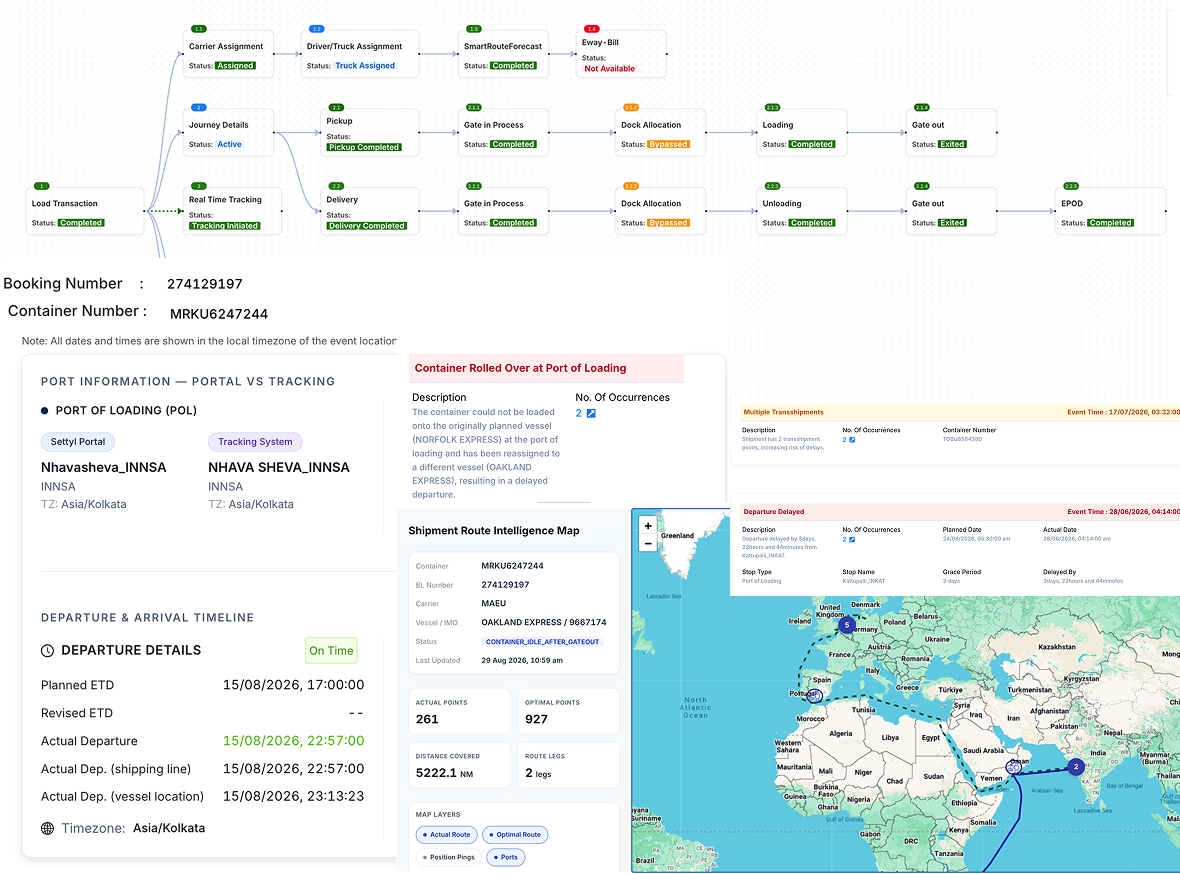
Every shipment makes the next movement easier to execute.
Lane Memory
Transit time, congestion, delay patterns and cost variance.
Carrier Memory
Acceptance, reliability, SLA performance and exception behavior.
Trade Memory
Classification, clearance, broker and duty outcomes.
Exception Memory
Recovery actions and which outcomes worked in context.
One execution layer. Different logistics outcomes.
Dispatch
Today: TMS + spreadsheet + calls.
Lasya: continuous dispatch execution.
Outcome: fewer planning touches.
Logistics
Today: contract, spot and carrier choices fragmented.
Lasya: tender and booking inside transaction state.
Outcome: less manual coordination.
Supply Chain
Today: fragmented shipment visibility.
Lasya: impact-ranked execution exceptions.
Outcome: faster recovery.
EXIM
Today: document packs and broker chasing.
Lasya: governed clearance execution.
Outcome: shorter border delays.
Customs
Today: evidence assembled manually.
Lasya: shipment evidence retained in context.
Outcome: stronger compliance traceability.
Finance
Downstream: receives actual freight evidence, delivery proof and variance context for financial closure.
Execution improvement should show up in service, cost and recovery.
Previously reported across selected deployments; results vary by lane, baseline, operating model and scope.
No context reset between commercial commitment, physical movement and financial closure.
Verified Supplier Commitment
Supplier · quantity · promise date · origin · shipment constraints
VERIFIED PHYSICAL EXECUTION
Finance-Ready Evidence
Booked vs actual rate · accessorials · POD · claims · invoice basis
Autonomous Freight & Logistics, answered.
What is Autonomous Freight & Logistics?
It is the execution of physical supply-chain movement from verified supplier commitment through carrier coordination, multimodal transportation, customs, receipt and verified delivery with minimal manual relay.
How is Lasya different from a TMS?
A TMS typically records, plans and optimizes transportation inside a defined logistics workflow. Lasya is the System of Execution carrying the transaction across supplier readiness, carriers, forwarders, brokers, customs, receipt evidence, exceptions and finance handoff. ERP, TMS or specialist applications can remain where required, while fragmented mode-specific execution and manual relay can be consolidated into one transaction state.
Do carriers need a new portal?
No. Carriers and partners can participate through existing channels such as email, WhatsApp, APIs, EDI, documents or existing portals where appropriate.
How does Lasya handle shipment exceptions?
Lasya assesses operational impact, evaluates permitted recovery options, executes governed actions and escalates only when policy or authority requires human intervention.
How does EXIM fit into freight execution?
Customs, documentation, broker coordination, duty and release events are maintained as part of the shipment transaction rather than a disconnected workflow.
What does Freight pass to Finance?
Verified delivery evidence, actual movement milestones, booked versus actual freight context, accessorial evidence, claims and the basis needed for reconciliation and settlement.
Start with one shipment that still depends on human coordination.
Choose one lane, carrier set, import corridor or exception-heavy movement. Measure manual touches, booking time, exception recovery, OTD and cost variance.