
Autonomous Finance Operations: From Execution Evidence to Financial Closure
Lasya turns procurement, shipment, receipt and invoice evidence into reconciled financial truth — resolving exceptions, applying controls and posting verified outcomes back to ERP.
SAP, Oracle or Dynamics remains the System of Record. Lasya carries the work required to make the record financially complete.
The invoice is in ERP. The financial work may still be unfinished.
Systems know the records
PO · Receipt · Invoice · Freight booking · GL account · Payment terms
Finance still resolves the work
Quantity variance · Price variance · Freight variance · Accessorials · Tax mismatch · FX difference · Missing POD · Claims · Approval
Finance should not reconstruct a transaction that Operations already executed.
The last software era digitized procurement, transportation, warehousing and finance as separate functions. Each system can become smarter. The transaction still crosses every boundary between them.
Four records describe one transaction. Lasya reconciles the execution behind them.
Contract
What was agreed?
PO
What was ordered?
Receipt / POD
What actually happened?
Invoice
What is being charged?
Matching is not the outcome. It is how Lasya determines whether the financial transaction is ready to close.
Seven execution states. One verified financial closure.
Evidence
PO, shipment, receipt, rate, invoice and supporting evidence assembled.
Match
Commercial and physical execution compared with invoice.
Explain
Variance classified and root cause identified.
Resolve
Allowed discrepancy, credit, claim or correction executed.
Approve
Policy and authority checks completed.
Post
Verified posting written to ERP.
Close
Settlement and audit evidence linked to the transaction.
One invoice. One execution context. From intake to approved financial transaction.
Lasya AI turns invoice processing into a continuous autonomous execution flow — from invoice intake and contract validation to GL coding, approval and ERP write-back.
ERP records the financial outcome. Lasya carries the work required to reach it.
ERP · System of Record
Invoice record
PO record
GRN / receipt
Freight invoice
Journal entry
Payment record
Audit history
Lasya · System of Execution
Reconciliation work
Commercial variance resolution
Receipt evidence interpretation
Rate / accessorial validation
Posting decision
Settlement execution
Decision + evidence trail
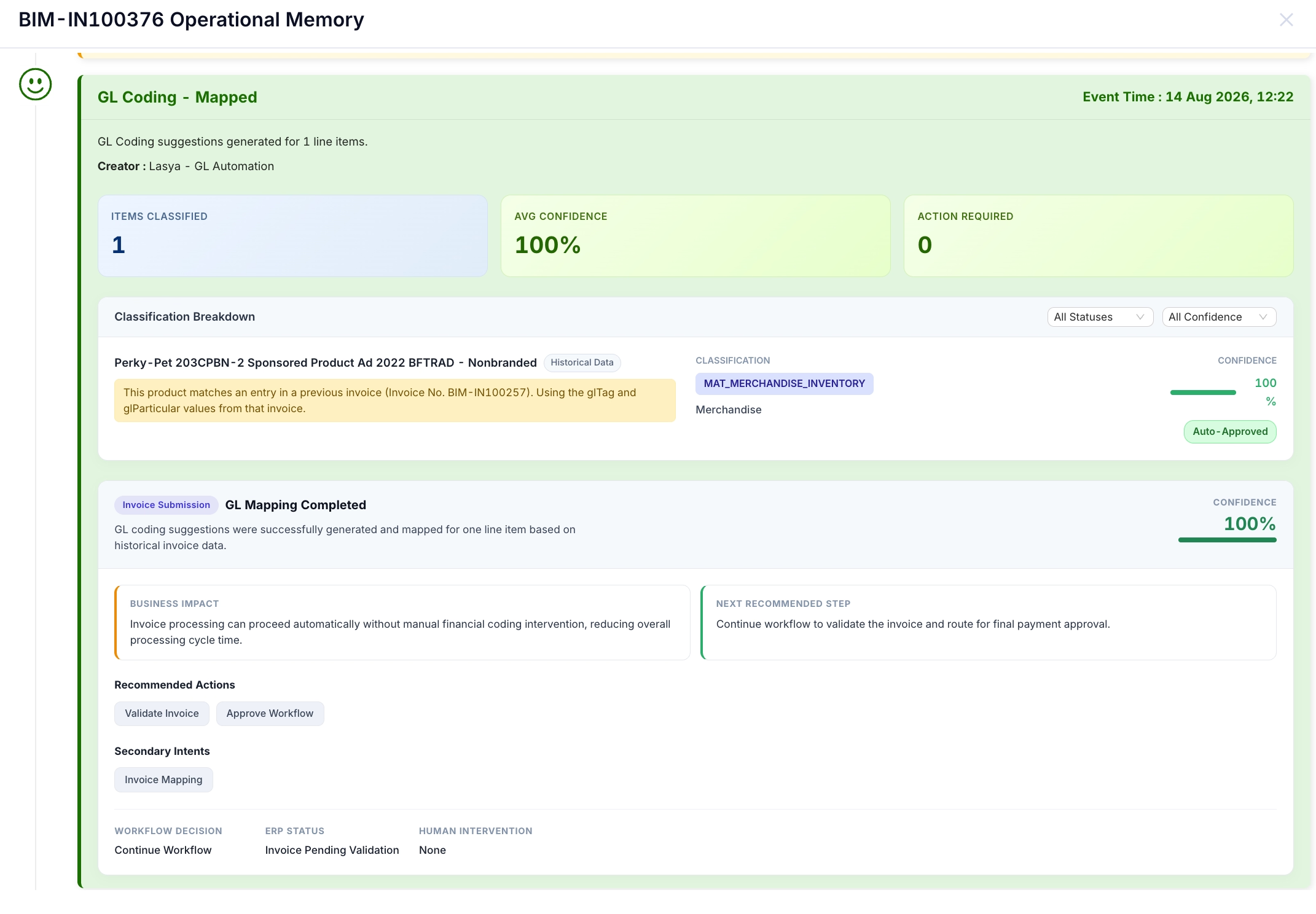
Lasya invoice memory becomes execution readiness and carries the resolution.
Lasya remembers how invoice exceptions were resolved and reuses that knowledge to accelerate future validation, routing and approval.
Reconcile → Resolve → Post → Optimize
Reconcile
Invoice ingestion · 3-way / 4-way matching · Freight audit · Rate-card validation · Tax validation · FX normalization
Resolve
Price variance · Quantity variance · Accessorial disputes · Damage / shortage · Claims · Credit note · Duplicate detection
Post & Settle
Approvals · Cost allocation · Accruals · Journal preparation · ERP posting · Payment authorization
Optimize
Working capital · Payment terms · Discount capture · Cash forecast · Spend visibility · DPO timing
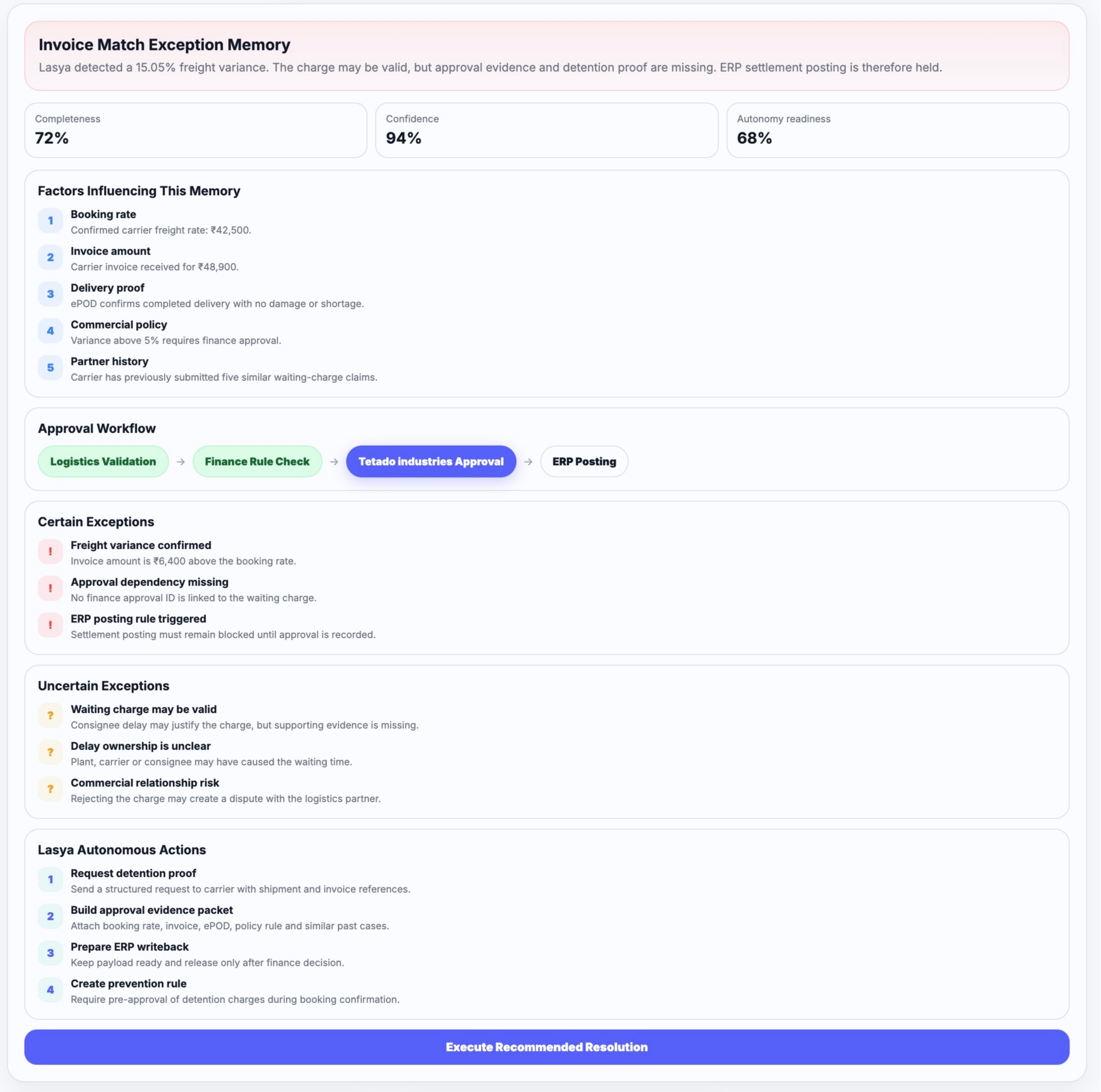
Autonomous finance is proven when the numbers do not match.
Detect
Carrier invoice ₹124,500 vs booked freight ₹116,000.
Investigate
Check rate card, detention terms, shipment events, POD, timestamps and prior approvals.
Execute
Approve valid charge, dispute unsupported charge, or escalate when authority requires.
Freight cost should reconcile against how the shipment actually ran.
Cash forecasts should change when execution changes.
Supplier delay
Promise moves +7 days → expected payment timing changes.
Customs delay
Receipt and invoice timing changes.
Freight exception
Expected payable changes.
PO quantity change
Cash exposure changes.
Lasya forecasts cash from live transaction state, not only from historical ledger snapshots.
Every financial exception becomes reusable execution knowledge.
Vendor Memory
Invoice behavior, dispute patterns, credits and payment performance.
Commercial Memory
Rates, tolerances, negotiated terms and discount behavior.
Accounting Memory
Approved mappings, allocations, tax treatments and posting patterns.
Exception Memory
What was accepted, rejected, disputed or escalated — and why.
One execution layer. Three finance outcomes.
CFO
Need: live cash and working-capital truth.
Lasya: financial state updates from live procurement, freight and invoice events.
Outcome: better cash visibility and fewer trapped decisions.
Controller
Need: continuous reconciliation and auditability.
Lasya: exceptions resolved with evidence before close.
Outcome: faster close with traceable decisions.
Accounts Payable
Need: throughput without losing control.
Lasya: eligible invoices reconcile automatically; teams focus on real exceptions.
Outcome: fewer manual touches and faster resolution.
Autonomy stops where financial authority says it should.
Auto-execute
Within approved tolerance and policy.
Request approval
Amount or variance exceeds delegated authority.
Escalate
Policy conflict, material exception or missing evidence.
Every action retains evidence, rule or policy, decision, approver where applicable, system write-back and outcome.
Evidence should show financial execution improvement — not feature count.
Previously reported across selected enterprise deployments; validate underlying case evidence before using as universal benchmarks.
No context reset between commercial commitment, physical movement and financial closure.
Hub 01 · Procurement
Verified Supplier Commitment
PO · Terms · Supplier · Quantity · Payment terms
Hub 02 · Freight
Verified Physical Execution Truth
Milestones · Receipt / POD · Freight events · Claims · Accessorial evidence
Hub 03 · Finance
Verified Financial Closure
Reconciled invoice · Resolved exceptions · Allocated cost · Approved liability · Settlement state
ERP
Authoritative Financial Record
SAP · Oracle · Dynamics
Autonomous Finance Operations, answered.
What is Autonomous Finance Operations?
It is the execution of financial closure from procurement and logistics evidence through reconciliation, exception resolution, approval, posting and settlement with minimal manual relay.
What is autonomous accounts payable?
Autonomous accounts payable is the governed execution of eligible invoice work from intake through transaction identification, validation, exception resolution, approval, ERP posting and verified closure with minimal manual relay. Lasya extends that execution across procurement and logistics evidence instead of treating the invoice as an isolated workflow.
Does Lasya replace ERP financials?
No. ERP remains the System of Record. Lasya is the System of Execution carrying the work required to reach a verified financial outcome.
How does Lasya handle invoice exceptions?
Lasya assembles evidence, determines the variance, applies policy, executes allowed recovery and escalates only when authority or materiality requires it.
How does Freight execution data reach Finance?
Shipment milestones, receipt evidence, booked rates, accessorials, claims and delivery proof remain attached to the same transaction state passed into Finance.
How are approvals governed?
Execution follows tolerances, delegated authority and policy guardrails. Material exceptions require approval or escalation, with full evidence retained.
Start with one financial workflow that still depends on manual reconciliation.
Choose one invoice queue, freight-audit flow, month-end reconciliation, claims process or multi-currency posting flow. Measure manual touches, exception resolution time, posting cycle and close duration.
Start One Finance Execution