

How to Choose E-Procurement Software: 8 Key Criteria for Deciding
Choosing e-procurement software usually begins with a feature comparison.
Can the platform automate requisitions?
Does it integrate with ERP?
Can suppliers manage their own information?
Does it provide approval workflows, spend analytics and compliance controls?
These are necessary questions. But they quietly assume that the organisation should be buying another standalone procurement tool in the first place.
That assumption deserves closer examination.
A procurement platform can perform exceptionally well inside the procurement function and still leave the larger transaction fragmented. The purchase order may be created faster, approved correctly and recorded in ERP—but what happens after it leaves procurement?
Someone still has to coordinate the supplier.
Someone still has to arrange transportation.
Someone still has to validate export-import documents, track the shipment, resolve delivery exceptions, reconcile the invoice and update ERP.
That is where the difference between a procurement tool and an execution layer becomes important.
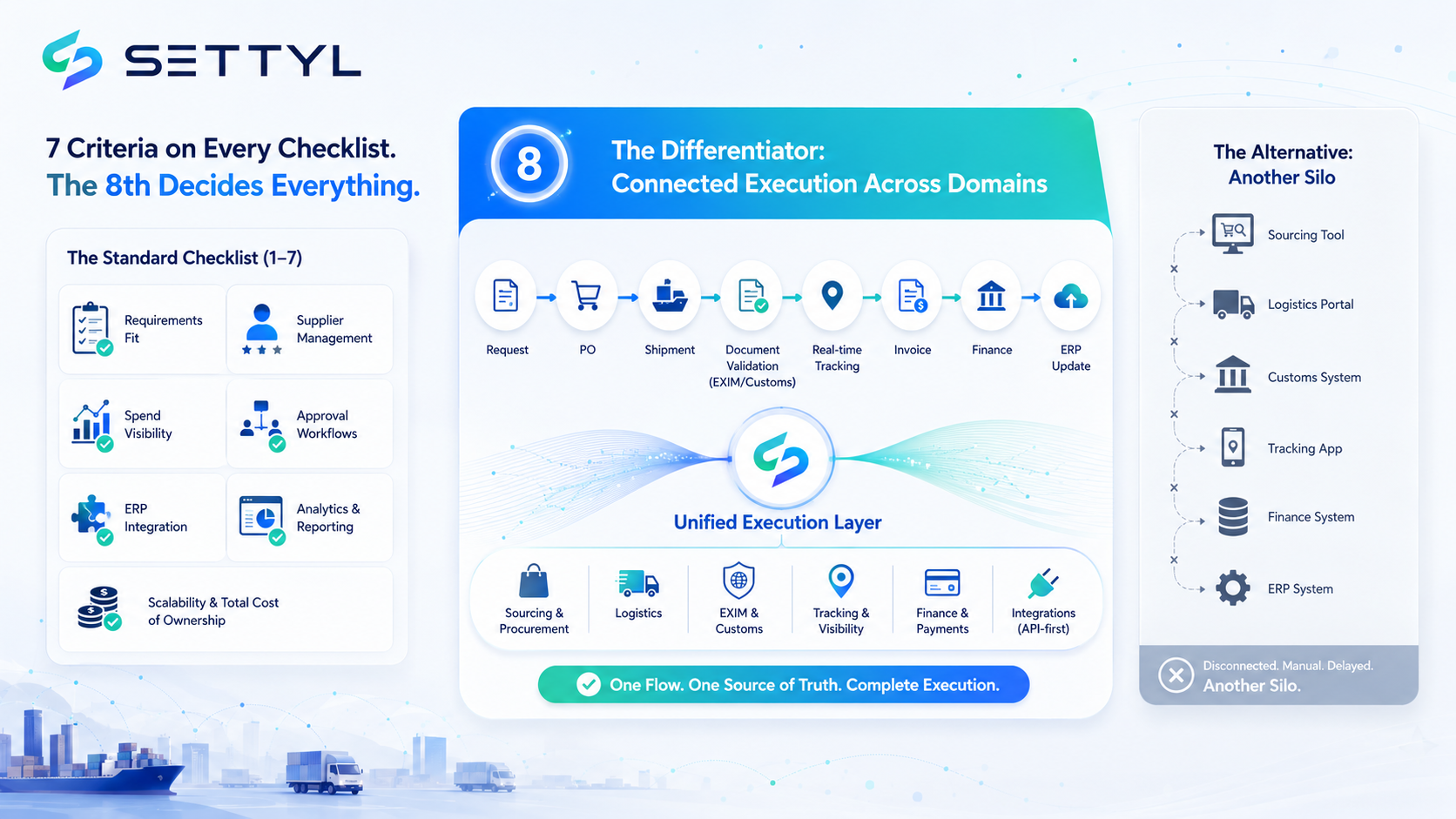
The first seven criteria in this guide will help you evaluate whether an e-procurement platform is functionally strong. The eighth will help you determine whether the platform solves the transaction—or simply creates another system your teams must connect manually -does it survive the handoff ?
What Is E-Procurement Software?
E-procurement software digitises and manages activities involved in purchasing goods and services.
Depending on the platform, this may include:
- Purchase requisitions
- Approval workflows
- Supplier onboarding
- Requests for quotation
- Catalog purchasing
- Purchase order creation
- Contract compliance
- Spend controls
- Invoice matching
- Procurement analytics
Traditional e-procurement systems focus primarily on what happens within the purchasing function. They help organisations replace emails, spreadsheets and paper-based processes with structured workflows.
That can create meaningful improvements.
But procurement does not operate in isolation.
A purchase request may begin with an internal team, move through sourcing and procurement, pass to a supplier, trigger transportation and EXIM activities, generate delivery documents, reach accounts payable and finally return to ERP as a completed financial transaction.
The real business process is not confined to one application or department.
A purchase order is not the end of procurement. It is the beginning of a cross-functional execution process.
This is why selecting e-procurement software requires more than comparing procurement features.
The Eight Criteria at a Glance
The first seven criteria help you choose a good procurement system.
The eighth helps you decide whether a procurement system is the right category of solution.
Criterion 1: Usability
Procurement platforms are often evaluated by procurement specialists. But many of their users are not procurement specialists.
Employees may raise purchase requests only a few times each year. Plant teams may need to confirm requirements. Department heads may approve transactions from mobile devices. Finance teams may review exceptions without regularly working inside the procurement platform.
A system can be functionally comprehensive and still fail because occasional users find it difficult to navigate.
Good usability should include:
- Clear requisition forms
- Guided buying experiences
- Simple approval actions
- Mobile-friendly interfaces
- Searchable catalogs and contracts
- Contextual prompts
- Role-specific dashboards
- Minimal training requirements
The platform should also reduce the need for users to understand procurement terminology.
A requester should not need to know which purchasing category, tax code, cost centre or sourcing route applies in every situation. The system should use available context and business rules to guide the request correctly.
Questions to include in your evaluation
- How many steps are required to create a standard purchase request?
- Can occasional users complete tasks without formal training?
- Does the platform support email or mobile approvals?
- Can forms change dynamically based on category, location or value?
- Are errors identified before submission?
- Does the system explain why a request has been rejected or returned?
Adoption should not depend on every employee becoming a procurement-system expert.
Usability matters because procurement automation creates value only when employees actually use the intended process.
Criterion 2: ERP Integration
ERP integration is one of the most important criteria in any procurement software comparison.
Your ERP will usually remain the authoritative system for vendor master data, materials, accounting structures, purchase orders, goods receipts, invoices and financial postings.
The e-procurement platform must therefore exchange information with ERP reliably.
This can include:
- Vendor and material master data
- Cost centres and general ledger codes
- Purchase requisitions
- Purchase orders and amendments
- Goods receipt information
- Invoice and payment status
- Budget availability
- Tax and accounting information
But integration should not be evaluated only by asking whether a connector exists.
A more useful question is:
What operational work must still happen outside the integration before the ERP record can be created or updated?
For example, a platform may technically integrate with ERP but still require employees to manually validate supplier documents, follow up on shipment status, reconcile quantity differences or resolve invoice exceptions before posting the final transaction.
That is integration without execution ownership.
Questions to ask vendors
- Which ERP objects can the platform read and update?
- Is the integration real time, scheduled or file based?
- How are failed transactions identified and retried?
- How are purchase order amendments synchronised?
- Can the system update ERP after resolving an operational exception?
- Is there a complete audit trail linking the business decision to the ERP update?
- Who owns integration monitoring after implementation?
Settyl’s position is not that ERP should be replaced.
ERP should remain the system of record.
The larger opportunity is to replace the fragmented execution layer around ERP—the emails, spreadsheets, portals, point applications and manual follow-ups required to make transactions complete enough to be recorded accurately.
Criterion 3: Spend Visibility and Control
Spend visibility is often presented as a reporting capability. In practice, it should be an operational capability.
It is useful to know how much the organisation spent by category, supplier, plant or business unit. But historical visibility alone does not prevent uncontrolled spending.
Effective spend control should influence the transaction while it is happening.
The platform should help teams:
- Direct requests toward preferred suppliers
- Identify existing contracts
- Detect duplicate or unnecessary purchases
- Enforce category-specific buying policies
- Monitor budget availability
- Consolidate similar requisitions
- Flag price deviations
- Identify maverick spend
- Route high-risk purchases for additional review
The system should also connect sourcing decisions with downstream purchasing.
For example, when an RFQ or auction results in a supplier award, the agreed commercial terms should flow into the applicable contract, rate card and purchase order. Buyers should not have to recreate those terms manually.
Questions to ask
- Can the platform provide committed, ordered, received and invoiced spend?
- Can it identify spend outside approved contracts?
- Does it detect price variance at the point of purchase?
- Can similar requisitions be consolidated before sourcing?
- Are sourcing awards connected to contracts and purchase orders?
- Can spend controls vary by category, entity, geography or business unit?
A spend dashboard tells you where money went.
A strong execution system also intervenes before avoidable spend occurs.
Criterion 4: Supplier Management
Supplier management is broader than maintaining a vendor database.
It includes the complete working relationship between the enterprise and its suppliers:
- Supplier discovery
- Registration and onboarding
- Document collection
- Compliance validation
- Qualification
- Catalog and pricing management
- RFQ participation
- Order acknowledgement
- Shipment coordination
- Performance monitoring
- Invoice and payment communication
Many procurement systems provide a supplier portal. That can work well for strategic suppliers that transact frequently with the organisation.
But portal participation can become a barrier for occasional suppliers, small vendors and partners already serving multiple enterprise customers.
The result is predictable: suppliers return to email, procurement teams re-enter information and the portal becomes only partially adopted.
A modern supplier-management model should support structured collaboration without assuming that every supplier will adopt another daily software workflow.
This may involve working across:
- Web forms
- Supplier portals
- Documents
- Spreadsheets
- Messaging channels
- APIs and EDI
Questions to ask vendors
- Can suppliers respond without maintaining another complex login?
- Can the system extract structured information from supplier emails and documents?
- How are tax, banking and compliance documents validated?
- Can suppliers acknowledge or request changes to purchase orders?
- Can the system track unresolved supplier actions?
- Is communication preserved as part of the transaction audit trail?
- Can supplier performance be connected to actual delivery, quality and invoice outcomes?
Supplier self-service should reduce work for both sides.
It should not simply transfer administrative work from the buyer to the supplier.
Criterion 5: Compliance and Approvals
Procurement software should help organisations apply policy consistently.
That includes controlling:
- Who can request a purchase
- Which suppliers can be used
- What approval levels apply
- Whether competitive sourcing is required
- Which contracts and price lists are valid
- What documents must be collected
- How exceptions are handled
- Who can amend or cancel an order
Configurable workflows are therefore essential.
But more approvals do not automatically create better control.
A poorly designed approval structure can turn every transaction into a queue. Employees begin escalating routine requests, approvers receive insufficient context and urgent purchases move outside the system.
The objective should be risk-based control, not approval volume.
Routine, policy-compliant transactions should move quickly. Unusual, high-value or high-risk transactions should receive deeper scrutiny.
Look for capabilities such as
- Dynamic approval routing
- Delegation and escalation rules
- Approval thresholds
- Parallel and sequential approvals
- Category-specific controls
- Segregation of duties
- Exception-based review
- Complete decision history
- Version control for order amendments
The audit trail should preserve more than the name of the approver and the date of approval.
It should retain the context behind the decision:
- What information was available?
- What changed?
- Which exception triggered the review?
- Which document supported the decision?
- What action followed?
- What was eventually updated in ERP?
This is where operational memory becomes important.
A static log shows that an action occurred. Operational memory preserves why it occurred, what it affected and how the transaction continued afterward.
Criterion 6: Analytics
Most procurement tools offer dashboards.
Fewer provide analytics that materially improve execution.
Standard reports may include:
- Spend by category
- Spend by supplier
- Purchase order cycle time
- Contract utilisation
- Savings achieved
- Supplier performance
- Approval turnaround time
- Requisition-to-order conversion
These are useful, but they primarily explain past performance.
More valuable analytics help teams identify why performance is changing and what requires attention now.
For example:
- Which approvals are repeatedly delaying critical orders?
- Which suppliers frequently request PO amendments?
- Which categories show recurring price variance?
- Which shipments are likely to affect production schedules?
- Which invoice exceptions originate from procurement, receiving or logistics?
- Which suppliers create the highest coordination workload?
- Which transactions repeatedly require manual intervention?
The platform should connect procurement analytics with downstream operational outcomes.
A supplier that offers the lowest quoted price may not be the lowest-cost supplier when delays, documentation errors, expedited freight and invoice disputes are included.
Questions to ask
- Can users trace a KPI back to the underlying transaction?
- Are analytics updated in real time?
- Can the platform identify root causes across functions?
- Does it distinguish automated transactions from manually handled ones?
- Can it measure exception frequency and resolution time?
- Can it connect supplier decisions with logistics and finance outcomes?
- Does it recommend actions, or only display charts?
Procurement analytics become more valuable when they reflect the complete cost and execution history of the transaction.
Criterion 7: Scalability and Total Cost
The initial subscription price is only one part of the cost of e-procurement software.
The real total cost of ownership may also include:
- Implementation
- ERP integration
- Custom workflows
- Supplier onboarding
- User training
- Data migration
- Additional modules
- Transaction fees
- Support
- Change requests
- Integration maintenance
- Internal administration
Scalability should also be evaluated across multiple dimensions.
Transaction scalability
Can the platform handle growing numbers of requisitions, sourcing events, purchase orders, suppliers, shipments and invoices?
Organisational scalability
Can it support multiple plants, entities, currencies, tax structures and approval hierarchies?
Geographic scalability
Can it accommodate different languages, trade requirements, documentation standards and regulatory processes?
Process scalability
Can the system extend beyond basic buying as the organisation requires more sophisticated sourcing, logistics, EXIM or finance operations?
Ecosystem scalability
Can external partners participate without creating prohibitive licensing, implementation or training requirements?
A platform may appear cost effective when evaluated only inside procurement. The economics can change once the organisation adds separate logistics, visibility, EXIM and invoice-management products around it.
Calculate the wider cost
When comparing vendors, include:
- Cost of the procurement platform
- Cost of supplementary point solutions
- Cost of integrations between them
- Cost of partner onboarding
- Internal support and administration
- Manual work that remains between systems
- Cost of delayed or unresolved exceptions
The cheapest application is not always the lowest-cost operating model.
Criterion 8: Does It Execute Across Domains—or Add Another Silo?
This is the criterion that most procurement-software evaluations miss.
Every new application becomes another system that the organisation must connect to its existing environment.
Inside procurement, the software may work beautifully. The requisition is structured, approvals are automated, suppliers submit quotations and the purchase order is created.
Then the purchase order crosses the boundary into execution.
The supplier needs to confirm quantities and dates.
Transportation must be booked.
Export-import documents may need to be collected and validated.
The shipment must be tracked.
Delays and quantity discrepancies must be resolved.
Delivery evidence must be received.
The invoice must be checked against the PO, contract, goods receipt or proof of delivery.
Finance exceptions must be approved.
ERP must be updated.
If different teams perform those steps across disconnected applications, emails and spreadsheets, the procurement system has optimised only the beginning of the transaction.
The most important question is not whether the software creates the purchase order. It is whether the system remains responsible for what happens next.
The Difference Between Integration and Execution
Software vendors frequently answer cross-functional questions by saying that their platform “integrates” with logistics, finance or compliance systems.
Integration is necessary—but it is not the same as execution.
An integration transfers data.
Execution ensures that the work required around that data is completed.
Consider a delayed shipment.
An integration may send the revised expected delivery date from a tracking platform into the procurement application.
An execution layer must do more:
- Detect that the delay threatens the required delivery date.
- Determine which purchase order, material and production requirement are affected.
- Notify the appropriate supplier, buyer, planner and logistics partner.
- Request or evaluate alternative transport options.
- Obtain approval when cost or terms change.
- Preserve the communication, decision and revised commitment.
- Update the relevant systems, including ERP.
- Continue monitoring the transaction until resolution.
That is not a data-transfer problem.
It is a coordination and ownership problem.
The Hidden Cost of Buying Another Disconnected Tool
A standalone procurement tool adds more than a software subscription.
It can add:
- Another integration to maintain
- Another login and access model
- Another partner-onboarding process
- Another source of operational data
- Another audit trail
- Another queue requiring human follow-up
- Another boundary where responsibility becomes unclear
Its return on investment may be visible inside procurement.
The cost at the edges is harder to see.
It appears as:
- Expedited freight
- Repeated supplier follow-ups
- Delayed production
- Customs documentation errors
- Invoice holds
- Duplicate data entry
- Disputed deliveries
- Working-capital delays
- Missed ERP updates
- Time spent reconciling systems
These costs rarely appear on the procurement-software comparison sheet.
That is precisely why they are overlooked.
A fragmented technology environment can automate individual tasks while leaving employees responsible for carrying context between them.
The system processes the records.
People still run the transaction.
What Cross-Domain Execution Should Look Like
A cross-domain execution platform should carry the transaction through its complete operational lifecycle.
A representative flow may look like this:
Purchase request → sourcing event → supplier response → quote comparison → approval → contract or rate agreement → purchase order → supplier acknowledgement → shipment booking → EXIM document validation → real-time tracking → delivery proof → invoice matching → finance exception resolution → ERP update
The system should retain the context created at every stage.
This includes:
- Requests
- Supplier quotations
- Commercial comparisons
- Approvals
- Purchase orders
- Amendments
- Contracts
- Emails and partner responses
- Shipment records
- Customs documents
- Tracking events
- Delivery evidence
- Invoices
- Exceptions
- Resolution decisions
- ERP updates
This connected record becomes operational memory.
It allows the system to understand not only what the current status is, but how the transaction reached that status.
That distinction is essential for autonomous execution.
Where Settyl and Lasya AI Fit
Settyl does not position Lasya AI as a replacement for ERP.
ERP remains the system of record.
Lasya AI replaces the fragmented execution layer around it.
Because sourcing and procurement, logistics, EXIM, real-time tracking and finance operations are available natively within the same execution environment, Lasya can continue owning the transaction after the procurement step is complete.
The role of the platform is to move the transaction from request to resolution while preserving operational memory across:
- Decisions
- Documents
- Approvals
- Partner responses
- Exceptions
- Amendments
- Shipment events
- Financial outcomes
- ERP updates
This changes the architecture of the process.
Instead of requiring separate point applications to own individual fragments, the execution layer coordinates the complete flow while ERP continues to maintain the official enterprise records.
Your ERP keeps the records. Lasya AI runs the work required to create, validate and update those records.
This is also why the eighth criterion should not be treated as another checkbox.
It determines whether the organisation is buying a better procurement application or building a more coherent execution model.
A Checklist You Can Take Into the RFP
The first seven criteria should remain part of your RFP.
Evaluate usability, ERP connectivity, spend control, supplier management, compliance, analytics and total cost carefully.
Then add a separate section called Cross-Functional Execution.
Ask each vendor to respond to the following scenario:
“Describe how the system carries a purchase order from supplier acknowledgement through logistics booking, export-import documentation, real-time tracking, delivery confirmation, invoice validation, finance exception resolution and ERP update—without requiring employees to relay information manually between systems.”
Request a live demonstration rather than a conceptual architecture slide.
Ask the vendor to show
- How the supplier acknowledges the order
- How a shipment requirement is created
- How logistics partners participate
- How EXIM documents are collected and validated
- How tracking events affect the transaction
- How delivery evidence is captured
- How invoice discrepancies are identified
- How an exception is routed and resolved
- How the final outcome is written back to ERP
- How the complete decision and document history is preserved
Listen carefully to the language used in the answer.
If the vendor repeatedly says:
- “We integrate with…”
- “The customer can connect…”
- “This can be exported…”
- “A partner application handles that…”
- “Your team would update…”
Then the platform may be handing responsibility back to your employees.
If the system can detect, coordinate, resolve and update the transaction across those domains, it is behaving as an execution layer.
At that point, you are no longer evaluating e-procurement software alone.
You are evaluating how the enterprise will run supply chain execution.
A Practical Scoring Model
A weighted evaluation can prevent feature volume from dominating the decision.
The precise weighting will vary by organisation.
However, cross-domain execution should receive enough weight to influence the outcome. Otherwise, a vendor with a longer list of procurement features can outrank a platform that removes substantially more manual work across the complete transaction.
For every claimed capability, score three dimensions:
- Native capability: Is it part of the platform or dependent on another product?
- Execution ownership: Does the system complete the work or merely provide information?
- Manual dependency: What must an employee still transfer, validate, chase or update?
This produces a more realistic comparison than counting features alone.
Warning Signs During Vendor Evaluation
Be cautious when:
- The demonstration ends immediately after PO creation.
- Logistics and finance are described only through integration diagrams.
- Supplier participation depends entirely on portal adoption.
- Exceptions are displayed but not actively resolved.
- Documents are stored but not validated against transaction context.
- Tracking is visible but disconnected from approvals and corrective action.
- Analytics stop at procurement KPIs.
- ERP updates require manual intervention after exceptions.
- Each additional process requires another module, partner product or integration.
- The vendor cannot show one continuous audit trail across the transaction.
None of these issues automatically disqualifies a platform.
But they reveal where your employees may remain the execution layer.
The Final Decision
The first seven criteria will help you identify reliable e-procurement software.
They tell you whether the platform is usable, integrated, controlled, scalable and commercially viable.
Criterion eight tells you whether buying it will reduce fragmentation.
That is the harder—and more consequential—decision.
A standalone procurement system may still be the correct choice when the organisation has a narrow requirement, a mature integration architecture and well-functioning downstream systems.
But when the real problem is repeated handoffs across procurement, suppliers, logistics, EXIM, tracking, finance and ERP, another standalone tool may improve one department while leaving the underlying operating model unchanged.
Do not ask only:
“Which platform has the best procurement features?”
Also ask:
“Who owns the transaction after procurement has completed its part?”
When the answer is still a collection of employees moving information between systems, the organisation has purchased automation without eliminating coordination work.
When one execution layer can carry the transaction from request to resolution, preserve its operational memory and keep ERP accurately updated, the organisation is solving a larger problem than e-procurement.
It is replacing fragmented execution.
Related Reading
- Why AI in One Function Won’t Fix Your Supply Chain
- Procure-to-Pay in the AI Era
- AI Procurement Software: How to Separate an Execution Layer From a Feature
Frequently Asked Questions
What is the most important factor when choosing e-procurement software?
The platform must satisfy the organisation’s core procurement requirements, including usability, ERP integration, supplier management, approvals and spend control. However, enterprises should also evaluate whether it can carry the transaction into logistics, EXIM, delivery, invoice validation and finance without creating manual handoffs.
What features should good e-procurement software include?
A strong platform should support purchase requests, approvals, sourcing, supplier onboarding, catalogs, contracts, purchase orders, spend controls, compliance, analytics and ERP integration. The exact requirements will depend on the organisation’s purchasing complexity and operating model.
How should ERP integration be evaluated?
Do not evaluate ERP integration only by checking whether a connector is available. Examine which ERP objects can be read and updated, how failures are handled, how amendments are synchronised and whether the platform can update ERP after operational exceptions have been resolved.
Does e-procurement software replace ERP?
Usually, no. ERP should continue serving as the system of record for financial, material, vendor and accounting data. E-procurement or execution software should manage the workflows and operational activities required to create and maintain accurate ERP records.
What is the difference between e-procurement software and an execution layer?
E-procurement software typically manages purchasing activities such as requisitions, sourcing, approvals and purchase orders. An execution layer continues coordinating the transaction across suppliers, logistics, EXIM, tracking, delivery, invoice validation, finance and ERP updates.
Why are manual handoffs a problem in procurement?
Manual handoffs cause delays, duplicate data entry, lost context, inconsistent decisions and weak accountability. They also make it difficult to identify the true status of a transaction because information is distributed across emails, spreadsheets, portals and separate applications.
What should be included in an e-procurement software RFP?
The RFP should cover usability, ERP integration, supplier participation, spend controls, approvals, compliance, analytics, implementation, scalability and total cost. It should also ask vendors to demonstrate how a purchase order moves through logistics, EXIM, delivery, invoice reconciliation and ERP update without manual relay.
How can organisations calculate the total cost of e-procurement software?
Total cost should include subscription fees, implementation, integration, supplier onboarding, training, support, additional modules and internal administration. Organisations should also account for the cost of manual work and exception handling that remains between procurement, logistics, finance and ERP systems.
Bring last month's exceptions.
Leave with the ROI model.
30-minute working session for the CFO and Controller. We'll run your real exception backlog through Lasya, project the working-capital release, and walk through the audit-trail evidence your InfoSec team will request.