
Why AI in One Function Won’t Fix Your Supply Chain

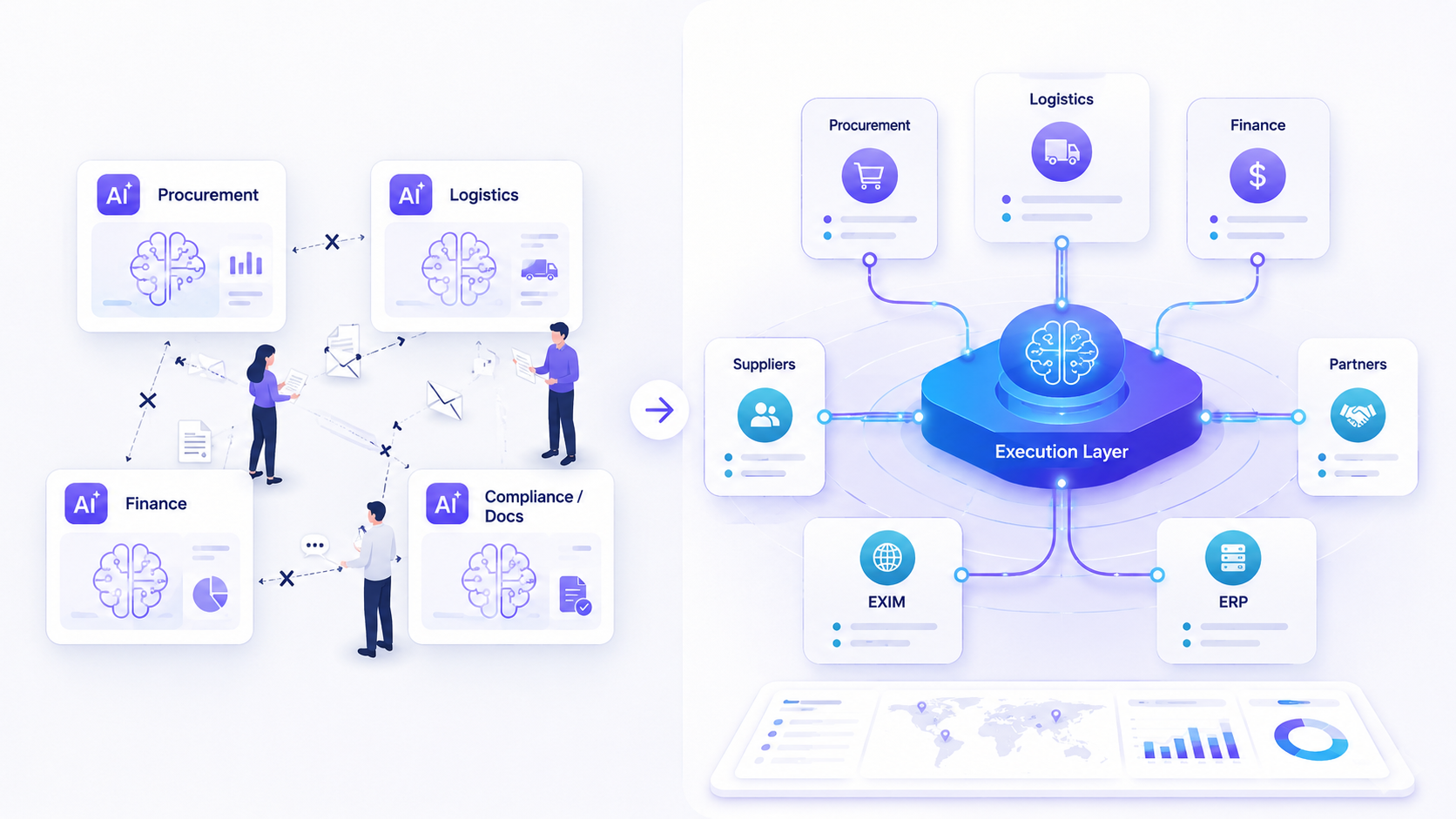
Why AI in One Function Won’t Fix Your Supply Chain
AI is entering every part of the supply chain.
Procurement teams are using it to compare quotations, assess suppliers, and support negotiations. Logistics teams are using it to predict delays and recommend routes. Finance teams are using it to extract invoices, detect mismatches, and automate reconciliation. Compliance teams are using it to review documents and identify risk.
Each investment makes sense on its own.
Procurement gets faster. Logistics gets faster. Finance gets faster.
The logic is local and convincing — which is exactly why it is so easy to keep buying.
But when you zoom out, the problem becomes obvious. You have not built an intelligent supply chain.
You have built a collection of faster silos that still cannot coordinate with one another. That is operational fragmentation.
And it is one reason supply chains can feel slow despite all the software and AI companies have already bought. The uncomfortable truth is that supply chains do not usually fail inside one function.
They fail between them.
A supplier delay becomes a logistics problem.
A logistics exception becomes a finance problem.
A customs issue becomes a production problem.
A missing document becomes a payment problem.
A sourcing decision becomes a landed-cost problem.
No single functional AI tool owns that complete chain. That is why AI in one function will not fix your supply chain.
It may improve a task. It may accelerate a team. But unless intelligence can move across procurement, logistics, EXIM, finance, suppliers, partners, and ERP workflows, people will still be responsible for connecting the work.
Solving that requires an AI Supply Chain Operating System — an execution layer that carries context across functions, coordinates action across systems, and preserves the operational memory behind every handoff.
The point-AI pitch is easy to understand. Find a slow process. Add AI. Make it faster.
Procurement takes too long to evaluate supplier bids, so add sourcing AI.
Logistics struggles to identify delays, so add predictive tracking.
Finance spends too much time validating invoices, so add invoice AI.
Compliance manually checks documents, so add document intelligence.
None of these decisions is irrational.
Most point AI solutions can create real value inside their lane. The problem begins when local improvement is mistaken for end-to-end transformation.
A sourcing AI may help procurement award a supplier faster. But it may not know how that decision affects freight capacity, customs readiness, working capital, inventory availability, or customer commitments.
A logistics AI may predict that a shipment will be delayed. But it may not understand the supplier’s production commitment, the purchase-order terms, the required customs documents, or the financial impact of expediting the cargo.
An invoice AI may identify a rate mismatch. But it may not know that the shipment was diverted, an extra customs charge was approved, or the carrier was asked to use a different route.
Each system sees its own part of the truth. The supply chain still depends on people to assemble the full picture.
Point AI is not the enemy. Poor architecture is.
A procurement AI can:
- Analyse supplier quotations
- Identify pricing anomalies
- Recommend negotiation positions
- Compare commercial terms
- Flag supplier risks
A logistics AI can:
- Predict delays
- Estimate arrival times
- Recommend routes
- Detect shipment exceptions
- Analyse carrier performance
A finance AI can:
- Extract invoice data
- Match invoices against purchase orders
- Detect duplicate invoices
- Identify pricing differences
- Route exceptions for approval
These are meaningful capabilities.But the supply chain outcome is not created inside one of them. It is created when the information and action move from one function to the next without losing context.
The issue is not specialisation. It is the absence of a shared execution layer across specialised systems.
Consider a supplier that informs procurement that production will be delayed by five days.
A procurement AI may identify the affected purchase order and flag the risk.
But that is only the beginning.
Logistics needs to check whether existing freight capacity can be moved.
EXIM needs to determine whether export or customs documents must be revised.
Production needs to assess material availability and reschedule operations.
Finance needs to calculate potential expedite cost and working-capital impact.
Customer-facing teams need to review delivery commitments.
The ERP needs to reflect the final decision.
When each function has a separate AI tool, the company still needs someone to carry the context between them.
The supplier delay was detected by AI. The response was coordinated manually. That is not autonomous execution. It is fragmented intelligence.
The cost of fragmentation rarely appears as one clean line item.
It is spread across the operation.
It appears in:
- Repeated data entry
- Supplier follow-ups
- Missed handoffs
- Duplicate checks
- Expedite charges
- Invoice disputes
- Delayed approvals
- Detention and demurrage
- Unplanned inventory
- Missed customer commitments
- Manual reconciliation
- Slow exception resolution
A single delay may look minor.
A single email follow-up may take only a few minutes.
A single invoice dispute may not appear material.
But these small coordination tasks happen across thousands of transactions.
That is where the cost accumulates.
The problem is not any one tool.
It is the work required to connect all of them.
People become the integration layer — copying information, checking multiple systems, interpreting alerts, reconciling conflicting data, and deciding who needs to act next. The software may be digital. The operating model is still manual.
Speeding up one function does not connect it to the next one. It only moves the work to the next seam faster.
That is the flaw in function-by-function AI adoption. The bottleneck was rarely the speed inside the box. It was the transition out of it.
Procurement may complete a sourcing event faster, but logistics may still receive incomplete shipment information.
Logistics may detect an exception earlier, but finance may still lack the context needed to validate the charge.
Finance may process the invoice faster, but compliance may still be waiting for a document that lives in an email thread.
Local speed does not guarantee end-to-end speed. A supply chain is only as fast as its slowest handoff. That is why the unit of improvement cannot be only the individual task or department. It must be the end-to-end workflow.
A procurement-to-delivery workflow may move through:
- An ERP
- A sourcing platform
- A supplier portal
- A transportation system
- A visibility platform
- A document repository
- A customs or compliance system
- A finance application
- Email and spreadsheets
Adding AI to each application may make each tool smarter.
But it does not automatically create one intelligent workflow.
Each application may still have its own:
- Data model
- Workflow
- Exception queue
- User interface
- Decision logic
- Audit history
- Operational context
The result is several intelligent islands. And people still have to build the bridges between them. More integrations can help data move. But data movement is not the same as execution.
An API can transfer a status update from one system to another.
It does not necessarily understand why the status changed, which workflow should begin, what policy applies, who needs to act, or whether the issue can be resolved autonomously.Connected systems can still produce disconnected work.
The transaction itself is usually not the hardest information to preserve.
ERP systems already record purchase orders, receipts, inventory movements, invoices, and payments well.
The harder information is the operational context around those transactions.
Why did the supplier miss the committed date?
Which shipment option was rejected?
What document blocked customs clearance?
Who approved the commercial exception?
Why did the invoice differ from the contract?
What did the carrier promise during the escalation?
What finally resolved the issue?
This is execution memory.
Execution memory preserves the history of:
- Handoffs
- Decisions
- Exceptions
- Documents
- Approvals
- Partner commitments
- Corrective actions
- Workflow outcomes
Without execution memory, each AI tool sees only its own part of the process.
It may know the current status.It may not know how the situation developed, why an earlier decision was made, or what worked when the same problem happened before.
That limits autonomy. A supply chain system cannot improve execution if it cannot remember execution.
The answer is not one giant application replacing every system.
And it is not another collection of connectors between point tools. What enterprises need is a shared execution layer that works across the systems they already use.
The unit of improvement should be the complete workflow or cross-functional handoff.
For example:
- Supplier delay to logistics replanning
- RFQ award to PO issuance and freight booking
- Shipment delivery to invoice settlement
- EXIM document readiness to customs clearance
- Supplier onboarding to compliance approval
- PO to GRN to invoice reconciliation
A shared execution layer should be able to:
- Carry context across functions
- Coordinate actions across systems
- Trigger workflows based on real-world events
- Manage approvals and exceptions
- Involve external partners
- Preserve execution memory
- Update the ERP with the final outcome
That is what turns several useful AI capabilities into one operating model.
The alternative to isolated point AI is not one general-purpose AI trying to do everything. It is a coordinated Agent Mesh.
An Agent Mesh is a network of specialised AI agents that work across supply chain domains.
For example:
- A procurement agent manages supplier engagement and sourcing
- A logistics agent manages freight and shipment execution
- An EXIM agent manages customs and documentation
- A finance agent manages invoice validation and reconciliation
- A compliance agent manages regulatory readiness
- A document agent extracts and validates operational documents
Each agent understands one domain. But they share context and coordinate actions.
When a supplier delay occurs:
- The procurement agent identifies the affected order.
- The logistics agent evaluates alternate freight options.
- The EXIM agent checks documentation and clearance implications.
- The finance agent calculates additional cost exposure.
- Stakeholders receive a recovery recommendation.
- Approved actions are executed.
- The outcome is written back to the ERP.
- Execution memory preserves what happened and why.
That is the difference between several AI tools and one coordinated execution environment.
The difference is not simply the number of features.
It is whether the system can carry work across boundaries.
An AI Supply Chain Operating System is the execution layer that connects functional AI capabilities, enterprise systems, workflows, and external partners.
It works alongside ERP. The ERP remains the system of record.
The AI Supply Chain Operating System becomes the system of execution.
It coordinates work across:
- Procurement
- Supplier collaboration
- Logistics
- EXIM
- Finance
- Compliance
- Documents
- External partners
- ERP workflows
It does not need to replace every application.It needs to stop those applications from becoming isolated operating islands.
That is the difference between adding AI to a supply chain and building an AI-native operating model.
The most important question for a supply chain AI vendor is not:
What can your model predict?
It is:
What operational work can your system complete?
A useful second question is:
What percentage of workflows or exceptions are resolved without human intervention?
That is the Autonomy Rate.
Autonomy Rate measures whether software is completing the work or merely helping a person complete it.
A dashboard may have an Autonomy Rate of zero.
A copilot may have an Autonomy Rate close to 25-50%.
A genuine execution platform should have a measurable and improving number.
This is how enterprises can separate AI marketing from operational capability.
Do not begin by buying another AI tool.
Start by selecting one workflow that crosses several functions.
Map:
- Every system involved
- Every team involved
- Every partner involved
- Every document exchanged
- Every manual handoff
- Every exception
- Every approval
- Every point where context is lost
Then ask:
Can one execution layer coordinate this workflow from beginning to end?
Can it act across functions instead of only advising one team?
Can it preserve the operational context behind every decision?
Can it write the final result back to ERP?
Can its Autonomy Rate be measured?
Those questions will tell you whether you are building connected execution or simply adding another intelligent silo.
Enterprises will continue to use ERP systems.
They will continue to use specialised applications.
They may continue to adopt domain-specific AI capabilities.
But the competitive advantage will come from the layer that coordinates them.
The winning architecture will not be:
One AI tool for every problem.
It will be:
One execution environment across every handoff.
That is how supply chains move from fragmented intelligence to autonomous execution.
Conclusion: Local Intelligence Is Not Supply Chain Transformation
AI in procurement can improve procurement. AI in logistics can improve logistics. AI in finance can improve finance.
But supply chain performance is determined by what happens between them.
A supplier delay does not stay in procurement. A shipment exception does not stay in logistics. An invoice mismatch does not stay in finance.
Every meaningful supply chain event crosses functions, systems, partners, documents, and decisions.
That is why AI in one function will not fix your supply chain. Point AI improves the parts.
An AI Supply Chain Operating System coordinates the outcome. The next stage of supply chain transformation is not more isolated intelligence.
It is autonomous execution with operational memory.
Related Guides
Autonomous Supply Chain Execution: The Complete Guide to the AI Supply Chain Operating System
Learn how agentic AI, workflow orchestration, ERP connectivity, autonomous workflows, and execution memory combine to create a system of execution across the supply chain.
Supply Chain Trends 2026: The Shift From Visibility to Execution Memory
Explore why supply chain leaders are moving beyond dashboards toward systems that can run, remember, and improve operational work.
Procure-to-Pay in the AI Era
See how AI changes procurement, purchase-order execution, goods receipt, invoice validation, and finance reconciliation.
Logistics Chain Management
Explore how connected planning, partner coordination, shipment execution, visibility, and settlement work across the logistics lifecycle.
Why will AI in one function not fix the supply chain?
Supply chain problems cross multiple functions. A supplier delay can affect logistics, finance, production, compliance, and customer commitments. A functional AI tool may improve one part of the process but cannot coordinate the complete response on its own.
What is a point AI solution?
A point AI solution is an AI tool designed for one task or function, such as invoice extraction, supplier-risk analysis, freight prediction, sourcing analytics, or document validation.
Are point AI solutions ineffective?
No. Point AI solutions can create useful local improvements. Their limitation is that they often lack the cross-functional context and workflow ownership needed for end-to-end execution.
What is the difference between point AI and an AI Supply Chain Operating System?
Point AI improves one task or function. An AI Supply Chain Operating System coordinates execution across procurement, logistics, EXIM, finance, compliance, suppliers, partners, and ERP systems.
What is execution memory?
Execution memory is the operational context preserved across handoffs, exceptions, decisions, documents, approvals, and partner interactions. It allows a system to understand how work happened and improve future execution.
What is an Agent Mesh?
An Agent Mesh is a network of specialised AI agents that collaborate across supply chain domains such as procurement, logistics, EXIM, finance, compliance, and document intelligence.
What is the Autonomy Rate?
Autonomy Rate is the percentage of workflows or exceptions completed end to end without human intervention. It measures whether an AI system is executing work or only generating insights and recommendations.
How should enterprises begin adopting cross-functional supply chain AI?
Start with one handoff-heavy workflow that crosses several functions. Map the systems, teams, partners, documents, exceptions, and approvals involved, and then introduce an execution layer that can coordinate the complete workflow.
Bring last month's exceptions.
Leave with the ROI model.
30-minute working session for the CFO and Controller. We'll run your real exception backlog through Lasya, project the working-capital release, and walk through the audit-trail evidence your InfoSec team will request.