
Autonomous Supply Chain Execution: The Complete Guide to the AI Supply Chain Operating System

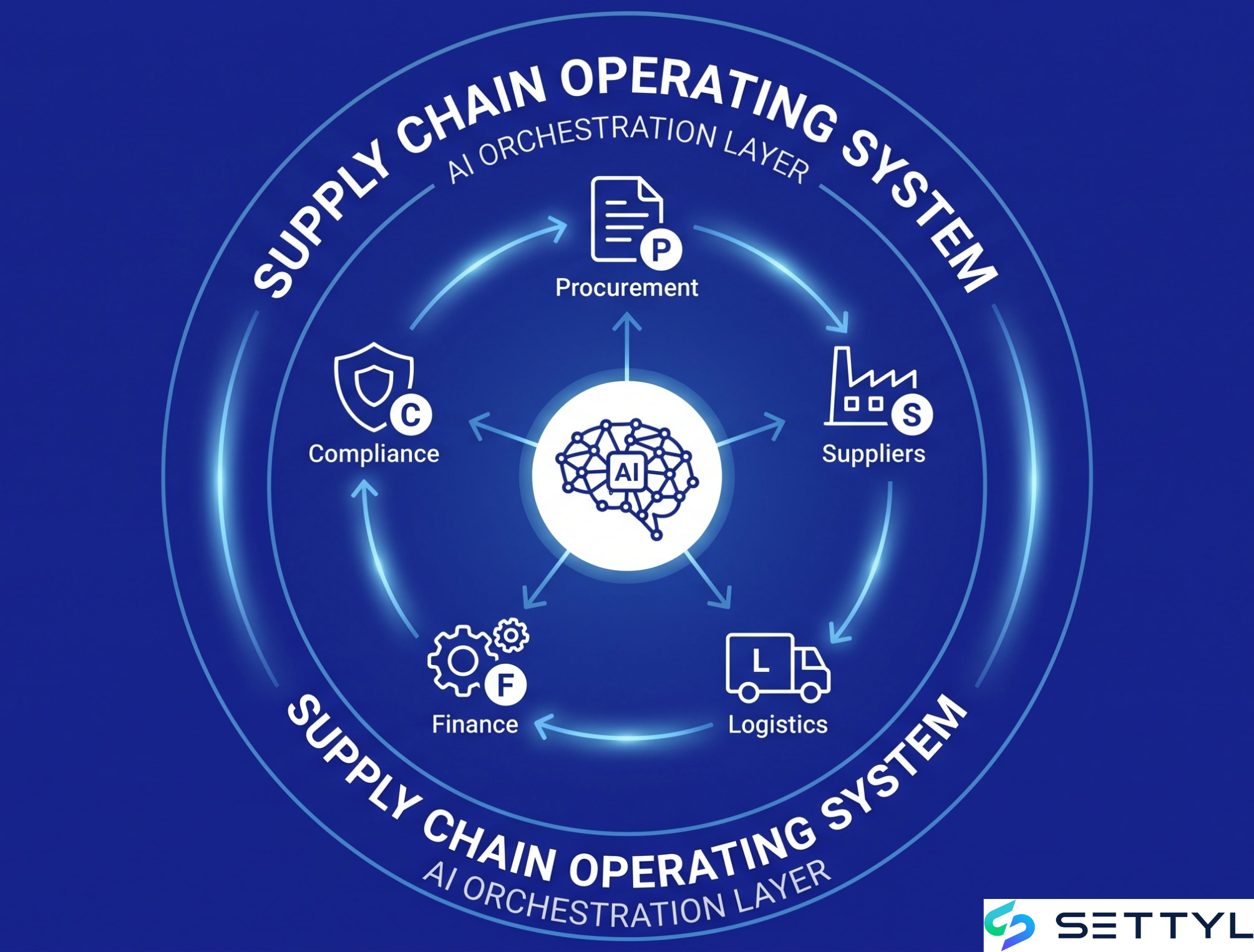
Autonomous Supply Chain Execution: The Complete Guide to the AI Supply Chain Operating System
Your ERP records what happened. Your dashboards show what is happening. Neither runs what happens next.
That is the gap this guide is about.
Most enterprises already run an ERP, procurement applications, supplier portals, transportation systems, warehouse platforms, finance tools, compliance systems, and visibility dashboards.
Now AI is being added on top.
And still, the same teams are chasing suppliers over email, escalating shipments over calls, validating documents manually, reconciling invoices in spreadsheets, and carrying context from one system to another.
The problem was never a shortage of software. It was a shortage of execution.
Modern supply chains need more than systems that store transactions, generate reports, or raise alerts. They need a system that can carry work forward across procurement, logistics, EXIM, finance, compliance, suppliers, carriers, forwarders, brokers, and ERP workflows.
They also need something most enterprise systems were never designed to preserve:
the operational memory of how the work actually happened.
Who followed up with the supplier?
What changed in the shipment plan?
Why was the document rejected?
Which exception caused the delay?
What did the carrier commit to?
Why was the invoice disputed?
What action finally resolved the issue?
That is the role of Autonomous Supply Chain Execution. The platform category behind it is the AI Supply Chain Operating System.
It is not an ERP replacement. It is not another dashboard. It is not a point AI tool for one function.
It is the execution layer that works across existing systems and partners, runs the operational work between transactions, and preserves the context needed to improve what happens next.
The Short Version
Autonomous Supply Chain Execution is a category of software that runs the operational work between recorded transactions.
It confirms suppliers, coordinates logistics, validates documents, manages customs workflows, reconciles invoices, resolves exceptions, and updates enterprise systems without requiring people to carry every task manually across functions.
The platform that enables this is an AI Supply Chain Operating System.
The ERP remains the system of record for master data, purchase orders, inventory, invoices, finance, approvals, and compliance.
The Supply Chain Operating System becomes the system of execution. Its defining capability is transaction owenership and execution memory: the ability to remember what happened across every handoff, why it happened, who acted, what changed, and what should improve next time.
That is what separates autonomous execution from ordinary automation
Supply chains have never run on more software. They have also never relied on more people to operate that software.
Each application may work well within its own boundary. Procurement platforms handle sourcing. Transportation systems handle freight. Supplier portals handle onboarding. Finance systems handle invoices. Visibility tools handle tracking.
But supply chain work does not stop at those boundaries.
A supplier commitment affects logistics.
A logistics exception affects production.
A customs delay affects finance.
A delivery issue affects invoicing.
A sourcing decision affects landed cost.
A missing document can stop the entire chain.
The hardest part is rarely the task inside one system. It is the handoff between systems, teams, and companies.
That is where context disappears.
That is where emails begin.
That is where people become the integration layer.
For years, most supply chain technology was designed to do one of two things:
- Record a transaction
- Recommend a decision
Very little was built to do the operational work that turns a decision into a coordinated outcome across every stakeholder involved.
That gap between knowing what should happen and actually making it happen is the execution gap.
Five structural changes have made that gap impossible to ignore.
1. Execution moved outside the ERP
ERP systems remain essential for finance, master data, purchase orders, inventory, invoices, approvals, governance, and auditability.
But modern execution no longer happens fully inside the ERP.
It happens across:
- Supplier emails
- Freight escalations
- External portals
- Broker communications
- Spreadsheets
- Messaging threads
- Shipping documents
- Customer escalations
- Plant-level workarounds
- Phone calls
- Partner systems
A purchase order may be created in the ERP.
But supplier confirmation, production readiness, document submission, cargo availability, and freight booking may happen elsewhere.
An invoice may be posted in the ERP.
But the validation trail may involve shipment milestones, contracts, GRNs, ePODs, customs charges, rate cards, deductions, and email approvals.
The ERP records the final event. It does not always retain the full operational trail that created that event.
2. SaaS created functional depth and cross-functional fragmentation
The SaaS wave improved many individual functions.
Procurement systems improved sourcing.
Transportation platforms improved freight management.
Warehouse systems improved fulfilment.
Supplier portals improved collaboration.
Visibility tools improved tracking.
Finance applications improved invoice processing.
But each additional application created another boundary. A single procurement-to-delivery workflow can now involve five, six, or eight systems.
Someone still has to connect them. Someone still has to copy the data. Someone still has to chase the supplier.
Someone still has to reconcile the mismatch. Someone still has to decide what happens next.
That person becomes the middleware. What looked like digital transformation gradually became operational fragmentation.
3. Visibility reached its limit
For years, the supply chain industry made one promise: If you can see the problem, you can control the problem.
That was only partly true. Visibility helps. But visibility is not execution.
Knowing a shipment is delayed is useful. Value is created only when the next work happens:
- Notify the customer
- Check alternate capacity
- Review production impact
- Update finance
- Validate documents
- Escalate the carrier
- Replan the route
- Update the ERP
- Confirm the revised delivery promise
A dashboard shows the issue. It does not resolve the issue.
This is why visibility without execution often becomes operational theatre: everyone can see the problem, but the response still depends on manual coordination.
4. Point AI is repeating the SaaS pattern
Many enterprises are deploying AI one function at a time.
Procurement AI.
Logistics AI.
Invoice AI.
Supplier-risk AI.
Document AI.
Planning AI.
Each may deliver useful local improvement. But supply chains do not fail only inside functions.
They fail between them. An AI model that predicts a supplier delay but cannot coordinate logistics replanning, document validation, financial impact, customer communication, and ERP updates is not an operating system.
An invoice AI that extracts data but cannot understand shipment exceptions, validate contract terms, route disputes, and prepare settlement still leaves the real work to people.
It is a more expensive alert. The problem is not that point AI is useless. The problem is that point AI is incomplete.
5. Multi-enterprise coordination outgrew human capacity
Modern supply chains are not internal workflows.
They are multi-enterprise operating networks involving:
- Suppliers
- Contract manufacturers
- Carriers
- Freight forwarders
- Customs brokers
- Warehouses
- Finance teams
- Compliance providers
- Customers
- Internal business units
Each participant works with different systems, timelines, incentives, and data formats.
The problem is not that people are inefficient, but the people are being asked to carry too much context across too many handoffs.
Autonomous Supply Chain Execution is emerging because that operating model no longer scales.
Autonomous Supply Chain Execution is the ability of a software system to coordinate and complete operational work across people, systems, suppliers, logistics partners, documents, finance workflows, and compliance processes with minimal human intervention.
It does not only record what happened.
It helps run what happens next.
A true execution system can:
- Monitor operational signals
- Understand dependencies
- Detect exceptions
- Decide the next action within policy
- Trigger workflows
- Coordinate stakeholders
- Escalate only when required
- Preserve context
- Update enterprise systems
- Learn from outcomes
The goal is not to remove people from every decision.The goal is to remove people from repetitive coordination.
Operations teams should spend more time on supplier strategy, risk, commercial judgment, resilience, and growth.
They should spend less time forwarding emails, checking portals, and carrying data between systems.
What an AI Supply Chain Operating System Is
An AI Supply Chain Operating System is the platform that delivers Autonomous Supply Chain Execution.
It creates one execution environment across:
- Procurement execution
- Supplier collaboration
- Logistics planning and orchestration
- EXIM and customs workflows
- Document intelligence
- Invoice and finance reconciliation
- Compliance validation
- Partner coordination
- ERP connectivity
- Exception management
- Autonomous workflows
- Execution memory
It does not replace the ERP. It works alongside it.
The ERP remains the governed source of truth.
The Supply Chain Operating System monitors operational activity, understands dependencies, determines what should happen next, initiates action, manages exceptions, and writes completed outcomes back to the ERP.
The ERP keeps the records. The Supply Chain Operating System runs the work.
ERP systems are essential.
But they were designed primarily to govern transactions.
They excel at recording business events:
- A purchase order was created
- Goods were received
- An invoice was posted
- Inventory was updated
- A payment was processed
The real operational work happens between those events.
Who followed up with the supplier?
Why was the shipment rescheduled?
Which document was missing?
Why did the carrier reject the booking?
What exception affected the invoice?
What was promised during escalation?
What action finally resolved the issue?
That context often sits outside the ERP.
Modern ERP and SCM suites are expanding into planning, collaboration, logistics, AI assistants, and business networks.
That is a meaningful evolution.It validates the market’s shift toward execution.
But the hardest execution gap does not sit neatly inside one enterprise suite. It exists across the messy handoffs between systems, partners, documents, emails, exceptions, and decisions that no single application fully owns.
Specialised SaaS and point AI tools can improve individual tasks, but they often deepen the same fragmentation.
The future architecture is therefore not ERP replacement. It is execution consolidation.
The ERP continues to govern transactions. The AI Supply Chain Operating System coordinates the work across the environment surrounding those transactions.
Execution memory is the operational context a supply chain system preserves across every handoff, exception, decision, document, and partner interaction.
It is the difference between recording the final transaction and remembering how the work happened.
An ERP may show that an invoice was approved.
Execution memory explains:
- Why it was held
- Which charges were disputed
- What shipment exception caused the mismatch
- Which document was missing
- Who approved the deviation
- What the supplier committed to
- How the issue was finally resolved
An ERP may show that a purchase order was changed.
Execution memory explains:
- What triggered the change
- Which stakeholder requested it
- How the supplier responded
- Whether logistics was affected
- What financial impact followed
- Which approval path was used
This matters because autonomy without memory is shallow. A system may automate a task once.
But if it cannot preserve the context behind the outcome, it cannot improve the next execution. Execution memory allows the system to run, remember, and improve. That is the real progression from automation to autonomy.
The clearest way to understand the category is to compare it with ERP.
An ERP can show that a shipment is delayed.
A Supply Chain Operating System can assess the impact, notify the right stakeholders, evaluate alternatives, update finance, check document readiness, escalate the carrier, and write the final outcome back to the ERP.
That is the difference between recording the work and running the work.
Agentic AI makes autonomous execution possible.Traditional automation works well when a task is predictable.
Supply chains rarely are.
Supplier delays, customs holds, missing documents, invoice disputes, carrier rejections, and production changes require context from multiple systems and stakeholders.
AI agents can monitor, reason, and act across those conditions.
Inside an AI Supply Chain Operating System, agents work as specialised digital operators.
A procurement agent can manage supplier responses, RFQs, negotiations, and PO follow-up.
A logistics agent can book freight, monitor shipments, and manage exceptions.
An EXIM agent can validate customs documents and clearance readiness.
A finance agent can reconcile invoices and prepare settlement decisions.
A compliance agent can track certificates, regulatory documents, and risk.
A document agent can extract, compare, validate, and route information.
The real value appears when those agents work together. A supplier delay should not stop with procurement. It should trigger logistics replanning, document checks, financial-impact analysis, stakeholder communication, and ERP updates. That is the difference between an AI tool and an execution system.
Every new software category needs a metric that separates capability from marketing.
For Autonomous Supply Chain Execution, that metric is the Autonomy Rate.
Autonomy Rate measures the percentage of workflows or exceptions resolved end to end without a person having to finish the work manually.
The most useful question to ask any AI supply chain vendor is:
What percentage of operational exceptions does your system resolve completely on its own?
A dashboard’s honest answer is usually zero. It shows the issue and waits.
A copilot’s answer is usually close to zero. It drafts, summarises, or recommends, but a person still has to execute.
A true execution platform should be able to show a measurable and improving number. Autonomy Rate focuses on the question that matters operationally : Did the work get done?
Supply chains often break at the handoff. Not because one team failed because context disappeared as work moved between teams. Each delay may look small on its own.
Together, they create longer cycle times, higher cost, and slower response.
The execution layer does not just automate tasks. It reduces the cost of the handoff itself.
An AI Supply Chain Operating System is not one application.
It is a coordinated framework of four layers.
1. Agent Mesh
A network of specialised AI agents across procurement, logistics, EXIM, finance, compliance, documents, and risk.
The agent mesh answers:
What is happening, and what should happen next?
2. Execution Layer
The orchestration layer that manages workflows, actions, exceptions, escalations, and approvals.
It answers:
Who or what needs to act?
3. ERP Connectivity
The integration layer connecting ERP, procurement, logistics, finance, supplier, and compliance systems.
It answers:
Where does the information live, and where should the outcome be recorded?
4. Autonomous Workflows
Continuously running processes that execute business work with minimal intervention.
Examples include:
- Supplier onboarding
- RFQ coordination
- PO follow-up
- Freight booking
- Shipment exception handling
- Customs readiness
- Invoice reconciliation
- Compliance verification
They answer:
How does the work continue without manual coordination?
Execution memory runs across all four layers.
Without it, the system may act. With it, the system can learn.
A Realistic End-to-End Example
Consider a supplier that informs procurement that production will be delayed by five days.
In a traditional operating model:
- Procurement receives the message.
- Someone emails logistics.
- Logistics checks existing capacity.
- EXIM checks whether documents need to change.
- Finance estimates the cost impact.
- Customer service updates the customer.
- Someone updates the ERP.
- The reasoning behind each decision remains scattered across emails and calls.
In an AI Supply Chain Operating System:
- The supplier delay is detected.
- The procurement agent evaluates the affected purchase order.
- The logistics agent checks alternate capacity and delivery options.
- The EXIM agent reviews document and clearance implications.
- The finance agent calculates additional cost exposure.
- Stakeholders receive the recommended recovery plan.
- Approved actions are executed.
- The final outcome is written back to the ERP.
- Execution memory preserves what happened, why decisions were made, and how the issue was resolved.
That is autonomous execution with operational memory.
The value of an AI Supply Chain Operating System is not another dashboard.
It is a different operating model.
Across selected Settyl workflows, observed outcomes have included reductions in cycle time, manual effort, invoice exceptions, and customs-processing delays.
Actual results depend on process complexity, system maturity, integration depth, workflow design, and partner participation.
The more important shift is that execution becomes measurable.
Once execution is measurable, it can improve.
Do not begin by trying to automate the entire supply chain.
Start with one workflow where the coordination cost is obvious.
Good starting points include:
- Supplier onboarding to compliance validation
- RFQ to PO to logistics planning
- Freight booking to delivery to invoice settlement
- EXIM documentation to customs clearance
- PO to GRN to invoice matching
- Supplier delay to logistics replanning
Ask:
How many systems are involved?
How many people touch the process?
How many emails are exchanged?
How often is information re-entered?
How often does context get lost?
How many exceptions require follow-up?
How much of the workflow could run without manual intervention?
That is where the business case usually appears.
The next era of supply chain will not be won by companies that add the most applications.
It will be won by companies that coordinate work better.
The industry has moved through several eras:
The next advantage will not come from having more data. It will come from having better execution. And better execution requires memory.
A supply chain that cannot remember its handoffs cannot improve them. A system that cannot preserve operational context cannot become truly autonomous.
The future belongs to autonomous execution with operational memory.
Related Reading
Explore these related Settyl resources:
- Supply Chain Trends 2026: The Shift From Visibility to Execution Memory
- Why AI in One Function Will Not Fix Your Supply Chain
- System of Record vs. System of Execution in Supply Chain
- Why Point AI Solutions Fail in Supply Chain Operations
- The Autonomy Rate: The New KPI for AI Supply Chain Execution
What is Autonomous Supply Chain Execution?
Autonomous Supply Chain Execution is a category of software that runs operational work across procurement, logistics, EXIM, finance, compliance, suppliers, partners, and enterprise systems.
It acts on information instead of only displaying it.
What is an AI Supply Chain Operating System?
An AI Supply Chain Operating System is the platform that delivers Autonomous Supply Chain Execution.
It coordinates actions, workflows, exceptions, agents, systems, documents, and partners while keeping ERP as the system of record.
What is execution memory?
Execution memory is the operational context preserved across handoffs, exceptions, documents, decisions, and partner interactions.
It remembers how the work happened, not only the final transaction.
How is a Supply Chain Operating System different from ERP?
ERP records and governs transactions.
A Supply Chain Operating System coordinates and runs operational execution across systems and partners.
They work together.
Does it replace SAP, Oracle, Microsoft Dynamics, or other ERP systems?
No.
It works alongside ERP systems and writes completed outcomes back to them.
Why is supply chain visibility not enough?
Visibility shows the problem.
Execution resolves it.
A dashboard may identify a delay, but the business outcome depends on whether the system can coordinate the response across suppliers, logistics, finance, documents, and enterprise workflows.
Why do point AI solutions fall short?
Point AI solutions improve one task or function but often lack the cross-functional context required to run the complete workflow.
They can create local efficiency without solving end-to-end execution.
What is the Autonomy Rate?
Autonomy Rate is the percentage of workflows or exceptions completed end to end without human intervention.
It measures whether software is actually doing the work or merely suggesting what a person should do.
What is an Agent Mesh?
An Agent Mesh is a network of specialised AI agents that collaborate across procurement, logistics, EXIM, finance, compliance, documents, and risk.
Which industries benefit most?
Manufacturing, automotive, pharmaceuticals, chemicals, industrial goods, electronics, FMCG, infrastructure, and other multi-enterprise or trade-heavy industries benefit most.
How should an organisation begin?
Start with one fragmented, handoff-heavy workflow where manual coordination is measurable and expensive.
Conclusion: From Fragmentation to Execution Memory
Supply chains have outgrown systems built only to record transactions, display alerts, or automate isolated tasks.
The real operation moves across suppliers, carriers, forwarders, brokers, finance teams, compliance teams, documents, approvals, exceptions, and ERP systems.
That work needs more than visibility. It needs execution. And execution needs memory.
Autonomous Supply Chain Execution brings together agentic AI, workflow orchestration, ERP connectivity, autonomous processes, and execution memory in one operating layer.
The question is no longer whether AI belongs in supply chain operations.
The question is whether your organisation is ready to move from recording transactions to running execution.
Your ERP keeps the records. Your dashboards show the signals.
Your Supply Chain Operating System runs the work. Execution memory helps it improve what happens next.
See How Settyl Lasya AI Enables Autonomous Supply Chain Execution
Settyl Lasya AI helps enterprises coordinate procurement, logistics, EXIM, finance, supplier collaboration, documents, and operational workflows through one autonomous execution layer.
It works with your ERP, connects the systems and partners involved in daily operations, and preserves execution memory across every handoff.
Bring last month's exceptions.
Leave with the ROI model.
30-minute working session for the CFO and Controller. We'll run your real exception backlog through Lasya, project the working-capital release, and walk through the audit-trail evidence your InfoSec team will request.