
System of Record vs. System of Execution in Supply Chain

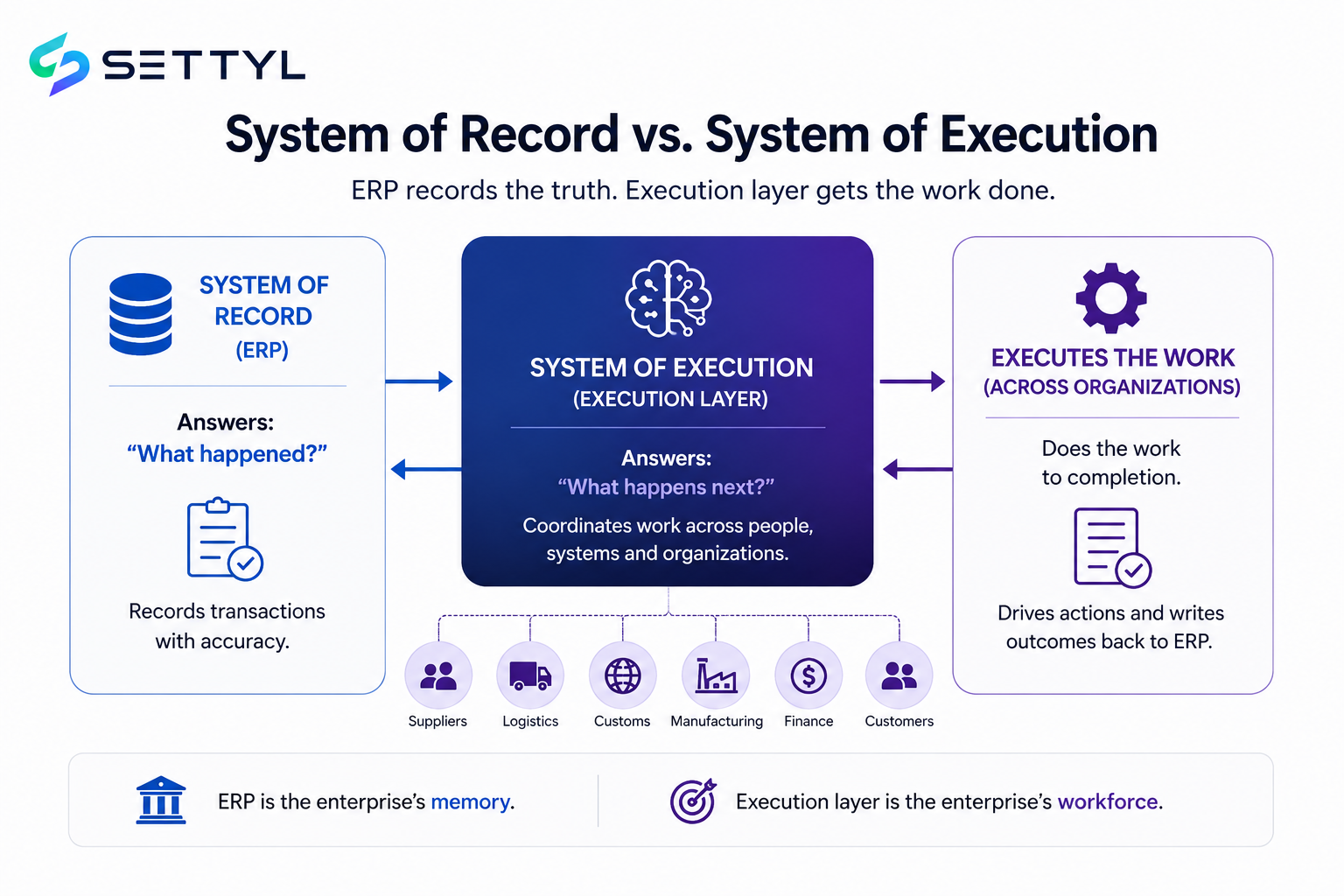
System of Record vs. System of Execution in Supply Chain: Why Your ERP Records the Work but Doesn't Do It
Ask a supply chain leader what system runs their operation, and the answer is almost always the ERP—SAP, Oracle, or Microsoft Dynamics. It's the default assumption across manufacturing.
The problem is that it confuses recording work with executing work.
This distinction explains why organizations that have invested millions in digital transformation still rely on emails, spreadsheets, phone calls, supplier portals, and manual follow-ups to move work forward. Their systems accurately record transactions, but people still coordinate execution.
This article explores the architectural difference between a System of Record and a System of Execution, why that distinction matters, and how closing the gap eliminates the Operational Fragmentation that slows modern manufacturing supply chains.
New to the concept? Start with Operational Fragmentation: The Hidden Tax on Manufacturing Supply Chains, which explains why manual coordination persists even after ERP, workflow automation, and digital transformation initiatives.
System of Record vs. System of Execution: At a Glance
The two are complementary—not competing.
A System of Execution depends on the System of Record as its authoritative source of truth. The System of Record, in turn, becomes more valuable because execution outcomes are written back automatically instead of being manually entered after the fact.
Understanding the Core Difference
Every enterprise system answers one of two fundamentally different questions.
A System of Record answers:
What happened?
A System of Execution answers:
What happens next, and who makes it happen?
One is the enterprise's memory.
The other is its workforce.
For more than three decades, manufacturers have invested heavily in perfecting the memory. Enterprise software became exceptionally good at preserving transactions, maintaining financial integrity, enforcing governance, and supporting audits.
What it never became particularly good at was moving work across multiple organizations.
Until recently, that responsibility belonged almost entirely to people.
What Is a System of Record?
A System of Record is the authoritative source of enterprise truth that stores transactions, master data, and audit history.
It stores:
- Purchase Orders
- Sales Orders
- Inventory balances
- Vendor master data
- Customer master data
- Financial transactions
- General ledger entries
- Audit history
- Compliance records
When finance closes the books or an auditor asks what happened to a transaction, the ERP provides the definitive answer.
This is exactly what systems like SAP, Oracle ERP, Microsoft Dynamics, and Infor were designed to do.
They excel at:
- Data integrity
- Transaction consistency
- Governance
- Compliance
- Financial control
- Historical accuracy
These capabilities remain indispensable.
What a System of Record Doesn't Do
A System of Record records that a Purchase Order exists.
It does not:
- persuade the supplier to confirm it,
- chase delayed acknowledgements,
- rebook transportation,
- negotiate a new delivery date,
- coordinate customs documentation,
- resolve invoice discrepancies,
- notify downstream stakeholders,
- orchestrate recovery when disruptions occur.
Instead, people perform those activities.
Only after the work is completed does someone update the ERP.
The ERP faithfully records the outcome of work.
It does not perform the work itself.
Think of it this way:
The ERP is the enterprise's memory, not its workforce. It preserves the final state of business transactions with audit-grade accuracy. It does not continuously coordinate suppliers, carriers, customs brokers, warehouses, and finance teams as conditions change. Those execution responsibilities have historically remained with people.
What Is a System of Execution?
A System of Execution coordinates work across people, systems, and organizations until a business outcome is achieved.
Rather than simply storing enterprise data, it actively coordinates work across departments, partners, and systems until the desired business outcome is achieved.
Instead of recording that a Purchase Order exists, it executes the procurement process.
That may include:
- Issuing RFQs
- Collecting supplier quotations
- Comparing commercial offers
- Negotiating pricing
- Creating Purchase Orders
- Monitoring supplier confirmations
- Tracking shipment milestones
- Preparing customs documentation
- Coordinating logistics providers
- Matching invoices
- Posting completed transactions back into the ERP
Its responsibility is not maintaining enterprise truth.
Its responsibility is ensuring work actually gets completed.
Why a System of Execution Is Emerging
Enterprise software evolved from recording transactions to automating tasks. The next evolution is executing work. Systems of Record transformed enterprise data. Systems of Execution transform enterprise operations by coordinating work across people, systems, and organizations. As supply chains become increasingly distributed, this execution layer becomes as fundamental as ERP was in the previous generation.
A Real Manufacturing Example
Imagine a supplier commits to delivering a critical component on Monday.
By Wednesday, production planning depends on that delivery.
On Thursday, the supplier slips the shipment by five days.
What happens next?
Typically:
- The supplier emails the buyer.
- The buyer calls the planner.
- The planner updates a spreadsheet.
- Logistics rebooks transportation.
- Manufacturing reschedules production.
- Finance revises cash-flow expectations.
- Procurement informs internal stakeholders.
- Eventually, someone updates the ERP.
Now ask a simple question:
Which system executed those decisions?
Not the ERP.
Not the supplier portal.
Not the TMS.
Not the email system.
People coordinated the entire recovery process.
The technology simply recorded pieces of what happened afterward.
Where the Execution Layer Fits
The execution layer does not replace ERP.
It sits above existing enterprise systems.
A simplified architecture looks like this:
                  AI Supply Chain Operating System
                               │
                 Multi-Enterprise Execution Graph
                               │
                    Autonomous Supply Chain Execution
                               │
        Procurement │ Logistics │ EXIM │ Finance │ Warehouse
                               │
        SAP │ Oracle │ Dynamics │ WMS │ TMS │ Other Systems
The ERP remains the authoritative source of record.
Specialized applications continue performing their domain-specific functions.
The execution layer coordinates activity across all of them and writes validated outcomes back into the systems of record.
Instead of replacing enterprise software, it activates it.
System of Engagement vs. System of Execution
Many organizations already have systems of engagement.
Examples include:
- Supplier portals
- Customer portals
- Vendor collaboration platforms
- Workflow applications
These improve communication.
They do not necessarily execute work.
Likewise, workflow automation routes predefined approvals and notifications.
Execution is fundamentally different.
Execution continuously coordinates independent organizations, adapts to changing events, manages exceptions, and drives work toward completion.
Communication supports execution.
It is not execution itself.
Does Your ERP Execute—or Just Record?
Here's a simple test.
Think about the last disrupted purchase order.
Perhaps:
- a supplier delayed production,
- a shipment missed a vessel,
- customs requested additional documentation,
- an invoice failed three-way matching.
Now ask:
When the disruption occurred, did the ERP:
- detect the issue,
- determine the next action,
- coordinate suppliers,
- communicate with logistics,
- update downstream teams,
- complete the recovery?
Or did people perform those activities before someone entered the final outcome into the ERP?
For most manufacturers, the honest answer is the latter.
The ERP recorded the completed work.
People executed it.
How Operational Fragmentation Emerges
Once the distinction becomes clear, Operational Fragmentation is no longer mysterious.
Fragmentation exists precisely between the point where information is recorded and the point where work is executed.
Consider a typical order.
The Purchase Order lives inside the ERP.
The supplier confirmation arrives by email.
The revised delivery date appears in a supplier portal.
Freight booking exists inside the forwarder's platform.
Customs documentation lives elsewhere.
Invoices arrive through another channel.
Each system owns part of the truth.
None owns the end-to-end execution.
People become the integration layer.
They:
- copy information,
- reconcile discrepancies,
- forward emails,
- update spreadsheets,
- coordinate stakeholders,
- chase responses,
- manually synchronize systems.
This is Operational Fragmentation.
It is not caused by bad software.
It is caused by missing architecture.
Why More Systems Don't Solve It
Many organizations respond by adding another application.
Another supplier portal.
Another logistics platform.
Another workflow engine.
Another AI assistant.
Unfortunately, every new point solution usually creates another isolated system of record.
Each one introduces another boundary requiring human coordination.
The result is more integrations, more notifications, more dashboards—and often more manual work.
Why APIs Alone Don't Solve Execution
APIs move information.
Execution moves work.
An API can transmit a shipment status from one platform to another.
It cannot decide whether procurement should expedite production, whether logistics should change carriers, or whether finance should revise accruals.
Integration enables connectivity.
Execution enables coordinated action.
The two are complementary but fundamentally different.
Common Misconceptions
Myth 1: ERP Already Executes Supply Chains
Reality:
ERPs execute structured internal transactions.
Cross-enterprise coordination still relies heavily on people.
Many organizations assume their ERP executes the supply chain because it manages purchase orders, inventory, production, and financial transactions. In reality, an ERP executes structured workflows within the enterprise—it does not coordinate work across the extended supply chain.
What an ERP does well:
- Maintains the authoritative record of transactions.
- Processes purchase orders, goods receipts, invoices, and payments.
- Enforces approval workflows and business rules.
- Provides financial, inventory, and audit visibility.
What still depends on people:
- Following up with suppliers for confirmations or delays.
- Coordinating freight forwarders, carriers, and customs brokers.
- Managing exceptions when shipments are delayed or disrupted.
- Resolving invoice mismatches and communicating across teams.
- Keeping multiple external stakeholders aligned throughout execution.
The ERP records the final outcome of these activities, but the coordination itself typically happens through emails, calls, spreadsheets, messaging apps, and supplier portals. That gap between recording transactions and executing work is where Operational Fragmentation emerges.
Myth 2: Workflow Automation Is Execution
Reality:
Workflow automation routes predefined approvals.
Execution coordinates dynamic business decisions across multiple organizations - The multi-enterprise execution graphs
Workflow automation is often mistaken for true execution because it automates repetitive tasks such as approvals, notifications, and document routing. While these capabilities improve efficiency, they follow predefined rules and linear processes. Real supply chain execution is far more dynamic—it requires continuous decision-making across suppliers, logistics providers, customs authorities, warehouses, finance teams, and customers as conditions change.
What workflow automation does well:
- Routes approvals based on predefined business rules.
- Sends notifications and reminders.
- Automates document routing and status updates.
- Reduces repetitive manual administrative tasks.
- Ensures process compliance within a defined workflow.
What execution requires:
- Coordinating multiple independent organizations in real time.
- Adapting to supplier delays, shipment disruptions, and changing demand.
- Recommending and initiating alternative actions when exceptions occur.
- Synchronizing procurement, logistics, warehouse, customs, and finance activities.
- Driving work to completion instead of simply moving it to the next step.
Workflow automation helps move processes forward. A System of Execution moves business outcomes forward by orchestrating decisions, actions, and collaboration across the entire supply chain ecosystem.
Myth 3: AI Copilots Solve Operational Execution
Reality:
Copilots answer questions.
Execution systems complete work.
AI copilots have transformed how people interact with enterprise software by answering questions, generating summaries, and recommending next steps. However, providing intelligent suggestions is fundamentally different from completing operational work. A copilot assists a user, while a System of Execution coordinates people, systems, and organizations to achieve a business outcome with minimal human intervention.
What AI Copilots do well:
- Answer operational questions using enterprise data.
- Summarize documents, emails, and reports.
- Generate insights and recommend possible actions.
- Assist users with drafting communications and decisions.
- Improve productivity by reducing search and analysis time.
What Execution Systems do instead:
- Initiate and complete multi-step business processes autonomously.
- Coordinate suppliers, carriers, customs brokers, warehouses, and finance teams.
- Monitor real-time events and respond to disruptions automatically.
- Make rule-based and AI-driven operational decisions within defined guardrails.
- Update ERP and enterprise systems with completed outcomes, creating an end-to-end audit trail.
An AI copilot acts as an intelligent advisor—it tells you what you should do. A System of Execution acts as an intelligent workforce—it actually does the work, coordinates execution across multiple organizations, manages exceptions, and delivers the completed outcome back to your systems of record.
Myth 4: Replacing ERP Eliminates Fragmentation
Reality:
Replacing one System of Record with another rarely removes coordination work.
The architectural gap remains.
Many organizations believe replacing an older ERP with a modern cloud ERP will eliminate operational inefficiencies. While a new ERP improves data quality, user experience, reporting, and standardization, it does not fundamentally change how work is coordinated across suppliers, logistics providers, customs brokers, customers, and other external partners. Replacing one System of Record with another rarely removes the manual coordination that occurs between organizations—the architectural gap simply remains.
What a new ERP improves:
- Modernizes enterprise processes and user experience.
- Standardizes master data and business workflows.
- Enhances reporting, analytics, and financial visibility.
- Simplifies upgrades, integrations, and governance.
- Provides a stronger and more reliable System of Record.
What it doesn't eliminate:
- Supplier follow-ups and confirmation management.
- Coordination with freight forwarders and carriers.
- Customs documentation and cross-border collaboration.
- Exception handling when orders, shipments, or invoices change.
- Manual communication across multiple external organizations.
A new ERP gives you a better ledger, but not necessarily a better execution engine. Unless the architecture includes a System of Execution that orchestrates work across the extended supply chain, employees will continue bridging the gaps through emails, spreadsheets, phone calls, and supplier portals. Fragmentation is not an ERP problem—it is an execution architecture problem.
The Evolution of Enterprise Software
Enterprise software has evolved through several distinct eras.
Each generation improved how enterprises captured information.
The emerging generation focuses on completing work across organizational boundaries.
Conclusion
Once you understand the difference between a System of Record and a System of Execution, Operational Fragmentation stops looking like a collection of disconnected operational problems. It becomes an architectural gap.
Your ERP records the purchase order. Your supplier portal records the confirmation. Your logistics platform records the shipment. Your finance system records the invoice. Each application owns its own version of the truth, but none owns the execution that connects them. That responsibility falls to people, who become the coordination layer between otherwise disconnected systems.
For decades, enterprises responded by buying more systems, building more integrations, and automating individual workflows. These investments improved visibility and data quality, but they did not eliminate the manual coordination required to move work across suppliers, logistics providers, customs brokers, warehouses, and finance teams. The execution gap remained.
The next evolution of enterprise software is not another System of Record. It is a System of Execution—an intelligent execution layer that continuously coordinates work across organizations, adapts to operational events, manages exceptions, and writes completed outcomes back to the systems of record that already exist.
That execution layer is powered by a Multi-Enterprise Execution Graph™, enabling Autonomous Supply Chain Execution across procurement, logistics, manufacturing, EXIM, and finance. Together, these capabilities form what we believe is the next category of enterprise software: the AI Supply Chain Operating System.
The question for manufacturers is no longer whether their ERP accurately records transactions. Most already do. The real question is far more important:
What system actually executes your supply chain?
If the answer is still people coordinating through emails, spreadsheets, phone calls, and portals, then your organization doesn't have a data problem—it has an execution architecture problem.
Related Reading
- Operational Fragmentation: The Hidden Tax on Manufacturing Supply Chains : Understand why fragmented execution silently erodes productivity, resilience, and profitability.
- Multi-Enterprise Execution Graph : Explore the architectural foundation that enables enterprise-wide execution across disconnected systems
- Autonomous Supply Chain Execution: Learn how AI agents coordinate procurement, logistics, EXIM, manufacturing, and finance with minimal human intervention.
- AI Supply Chain Operating System : Discover the emerging category designed to transform enterprise software from systems that record work into systems that execute it
Frequently Asked Questions
Is SAP a System of Record?
Yes.
SAP is primarily the authoritative source for enterprise transactions, master data, inventory, financial records, and audit history.
Can an ERP Become a System of Execution?
ERPs execute structured internal workflows exceptionally well.
However, coordinating suppliers, logistics providers, customs brokers, manufacturers, and finance teams across organizational boundaries typically requires an additional execution layer.
What's the Difference Between Workflow Automation and Execution?
Workflow automation follows predefined business rules.
Execution continuously adapts to real-world operational events, exceptions, and changing decisions.
Why Can't APIs Replace an Execution Layer?
APIs exchange data.
Execution coordinates business outcomes.
One transports information.
The other manages work.
Do Organizations Need to Replace Their ERP?
In most cases, no.
The most effective architecture preserves existing Systems of Record while adding an execution layer that coordinates work across them.
The Next Evolution of Supply Chain Software
Enterprise software spent four decades perfecting the enterprise's memory.
The next decade will focus on building the enterprise's workforce.
Systems of Record will remain the authoritative source of truth.
Systems of Execution will increasingly become the source of operational action.
The gap between those two worlds is where Operational Fragmentation lives.
Closing that gap is what enables Autonomous Supply Chain Execution, powered by a Multi-Enterprise Execution Graph, and ultimately delivered through an AI Supply Chain Operating System.
Manufacturers don't have a System-of-Record problem.
Most have excellent ledgers.
What they are missing is the execution layer capable of turning enterprise knowledge into coordinated action.
Bring last month's exceptions.
Leave with the ROI model.
30-minute working session for the CFO and Controller. We'll run your real exception backlog through Lasya, project the working-capital release, and walk through the audit-trail evidence your InfoSec team will request.