

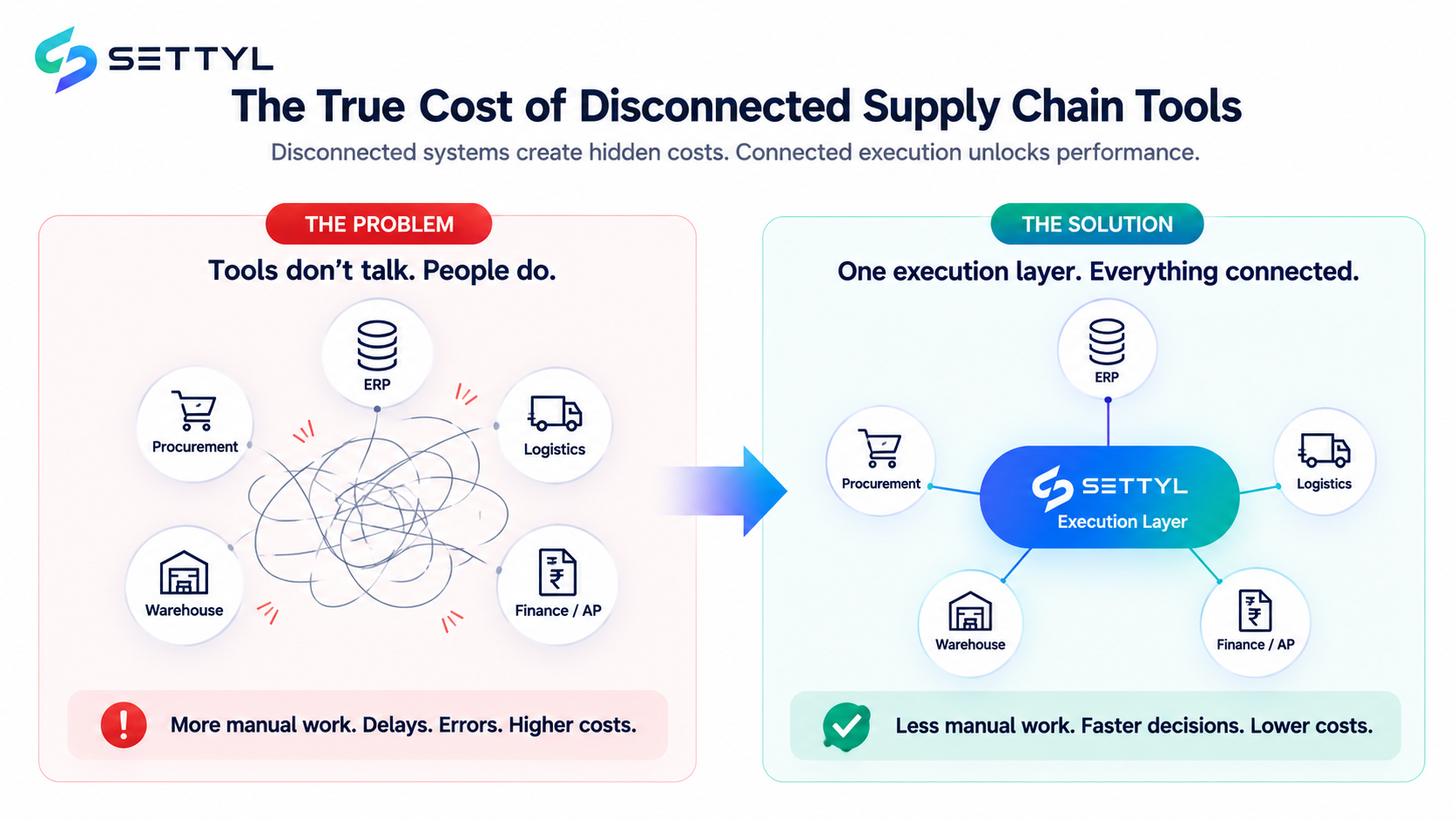
The True Cost of Disconnected Supply Chain Tools
The software bill is visible. The cost of making the software execute together is not.
Every enterprise knows what its supply-chain software costs: licenses, implementation, maintenance, integrations, and renewals.
But another cost is distributed across procurement, planning, logistics, EXIM, warehousing, finance, suppliers, carriers, forwarders, and other partners.
It appears every time a buyer chases a supplier confirmation, a logistics coordinator forwards a status email, a planner reconciles spreadsheets, a finance analyst investigates an invoice mismatch, or someone manually carries information from one system into the next.
Those activities are rarely recorded as technology costs. Yet they exist because the transaction cannot progress across the technology landscape on its own.
Settyl calls this the Execution Fragmentation Tax™: the cumulative operational cost of compensating for Operational Fragmentation.
The important distinction is that disconnected software is not, by itself, the problem. Modern supply chains will continue to contain different ERPs, planning systems, TMS platforms, procurement applications, partner systems, portals, email, messaging, and spreadsheets.
The economic problem is that people are still required to make the transaction continuous across those boundaries.
The Cost Is Not Software Sprawl. It Is Execution Fragmentation.
A typical enterprise stack may include ERP, procurement, planning, transportation, warehouse, trade-compliance, accounts-payable, supplier-management, and visibility applications.
Each system can perform its own function well. The fragmentation appears when a business transaction crosses from one boundary to another.
A purchase order may originate in ERP. The supplier confirms through email. A forwarder coordinates transport in another system. Customs documentation travels through another channel. Goods receipt is recorded elsewhere. An invoice enters finance through yet another workflow.
The transaction is continuous, but execution is distributed.
When no system owns the transaction across those boundaries, people become the execution layer.
That is the structural problem behind the Execution Fragmentation Tax.
What the Execution Fragmentation Tax™ Includes
The tax has two components: direct coordination cost and downstream consequence cost.
1. Direct coordination cost
This is the human capacity consumed simply keeping work moving:
- supplier and carrier follow-ups;
- status chasing across email, portals, and messaging;
- spreadsheet reconciliation;
- manual data re-entry;
- document collection and validation;
- cross-functional handoffs;
- approval chasing;
- invoice and shipment exception investigation;
- manually updating Systems of Record after an outcome is known.
2. Downstream consequence cost
Coordination latency and errors can then create second-order costs:
- expedite and premium freight;
- avoidable inventory buffers;
- production disruption;
- customs and documentation delays;
- invoice disputes and payment exceptions;
- supplier and carrier claims;
- missed customer commitments;
- management time spent escalating routine execution problems.
The first category is usually easier to measure. The second is often financially larger but requires stronger attribution.
That distinction matters: do not inflate the business case by treating every supply-chain cost as fragmentation cost. Count a downstream cost only where there is a defensible link to delayed, missing, duplicated, or incorrect execution across boundaries.
Why the Tax Remains Invisible
No single function owns it.
Procurement classifies supplier follow-ups as procurement work. Logistics classifies shipment coordination as logistics work. Finance treats reconciliation as finance operations. Planning treats spreadsheet maintenance as planning activity.
Each department sees its own workload. Few organizations aggregate the cross-functional coordination required to complete the same transaction.
This creates a measurement blind spot.
The Execution Fragmentation Tax is not hidden because it is insignificant. It is hidden because it is distributed.
A Practical Way to Measure the Execution Fragmentation Tax
Start with transaction families rather than applications.
For example:
- supplier RFQ → quotation → award;
- purchase order → supplier commitment → delivery;
- shipment request → booking → delivery;
- EXIM documentation → customs release;
- goods receipt → invoice → settlement;
- supply exception → resolution → verified recovery.
For each transaction family, measure five variables:
- Volume: how many eligible transactions occur in the measurement period?
- Manual coordination time: how many minutes are spent chasing, reconciling, re-entering, checking, escalating, or communicating?
- Loaded labor cost: what is the realistic cost of the roles performing that coordination?
- Exception frequency: what percentage of transactions require additional manual intervention?
- Attributable consequence cost: what measurable rework, expedite, delay, dispute, or penalty cost resulted from fragmented execution?
A simple baseline is:
Direct Fragmentation Cost = Transaction Volume × Average Manual Coordination Time × Loaded Cost per Minute
Then add only defensible downstream costs:
Execution Fragmentation Tax = Direct Fragmentation Cost + Attributable Exception and Delay Costs
This is not an accounting standard. It is an operating model for establishing a baseline, prioritizing workflows, and measuring improvement.
Settyl’s Execution Fragmentation Calculator provides a practical starting point for estimating that baseline.
Example: The Cost Hidden Inside a Purchase Order
Consider a PO after it has been released from ERP.
The buyer may need to obtain acknowledgement, validate committed quantity and date, resolve a partial confirmation, notify planning, coordinate readiness with logistics, collect shipment documents, manage a delay, and eventually ensure the correct outcome is reflected back in ERP.
Each activity may take only a few minutes. Across thousands of purchase orders, suppliers, plants, and exceptions, those minutes become material capacity.
The key question is not how much the procurement application costs.
How much human coordination is required before the PO reaches a verified business outcome?
That is the economic unit worth measuring.
Integration Debt Is Only Part of the Problem
APIs, EDI, middleware, and connectors are necessary infrastructure. They reduce data re-entry and allow systems to exchange events.
But integration does not automatically remove execution fragmentation.
An API can communicate that a delivery date changed. It does not inherently decide what the change affects, determine the governed next action, obtain a supplier or carrier commitment, resolve an exception, or verify that the intended outcome occurred.
Integration moves data. Execution moves the transaction.
That distinction becomes increasingly important as enterprises add AI agents to existing applications. A procurement agent, logistics agent, finance agent, and ERP agent can each automate local tasks while a human still coordinates the transaction between them.
For the architectural argument, see The Transaction Is the New Unit of Autonomy.
Why Tool Consolidation Alone Does Not Remove the Tax
Reducing redundant applications can lower license and maintenance costs. But replacing five point solutions with one suite does not guarantee that the transaction becomes continuous.
External suppliers, carriers, forwarders, customs brokers, banks, and customers still operate outside the enterprise boundary. They will continue using different systems and channels.
This is why the objective should not be to eliminate fragmentation itself.
Fragmentation is structural. Manual coordination across fragmentation is the cost to eliminate.
That is the role of Multi-Enterprise Execution: enabling the transaction to progress across independent enterprises, systems, and communication channels without requiring universal adoption of one new portal.
The Economic Case for a System of Execution
Once the problem is defined as execution fragmentation rather than software sprawl, the architecture changes.
ERP remains the System of Record. Planning systems continue deciding what should happen. Functional applications retain specialized capabilities. Integrations continue moving data.
A System of Execution has a different responsibility: own the transaction journey across those components from intent to verified outcome.
That means maintaining transaction context, understanding dependencies, determining governed next actions, coordinating internal and external parties, invoking specialized capabilities, handling expected exceptions, preserving execution evidence, verifying outcomes, and writing validated results back to authoritative systems.
The economic objective is not simply fewer applications.
It is less human coordination per completed transaction.
That is why Lasya AI is positioned as the System of Execution for supply chains, not another System of Record.
Measure Capacity Recovery, Not Just Automation
Automation counts can be misleading. Automating ten steps inside one application may produce less value than removing one recurring cross-enterprise handoff.
For an Execution Fragmentation program, useful baseline measures include:
- manual coordination minutes per transaction;
- touches per transaction;
- exception resolution time;
- percentage of transactions requiring manual cross-system intervention;
- time from intent to verified outcome;
- attributable expedite, dispute, and rework cost;
- Autonomy Rate—the share of eligible transaction work completed end to end without manual coordination within defined governance boundaries.
These metrics connect AI and automation investment to operating economics rather than feature adoption.
Where to Start
Do not begin by mapping every application in the enterprise.
Pick one high-volume, coordination-heavy transaction and follow it end to end.
- Identify every system, enterprise, person, and channel the transaction crosses.
- Record each point where a person must retrieve context, interpret information, chase another party, re-enter data, or decide what happens next.
- Measure the time and frequency of those interventions.
- Separate routine coordination from genuine human judgment.
- Identify downstream costs that can be credibly attributed to coordination delay or error.
- Establish the baseline before automating.
This creates a defensible business case and identifies the transaction where autonomous execution can recover the most capacity.
Conclusion: The Hidden Cost Is Human Coordination
Enterprises do not need every participant to use the same system. Supply chains will remain multi-enterprise and technologically heterogeneous.
The opportunity is to stop requiring people to act as the permanent integration and execution layer between those systems.
Operational Fragmentation describes the structural problem.
Execution Fragmentation Tax™ describes its economic consequence.
Multi-Enterprise Execution provides the cross-enterprise framework.
Autonomous Supply Chain Execution is the outcome.
And the System of Execution is the architectural layer that carries the transaction across those boundaries.
The first step is measurement.
Estimate your Execution Fragmentation Tax™, then identify the transaction consuming the greatest amount of avoidable coordination capacity.
Frequently Asked Questions
What is the Execution Fragmentation Tax?
The Execution Fragmentation Tax is the hidden operational cost of keeping transactions moving across disconnected systems, functions, enterprises, and communication channels through manual coordination.
What causes Operational Fragmentation?
Operational Fragmentation occurs when transaction execution is distributed across ERP, point applications, spreadsheets, email, messaging, portals, and external partners without one layer owning the complete transaction journey.
How can a company measure its Execution Fragmentation Tax?
Measure coordination hours spent on follow-ups, reconciliation, re-entry, status chasing, exception handling, and partner communication. Then add only downstream costs—such as expedite freight, rework, disputes, or delays—that can be credibly attributed to fragmented execution.
Do integrations eliminate the Execution Fragmentation Tax?
Not necessarily. Integrations exchange data, but people may still need to interpret signals, determine the next action, coordinate external parties, resolve exceptions, and verify outcomes.
Does reducing execution fragmentation require replacing ERP?
No. ERP can remain the System of Record while a System of Execution carries the transaction across systems and partners and writes verified outcomes back.
What is a System of Execution?
A System of Execution owns the transaction journey from intent to verified outcome across enterprise systems, people, AI agents, suppliers, carriers, and other partners.
Related Reading
- Operational Fragmentation — the structural problem behind the hidden coordination cost.
- Operational Fragmentation: The Hidden Tax on Manufacturing Supply Chains — the pillar argument for why fragmented execution persists.
- The Transaction Is the New Unit of Autonomy — why autonomous applications alone do not create autonomous transactions.
- Multi-Enterprise Execution — the framework for execution across enterprise boundaries.
- Autonomous Supply Chain Execution — the domain and outcome.
- Lasya AI — System of Execution for Supply Chains.
Bring last month's exceptions.
Leave with the ROI model.
30-minute working session for the CFO and Controller. We'll run your real exception backlog through Lasya, project the working-capital release, and walk through the audit-trail evidence your InfoSec team will request.