Operational Fragmentation: The Hidden Tax on Manufacturing Supply Chains

Gokulganth TM
July 14, 2026
4 mins
Illustration showing supply chain trends from 2026 to 2030, where AI coordinates suppliers, logistics, customs, finance, and ERP systems through an autonomous execution layer

Operational Fragmentation: The Hidden Tax on Manufacturing Supply Chains

Ask ten manufacturing executives where their supply chain actually runs, and nearly every answer starts the same way: SAP, Oracle, Microsoft Dynamics. It's an understandable reflex. Enterprise Resource Planning systems have been the backbone of manufacturing for three decades — the system of record for purchase orders, inventory balances, production schedules, supplier records, and financial transactions. For most executives, the ERP is the supply chain, in the same way the speedometer feels, at a glance, like the engine.

But systems of record are not where work happens. Follow a single purchase order from the moment it's created to the moment the goods arrive, and the gap between the two becomes obvious almost immediately. A planner creates a requisition inside the ERP. Procurement converts it into a purchase order and emails it to the supplier, because not every supplier logs into the portal reliably enough to depend on. The supplier replies — in email — with a revised delivery commitment. The buyer copies that date into a spreadsheet, because production planning depends on promised delivery dates that nothing keeps automatically synchronized with the ERP.

Days later, a quality issue changes the required quantity. The revised purchase order goes out again. Production planning hears about it through Microsoft Teams. Logistics is notified by email. The freight forwarder receives a PDF copy. Customs documentation is prepared in a separate portal. Shipment milestones are tracked inside the forwarder's own system. The warehouse updates receipt information inside its own Warehouse Management System. Finance waits for an invoice to arrive before it can even begin a three-way match — against a transaction it has, in effect, been chasing the entire time.

By the time the materials reach the factory floor, that single transaction has traveled through dozens of applications, multiple independent organizations, hundreds of emails, an uncountable number of phone calls, and at least one spreadsheet that nobody remembers creating but everybody now depends on. The ERP recorded the transaction faithfully, start to finish. The work happened somewhere else entirely. That distinction — between where a transaction is recorded and where it is actually executed — matters more than most organizations realize, and it is the whole story of this piece. We call the gap between the two Operational Fragmentation, and it is the single largest hidden cost still sitting inside manufacturing supply chains today.

A problem with no name is a problem nobody owns

Every major shift in enterprise technology began the same way: by giving a name to something that had, until then, existed without language. Cloud computing gave a name to infrastructure abstraction. Technical debt gave a name to the long-term cost of software shortcuts. Network effects gave a name to platform economics. Manufacturing has reached a similar moment, but it has spent years describing its version of the problem without ever naming it correctly. "We have too many systems." "Our integrations don't really work." "Our departments operate in silos." "Our suppliers don't collaborate." "Our processes are too manual."

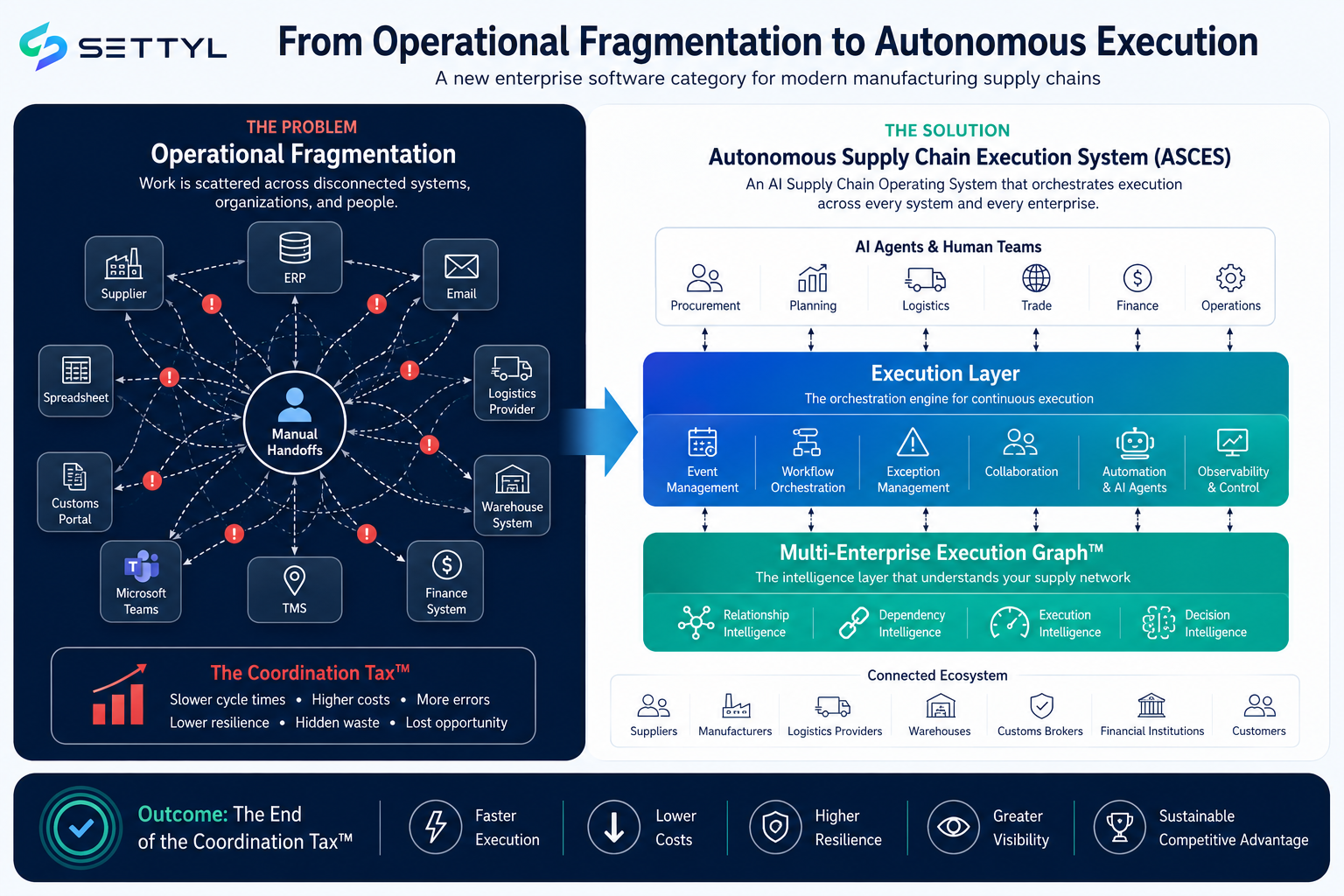
Each of those statements is true. None of them names the underlying condition — they describe symptoms, not the disease. The disease is Operational Fragmentation: what happens when work is distributed across disconnected systems, disconnected organizations, and disconnected people, with no shared mechanism for execution holding it together. Notice, carefully, what that definition does not say. It does not say companies lack software. It does not say companies lack automation. It does not say companies lack data. Modern manufacturers possess more of all three than at any point in their history. What they lack is continuity of execution — something that carries a decision from the moment it's needed to the moment it's done, across every system and every company the decision touches, without a person relaying it by hand at every single step along the way.

Why manufacturing became comfortable with fragmentation

Operational Fragmentation did not arrive because manufacturers made bad decisions. It arrived because they made the right decision, repeatedly, for one function at a time. In the 1990s, ERP systems transformed manufacturing by bringing finance, procurement, inventory, production, and accounting into a single system of record — for the first time, organizations could centralize enterprise data and standardize their core processes. It was a genuine breakthrough, and it earned ERP its place as the backbone of the enterprise.

As supply chains grew more complex through the 2000s, manufacturers began adopting specialized, best-of-breed applications to solve problems the ERP was never built to solve. Transportation Management Systems optimized freight. Warehouse Management Systems improved inventory accuracy. Strategic sourcing platforms streamlined procurement. Manufacturing Execution Systems digitized the shop floor. Compliance teams adopted dedicated trade and customs software. Each of these investments delivered real, measurable improvement — within its own domain.

Cloud software accelerated the pattern through the 2010s. Every department could now select and deploy its own best-in-class tool faster than ever, and every department did: procurement chose its procurement platform, logistics implemented its own TMS, warehouses modernized their own systems, finance automated its own invoice processing. Each function optimized independently. No organization set out, deliberately, to build a disconnected supply chain — fragmentation was the unintended consequence of optimizing individual functions instead of optimizing how work actually flowed across the network connecting them. Every investment made a department better. No investment made the handoff between departments better. The enterprise became more capable locally, and more complex operationally, at the same time.

The integration illusion

Enterprise software vendors noticed the growing complexity and offered a compelling answer: integration would solve fragmentation. Manufacturers invested heavily in APIs, EDI, middleware, Enterprise Service Buses, and data lakes, all in pursuit of the same promise — a single source of truth, where every application could exchange information seamlessly and operations would naturally become easier.

To a real extent, these initiatives succeeded. Purchase orders, inventory updates, shipment milestones, invoices, and financial transactions genuinely do move between systems today far more fluidly than they once did. Information is more connected than at any point in manufacturing history. And yet operations did not become proportionally easier to run. Production planners still live in spreadsheets. Buyers still chase supplier confirmations over email. Logistics teams still coordinate exceptions by phone and by messaging app. Finance teams still reconcile mismatched invoices by hand. Executives, looking at this, started asking an uncomfortable question: if we've digitized everything, why does so much of the real work still happen in email and spreadsheets?

The answer is simple, and it is easy to miss because it sounds like a small distinction: integration moves data. It does not move work. An API can copy a field from one system into another flawlessly. It cannot decide whether a supplier's revised delivery date should trigger a change to the production schedule. It cannot decide which of six alternative carriers to book when the primary carrier hasn't confirmed within four hours. It cannot negotiate a price. It cannot resolve a conflicting delivery commitment. It cannot decide who, out of a dozen possible stakeholders, should be the one to act next. Those are judgment calls, made continuously, and today a person makes every one of them — which is exactly why the tools can be perfectly integrated and the coordination burden barely moves. APIs communicate. Organizations collaborate. Those are fundamentally different capabilities, and manufacturing increasingly needs the second one far more than the first.

The enterprise no longer ends at the enterprise

The deeper reason integration was never going to be enough is that the modern supply chain isn't contained inside one company to begin with — it belongs to an interconnected network of enterprises. A single purchase order rarely begins and ends within one organization. It moves across suppliers, contract manufacturers, freight forwarders, ocean and air carriers, customs brokers, third-party warehouses, financial institutions, and ultimately the customer. Each participant runs its own systems, its own processes, and its own priorities, and none of them report to the same executive.

Even a manufacturer that achieved flawless internal integration — genuinely rare — hits fragmentation the instant execution crosses its own boundary, because ERP, WMS, and TMS were each built to optimize a function within or around one enterprise. None of them were ever designed to continuously orchestrate execution across a network of independent organizations. That's not a feature gap a better module closes next year. It's an architectural ceiling, and the industry has been running straight into it for a decade without naming it.

Two kinds of fragmentation, and manufacturing solved the wrong one

Enterprise software has spent decades solving the wrong problem — it assumed manufacturing suffered primarily from information fragmentation, when the real disease is execution fragmentation. The two sound similar. They are fundamentally different. Information fragmentation asks: can every system access the same data? Execution fragmentation asks: can every participant move work forward without manual coordination? One is a data problem. The other is an operating-model problem. Manufacturing has become very good at solving the first. It still struggles badly with the second.

This is also, in fairness, not a failure of ERP — it's a mismatch of expectations. ERP is extraordinary at what it was built to do: it maintains financial integrity, records transactions, enforces master data, manages accounting structures, and creates auditability. In other words, ERP answers one question exceptionally well: what happened? But manufacturing leaders increasingly need answers to a different set of questions entirely — what is happening right now, who needs to act next, which supplier hasn't responded, which shipment needs intervention, which invoice should wait because the goods haven't actually arrived. Those are execution questions, not transaction questions, and expecting ERP to answer them is a little like expecting an accounting system to manage air traffic control.

The relay race nobody trained for

One of the more surprising outcomes of the past decade of digital transformation is that it often produced more operational complexity, not less — because digital transformation digitized departments, not the coordination between them. Picture a relay race in which every individual runner trains relentlessly, gets faster equipment, and improves their own performance dramatically — and nobody ever practices passing the baton. The team, overall, doesn't get faster. It gets more inconsistent. That's what happened inside manufacturing: every function modernized on its own schedule; almost no organization modernized the handoffs between functions. And handoffs are exactly where delays, misunderstandings, and hidden cost accumulate.

The Coordination Tax: the cost nobody budgets for

Every CFO can tell you what the company spends on freight, inventory, labor, and raw materials to the decimal point. Almost none can tell you what the company spends on coordination — and yet coordination may be one of the largest true operating expenses inside a modern manufacturing enterprise. Walk through the finance department of any manufacturer and you'll find meticulously categorized costs: raw materials, freight, warehousing, inventory carrying cost, utilities, maintenance, software subscriptions, salaries. Every one of them has a cost center, a budget, and an owner. Except one. No line item exists for the hours a buyer spends chasing a supplier. No budget captures the time a planner spends reconciling a schedule after a delay. No report measures the effort spent forwarding documents between a freight forwarder, a customs broker, a warehouse operator, and a finance team. No KPI tracks the hundreds of small decisions employees make every day simply to keep work moving between systems that don't talk to each other on their own.

The work happens. The cost is real. It just remains invisible, because it's distributed across hundreds of people and thousands of tiny, unbilled actions — the email requesting a status update, the spreadsheet kept "just in case," the phone call to confirm a shipment nobody trusted the portal to report accurately, the meeting held purely to align stakeholders who should already have agreed. Individually, each action looks insignificant. Collectively, they become one of the largest consumers of organizational time in the company. We call this the Coordination Tax™ — the cumulative cost of the human effort required to move work across disconnected systems, departments, organizations, and partners. It is explicitly not the cost of the software, not the cost of labor itself, not the cost of freight, and not the cost of inventory. It is the cost of making all of those things work together.

The job description nobody wrote down

Look closely at many roles inside procurement, logistics, planning, and finance today, and a pattern emerges. The official title might read Procurement Manager, Supply Planner, Logistics Coordinator, or Import Manager. But watch what these professionals actually spend much of the day doing, and it isn't procurement, planning, or logistics at all — it's coordination. Gathering information from multiple systems. Translating context between departments. Clarifying misunderstandings. Following up with partners. Escalating delays. Synchronizing stakeholders. Updating spreadsheets. Sending reminders. The modern manufacturing office has, without anyone deciding it should, become a coordination engine — and highly skilled professionals spend a remarkable share of their expertise simply making sure information moves between people, rather than creating strategic value with it.

The four dimensions of the tax

Most organizations underestimate the Coordination Tax because they only count labor. It has four distinct dimensions. Time is the most visible: every hour spent waiting, following up, clarifying, reconciling, escalating, or searching is an hour not spent negotiating supplier terms, improving a relationship, or solving a strategic problem. Delay compounds through the network: a delayed supplier confirmation postpones production; a delayed production schedule postpones a freight booking; a delayed booking affects customs planning; customs delays affect warehouse scheduling; warehouse delays postpone invoicing; invoice delays hit cash flow. One coordination delay propagates through the entire chain the way a single accident slows an entire city's traffic. Decision quality suffers quietly: when procurement, production, finance, and logistics each see a different version of reality at a different moment, executives end up optimizing locally instead of globally, and the result is a supply chain that is efficient in pieces and suboptimal as a whole — a plant manager might hit a perfect on-time-production number for the month by pulling forward an order that finance would never have approved had they seen the cash-flow impact in time to weigh in, because by the time that number reached finance, the decision was already made and the working capital already committed. And organizational fatigue may be the most overlooked cost of all — not because the work of manufacturing is inherently exhausting, but because coordination itself is cognitively expensive: switching between ten applications, answering hundreds of emails, sitting through status meetings, searching for missing documents, resolving duplicate information. Eventually people stop trying to improve the process and simply try to survive it. Organizations call this burnout. Operationally, it is coordination overload — and it shows up in retention numbers long before it shows up in any operational KPI, because the people most capable of doing the coordination well are also the ones most employable elsewhere, and the ones most likely to leave once the job becomes indistinguishable from clerical relay work.

Why the tax compounds instead of scaling

The Coordination Tax doesn't grow linearly with the size of the business — it compounds. A company with one supplier coordinates easily. A company with ten is still manageable. A company with 800 suppliers, 15 factories, 12 warehouses, 40 logistics providers, 8 customs brokers, six regional procurement teams, multiple currencies, and thousands of monthly shipments faces a number of possible interactions between participants that grows combinatorially with every one added — a dynamic network theory calls the combinatorial effect. This is precisely why the most sophisticated manufacturers, running the largest and most interconnected networks, often carry the heaviest coordination burden of all: complexity grows faster than headcount, and coordination grows faster than complexity. It also explains a counterintuitive pattern many operations leaders have lived through — hiring more coordinators seems, briefly, to help, and then makes things worse, because every new employee is another communication path, another approval chain, another inbox the network has to route information through. The organization becomes more responsive in the short term and more complex in the long term, which is why many growing manufacturers experience declining operational agility despite hiring aggressively. They aren't scaling execution. They're scaling coordination.

A day in the life of one purchase order

Abstractions are easy to nod along with and easy to underestimate. It helps to watch the tax accrue on one ordinary transaction. A buyer creates a purchase order inside the ERP for a component from an overseas supplier. The system emails it automatically. So far, everything looks digitized and seamless. Then the supplier notices, mid-production, that one line item can't be delivered on the original date — a raw material shortage upstream, nothing anyone could have prevented. Instead of updating the ERP directly, because the supplier has no reason to log into a customer's system for a status update, they reply to the email. The buyer reads the reply hours later, between other tasks. Production planning needs to know, so the buyer sends a message over Teams. The planner realizes the freight booking, originally set for Friday, now needs to move to the following Tuesday, so the logistics coordinator calls the freight forwarder directly, because email response times are too slow for a schedule change this close to departure. The forwarder updates its own internal portal — not the customer's system, its own. The customs broker, seeing the date shift, requests revised commercial invoices to match. Finance needs updated payment milestones reflecting the new delivery window. Warehouse labor scheduling changes too, because the arrival date has moved. None of these seven downstream actions appear anywhere inside the original purchase order record. Every one of them required a person to notice, translate, and relay it into the next system by hand. Now multiply this single, entirely ordinary disruption by five hundred purchase orders a week, two thousand suppliers, multiple manufacturing plants, and dozens of logistics providers, and the enterprise is no longer really processing transactions. It is processing conversations — an enormous, continuous, mostly invisible volume of them, running in parallel, all day, in every function at once.

What the tax costs beyond the obvious

Because the Coordination Tax hides inside job titles rather than cost centers, most quantification attempts understate it badly. A more honest accounting has to include the opportunity cost of what a coordinator isn't doing while coordinating: a buyer chasing a confirmation isn't negotiating better payment terms with that same supplier; a planner reconciling a spreadsheet isn't running a what-if scenario that could have caught the disruption three weeks earlier; a finance analyst manually matching an invoice isn't forecasting the working-capital impact of a slower quarter. It has to include the compounding cost of errors introduced by manual re-entry — a transposed HS code, a mismatched unit of measure, a currency conversion applied at the wrong rate — each one small, each one capable of triggering a customs hold, a payment dispute, or a quality escalation days or weeks later, far removed from the original data-entry moment that caused it. And it has to include the strategic cost of slow decisions: by the time a fragmented organization has finished routing a disruption through six people and four systems, the decision window for the cheapest fix — the one extra day of lead time, the one alternate carrier still available — has often already closed, leaving only the more expensive options: expedite freight, air shipment instead of ocean, a rush order at a premium price. None of that shows up on an invoice labeled "coordination." All of it shows up somewhere on the P&L.

Why more point AI makes it worse, not better

The instinctive response to all of this is to add AI to the worst-offending function — a copilot for procurement, an assistant for invoice capture, a model for freight optimization, a chatbot for shipment tracking. Individually, these products are genuinely impressive. Collectively, they raise an uncomfortable question: what happens when every department buys its own AI?

The industry has entered what might be called the Point AI era — instead of replacing enterprise platforms, vendors are embedding AI into narrow, single-function workflows. One model summarizes invoices. Another predicts delays. Another negotiates prices. Another drafts contracts. Another optimizes inventory. Another schedules transportation. Each one solves its own problem exceptionally well. Each one also becomes another application, another login, another interface, another vendor, another data model, another integration project, another source of notifications. The industry is using AI to automate individual islands while leaving the ocean between them exactly as untouched as it always was.

Consider a manufacturer running five specialized AI tools at once. The procurement model recommends delaying an order to secure better pricing. The planning model recommends accelerating the same order because demand just increased. The finance model recommends postponing payment to manage cash flow. The logistics model insists on shipping immediately because of port congestion. Every recommendation is, on its own terms, intelligent. Nothing reconciles them. Who optimizes the enterprise, when every AI is only optimizing its own function? Without a coordinating layer, organizations risk trading fragmented software for fragmented intelligence — the technology gets smarter and the enterprise gets more conflicted, at the same time.

The first generation of enterprise software created data silos. The next generation, left unchecked, risks creating AI silos: different models, different recommendations, different priorities, different decision logic, each locally sound and collectively incoherent. Instead of asking which system contains the latest information, organizations may soon find themselves asking which AI they should even trust. That is not progress. It is fragmentation wearing a more sophisticated disguise. It follows that the next competitive advantage will not belong to whoever owns the smartest individual model. One intelligent function is optimization. Many coordinated intelligent functions, working toward a shared operational objective, is autonomy — and that distinction changes the entire conversation, from AI features to enterprise execution.

From automation to orchestration

For decades, enterprise software has pursued automation: automate invoice processing, automate purchase orders, automate freight booking, automate forecasting. Automation improves individual tasks. But manufacturing isn't a collection of isolated tasks — it's a living network of continuously changing decisions, and the next frontier isn't automation. It's orchestration. An orchestra isn't remarkable because each musician plays beautifully in isolation; it's remarkable because every musician plays the same composition, at precisely the right moment, together. Manufacturing works the same way. Excellence emerges not from optimizing individual departments, but from synchronizing them — and that requires something fundamentally different from one more application. It requires a system capable of coordinating work across every participant in the network, continuously.

The Execution Layer: the architecture manufacturing never built

Open a mapping app and enter a destination. Within seconds, it has coordinated roads, live traffic, construction zones, accidents, speed limits, toll routes, weather, and millions of other moving vehicles — and no human being manually reconciled any of it. Modern manufacturing has no equivalent. Suppliers understand production. Carriers understand transportation. Warehouses understand inventory. Finance understands payment. ERP understands the transaction. Every participant understands their own slice of the journey, and no system understands execution across all of them at once. That is the missing layer — not another application, not another database, not another dashboard, but an execution fabric capable of continuously coordinating work across independent organizations.

Crucially, an Execution Layer does not replace the systems manufacturers have already invested decades in building. It does not replace ERP, WMS, TMS, or finance systems — those remain exactly what they should be: the systems of record that preserve financial integrity, master data, production orders, and auditability, and that answer what should be produced, what inventory exists, and what has already happened. What an Execution Layer replaces is something else entirely: the sprawling second stack that exists only because those systems of record were never built to coordinate work across companies — the separate sourcing tool, the separate RFQ platform, the separate TMS, the separate freight-execution product, the separate supplier portal, the separate customs-execution tool, the separate document-processing product, the separate invoice-capture tool, the separate exception-management dashboard, the separate email-based coordination habit, and the separate departmental AI copilot bolted on top of each one. Every one of these applications solves a real problem in isolation. Together, they create the very fragmentation this piece is describing. Instead of deploying independent products for procurement execution, transportation execution, supplier collaboration, document processing, and invoice automation, an Execution Layer makes those capabilities native services inside a single execution environment. Execution stops jumping from application to application and starts flowing continuously across the whole network.

Picture, concretely, what changes when a supplier misses a promised shipment date. Today, the pattern is familiar: the supplier sends an email; a buyer notices it, eventually; a planner updates a spreadsheet; production adjusts its schedule; logistics changes a booking; finance revises a payment forecast; the warehouse reschedules receiving — six separate people, six separate manual actions, each one dependent on someone noticing and acting on the last. Inside an Execution Layer, the supplier's update becomes a single shared operational event. Planning is informed automatically. Transportation options are recalculated. Inventory impact is evaluated. Alternative suppliers are identified where relevant. Finance forecasts are revised. Every affected stakeholder receives only the action that's actually theirs — nobody copies information between systems, nobody forwards an email as a substitute for a workflow, and nobody manually synchronizes departments that should already agree. The system coordinates execution. Humans intervene precisely where their judgment creates value, and nowhere else.

How the outcome gets written back to the system of record

The part of this architecture most often misunderstood is what happens at the end of the sequence, once the real-world work is actually done. An Execution Layer isn't a parallel record competing with the ERP for the truth — it's explicitly the opposite. Every action it takes on a company's behalf — a renegotiated delivery date, a rebooked carrier, a revised payment milestone, a completed three-way match — gets written back to the ERP as the authoritative outcome, the same way it always would have been, had a person typed it in manually after finishing the coordination work themselves. The ERP still closes the purchase order. The ERP still posts the journal entry. The ERP still holds the auditable history a finance team, an auditor, or a regulator would expect to find there. What's different is not where the truth lives — it's how much manual translation had to happen before that truth arrived. A goods receipt that would have waited three days for someone to reconcile a mismatched invoice now posts the same day the shipment actually clears, because the matching happened automatically, the moment the data needed to match it became available. A revised delivery commitment that would have lived in an email thread for a week, quietly diverging from what the ERP still believed to be true, now updates the ERP the moment the supplier confirms it — closing the gap between what actually happened in the world and what the system of record believes happened, a gap that, in most fragmented operations, is measured in days, and sometimes in weeks. This is also precisely why an Execution Layer coexists with an ERP rather than competing with it: the ERP was never the problem to begin with. The problem was always the distance between the ERP and the real-world event it was waiting to record.

This architectural shift also changes how AI itself should be deployed. Today, most organizations run a collection of individual AI assistants — one per function, each working independently. The more durable pattern is AI teams: procurement agents, logistics agents, finance agents, compliance agents, planning agents, supplier agents, and warehouse agents, not working in isolation but coordinating the way human departments are supposed to. An Execution Layer is the environment in which that coordination actually happens. Without it, organizations risk replacing human silos with AI silos — a more expensive version of the same problem, dressed up as progress.

The Multi-Enterprise Execution Graph: The Intelligence That Makes Autonomous Execution Possible

An Execution Layer is only as effective as its understanding of how work actually moves across a supply network. Coordinating execution isn't simply about knowing that a purchase order exists or that a shipment has been delayed. It requires understanding who needs to act, what depends on that action, which organizations are involved, how they typically collaborate, what exceptions have occurred before, and how similar situations were successfully resolved.

That contextual understanding is the purpose of the Multi-Enterprise Execution Graph.

Unlike traditional enterprise systems that organize information into isolated records, tables, or documents, the Multi-Enterprise Execution Graph™ models the supply chain as a living network of relationships. Every purchase order, shipment, invoice, supplier, carrier, warehouse, customs broker, production order, contract, document, approval, workflow, AI agent, and human participant becomes part of a continuously evolving execution graph. More importantly, the graph doesn't merely store these entities—it understands how they relate to one another and how work flows between them.

Instead of asking:

"Where is my purchase order?"

the graph answers far more operationally valuable questions.

Which production orders depend on this shipment?

Which suppliers can realistically fulfill this requirement if the current supplier fails?

Which logistics provider consistently responds fastest on this trade lane?

Which warehouse will be impacted first by this delay?

Which finance workflows should pause because goods have not yet arrived?

Which AI agent should act next, and which decision still requires human judgment?

These are execution questions rather than reporting questions, and they cannot be answered by looking at individual applications in isolation.

The graph continuously captures relationships across four interconnected dimensions.

The first is relationship intelligence. It understands how organizations interact with one another—not simply who supplies whom, but how procurement teams collaborate with suppliers, how freight forwarders coordinate with customs brokers, how warehouse operators communicate with transport providers, and how finance teams reconcile transactions across the network. These relationships evolve over time, allowing the graph to recognize recurring collaboration patterns rather than treating every transaction as an isolated event.

The second is dependency intelligence. Every operational event creates downstream consequences. A delayed supplier confirmation affects production planning. A revised production schedule changes transportation requirements. Transportation delays influence warehouse operations, customer commitments, and cash-flow forecasts. Rather than treating these as independent workflows, the graph understands the chain of dependencies connecting them and can predict how a single exception propagates across the network before it becomes an operational crisis.

The third is execution intelligence. Supply chains rarely fail because information is unavailable. They fail because work stalls between participants. The graph continuously observes how work actually moves—which stakeholders typically respond first, where approvals become bottlenecks, which suppliers frequently miss commitments, which carriers consistently recover from disruptions, and which workflows repeatedly require manual intervention. Over time, it develops an increasingly accurate understanding of how execution occurs in the real world rather than how process diagrams suggest it should occur.

The fourth is decision intelligence. Every day, procurement teams, planners, logistics coordinators, finance professionals, and suppliers make thousands of operational decisions. Most enterprise software records only the outcome of those decisions. The graph learns from the decisions themselves. It recognizes which actions resolved similar exceptions successfully, which escalations consistently shortened delays, and which interventions created unintended downstream consequences. As a result, every transaction strengthens the system's understanding of how execution should be orchestrated across that specific supply network.

This distinction is fundamental.

Most enterprise software accumulates data.

The Multi-Enterprise Execution Graph™ accumulates operational knowledge.

Every completed purchase order.

Every supplier interaction.

Every shipment milestone.

Every customs clearance.

Every invoice reconciliation.

Every approval.

Every delay.

Every recovery.

Every exception.

Each one enriches the graph's understanding of how work flows across the network, making future execution progressively faster, more accurate, and increasingly autonomous.

This is also why the graph becomes more valuable over time.

Traditional software scales by processing more transactions.

Artificial Intelligence scales by training larger models.

The Multi-Enterprise Execution Graph™ scales by learning the operational behavior of the network itself.

As suppliers, logistics providers, manufacturing plants, warehouses, financial systems, and AI agents continue interacting, the graph develops a richer understanding of who collaborates effectively, where bottlenecks emerge, how exceptions propagate, and which execution paths consistently produce the best operational outcomes.

In effect, the supply network begins to learn from itself.

This creates a competitive advantage that is fundamentally different from adding another AI feature.

An AI model can summarize a document, predict a delay, or recommend a supplier.

The Multi-Enterprise Execution Graph™ determines how every participant—human or AI—should collaborate to resolve that delay as quickly as possible across the entire network.

That difference is profound.

One optimizes individual decisions.

The other orchestrates collective execution.

It is also exceptionally difficult to replicate.

A competitor can license the same large language model.

They can build similar dashboards.

They can automate similar workflows.

They can copy product features within a release cycle.

What they cannot copy is a graph built from millions of real execution events flowing across thousands of suppliers, carriers, warehouses, manufacturers, customs brokers, financial systems, and AI agents operating together over time.

That operational intelligence cannot be purchased.

It must be earned through continuous execution across a living supply network.

This is why we believe the Multi-Enterprise Execution Graph™ is more than a technical architecture—it is the foundational intelligence layer of the Autonomous Supply Chain Execution System (ASCES).

If the Execution Layer is the engine that coordinates work, the Multi-Enterprise Execution Graph™ is the navigation system that knows where work should go, who should act next, how exceptions ripple through the network, and how execution continuously improves with every transaction.

It is the intelligence that transforms an AI Supply Chain Operating System from a collection of autonomous capabilities into a continuously learning execution platform.

Because in the future, competitive advantage will not come from software that merely understands transactions.

It will come from software that understands how work moves across an entire supply network—and becomes smarter every time that work is executed.

The Next Enterprise Software Category: Autonomous Supply Chain Execution System

Operational Fragmentation is not a software problem. It is an architectural one.

For years, manufacturers have tried to solve it the only way enterprise software knew how—by adding another application, another integration, another dashboard, or another AI assistant. Yet every new layer optimized an individual function while leaving the coordination between functions—and between enterprises—largely unchanged.

Disconnected applications were never the real problem. They were simply the visible symptom of a deeper architectural gap: the absence of a shared execution model spanning every organization involved in moving products from supplier to customer.

That realization fundamentally changes the question manufacturing leaders should be asking.

Not "Which application should we buy next?"

But "How should work move across our entire supply network?"

Every generation of enterprise software emerged to solve the defining constraint of its era.

ERP systems unified enterprise transactions and became the System of Record.

Best-of-breed applications optimized individual business functions.

Integration platforms connected enterprise data.

Artificial Intelligence accelerated individual decisions.

Each represented a significant advance. Each solved yesterday's bottleneck. Yet none was designed to continuously coordinate execution across a network of independent suppliers, manufacturers, logistics providers, financial institutions, warehouses, customs brokers, and customers.

That architectural gap is giving rise to the next category of enterprise software: the Autonomous Supply Chain Execution System (ASCES).

The easiest way to understand this new category is through a familiar metaphor.

An AI Supply Chain Operating System.

Just as an operating system coordinates applications, devices, memory, and users into a single computing environment, an Autonomous Supply Chain Execution System coordinates procurement, supplier collaboration, logistics, trade operations, finance, warehouses, documents, workflows, and AI agents into a single execution environment.

Importantly, it does not replace the enterprise systems manufacturers have spent decades building.

ERP remains the System of Record.

Planning platforms remain the System of Intent.

Manufacturing Execution Systems continue to manage production.

Financial systems continue to preserve compliance and auditability.

The Autonomous Supply Chain Execution System becomes the System of Execution—the layer that continuously orchestrates work across multiple enterprises while writing the outcome back to existing Systems of Record.

Within this architecture, the Execution Layer provides the orchestration engine that coordinates work across organizations, while the Multi-Enterprise Execution Graph™ provides the operational intelligence that understands relationships, dependencies, execution patterns, and decision history across the entire supply network. Together, they enable AI agents and human teams to operate from the same continuously evolving understanding of how work actually moves.

This distinction matters because the next decade of competitive advantage will not belong to organizations that simply own more software or deploy more AI models.

It will belong to organizations that reduce the time between detecting an operational event and resolving it—across every supplier, logistics partner, warehouse, financial process, and customer they depend upon.

Operational Fragmentation gave the industry a name for a problem that had existed for decades.

The Coordination Tax™ revealed the economic cost of leaving that problem unsolved.

The Execution Layer defined the architecture required to eliminate it.

The Multi-Enterprise Execution Graph™ introduced the intelligence that allows execution to continuously improve with every transaction.

Together, they establish a new category of enterprise software:

Autonomous Supply Chain Execution System (ASCES)

Because the future of manufacturing will not be defined by how accurately enterprises record transactions.

It will be defined by how autonomously entire supply networks execute them.

Frequently Asked Questions (FAQs)

1. What is Operational Fragmentation in manufacturing supply chains?

Operational Fragmentation is the disconnect between where supply chain transactions are recorded and where the actual work gets done. While ERP systems record purchase orders, inventory, invoices, and financial transactions, execution typically happens across emails, spreadsheets, supplier portals, logistics platforms, messaging applications, and manual follow-ups. This gap creates delays, inconsistent information, and significant coordination overhead across the supply chain.

2. Why don't ERP systems eliminate Operational Fragmentation?

ERP systems are designed to be Systems of Record. They maintain financial integrity, inventory, production orders, accounting, and compliance. However, they were never built to coordinate execution across suppliers, freight providers, warehouses, customs brokers, finance teams, and other external partners. As a result, much of the operational work still relies on manual coordination outside the ERP.

3. What is the Coordination Tax?

The Coordination Tax™ is the hidden operational cost of manually moving work between disconnected systems, departments, suppliers, logistics providers, warehouses, and finance teams. It includes time spent chasing supplier confirmations, forwarding emails, updating spreadsheets, reconciling invoices, resolving exceptions, and keeping multiple stakeholders aligned. Although rarely measured, it often represents one of the largest sources of inefficiency in modern manufacturing operations.

4. Why don't integrations and APIs solve Operational Fragmentation?

Integrations and APIs are designed to move data between applications—not work. While they can synchronize purchase orders, shipment updates, or invoices, they cannot decide who should act next, coordinate multiple stakeholders, resolve exceptions, or orchestrate execution across independent organizations. Operational Fragmentation is fundamentally an execution challenge rather than a data integration problem.

5. What is an Execution Layer?

An Execution Layer is an orchestration platform that continuously coordinates work across procurement, suppliers, logistics, customs, warehouses, finance, and AI agents. Instead of simply recording transactions, it manages execution across multiple organizations, ensuring operational events trigger the right actions automatically before completed outcomes are synchronized back to enterprise systems.

6. Does an Execution Layer replace ERP?

No. An Execution Layer complements existing enterprise systems rather than replacing them. ERP continues to serve as the System of Record, preserving financial integrity, inventory, and compliance. The Execution Layer acts as the System of Execution, coordinating operational work across multiple enterprises and updating the ERP once execution is complete.

7. What is the Multi-Enterprise Execution Graph?

The Multi-Enterprise Execution Graph™ is an intelligence layer that models the relationships between suppliers, manufacturers, logistics providers, warehouses, customs brokers, finance systems, AI agents, documents, and operational workflows. Rather than simply storing data, it continuously learns how work flows across the supply network, enabling faster decisions, better coordination, and increasingly autonomous execution over time.

8. What is an Autonomous Supply Chain Execution System (ASCES)?

An Autonomous Supply Chain Execution System (ASCES) is a new category of enterprise software designed to orchestrate procurement, logistics, supplier collaboration, finance, trade operations, warehouses, documents, and AI agents within a single execution environment. It works alongside ERP and other enterprise systems while continuously coordinating execution across the entire supply network.

9. How is ASCES different from traditional supply chain software?

Traditional supply chain software focuses on individual functions such as procurement, transportation, warehousing, finance, or planning. ASCES coordinates execution across all of these functions and across multiple organizations. Rather than optimizing isolated workflows, it enables procurement teams, suppliers, logistics providers, finance departments, warehouses, and AI agents to operate as a single coordinated execution network.

10. Why is Autonomous Supply Chain Execution becoming the next enterprise software category?

Previous generations of enterprise software focused on recording transactions, optimizing departmental processes, connecting enterprise data, or automating individual tasks. Today's supply chains require something fundamentally different: continuous coordination across multiple independent organizations. Autonomous Supply Chain Execution addresses this architectural challenge by enabling enterprises to orchestrate work across their entire supply network, making execution faster, more resilient, and increasingly autonomous.

Share this post
Gokulganth TM
July 14, 2026
4 mins

Bring last month's exceptions.
Leave with the ROI model.

30-minute working session for the CFO and Controller. We'll run your real exception backlog through Lasya, project the working-capital release, and walk through the audit-trail evidence your InfoSec team will request.

Wireframe globe composed of overlapping blue ellipses and circles on a transparent background.