

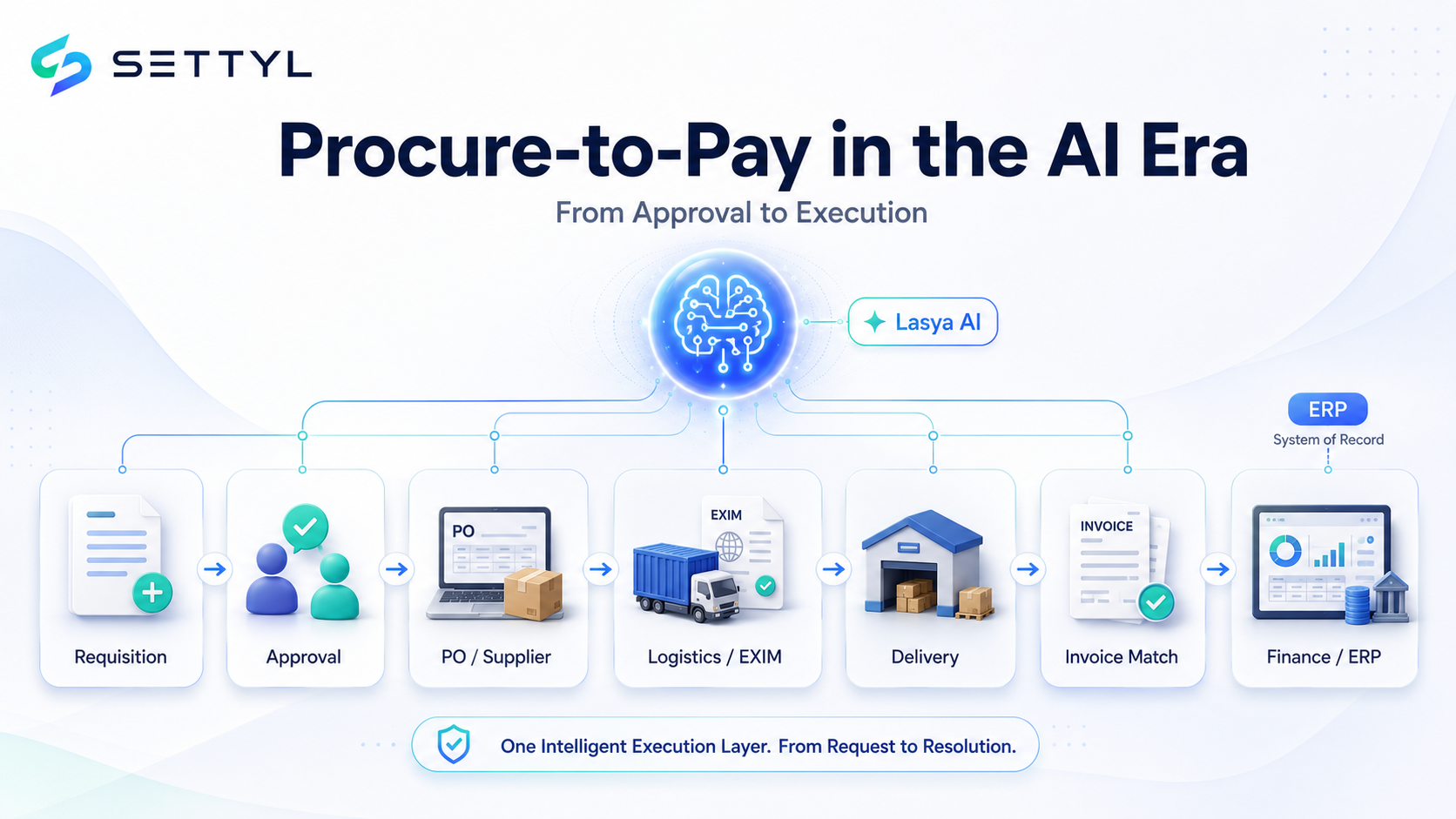
Procure-to-Pay in the AI Era: The Complete Guide
Procure-to-pay has been automated for years.
Enterprises have digitized purchase requisitions, approval workflows, purchase orders, goods receipts, invoice matching and payment processing.
Yet procurement teams still chase suppliers for confirmations. Logistics teams still re-enter purchase-order data. Finance teams still investigate invoice discrepancies across emails, spreadsheets, contracts, delivery records and disconnected systems.
The process may be digital. The execution is still fragmented.
AI changes what is possible across the procure-to-pay process. It can interpret requests, validate transactions, coordinate approvals, communicate with suppliers, investigate exceptions and update enterprise systems.
But there is an important limitation.
Automating every step of procure-to-pay does not automatically create an autonomous supply chain.
The purchase order does not end at procurement. It becomes a supplier commitment, a shipment, a customs filing, a delivery, a goods receipt, an invoice, a settlement decision and an ERP update.
Each of these stages is often handled by a different team, partner, system or communication channel.
This is where Settyl takes a different position.
Settyl coexists with the ERP, but replaces the fragmented execution layer around it.
Its native sourcing, procurement, logistics, EXIM, real-time tracking and finance operations capabilities allow Lasya AI to own the transaction from request to resolution—while preserving operational memory across every decision, document, exception and ERP update.
This guide explains the procure-to-pay process step by step, where it breaks in real enterprises, what AI changes at each stage, and why P2P must operate as part of a System of Execution architecture rather than as an isolated workflow.
What is the procure-to-pay process?
The procure-to-pay process, commonly called P2P, covers the operational steps through which an enterprise requests, purchases, receives, validates and pays for goods or services.
The process usually begins when an internal team identifies a requirement.
It ends when the supplier is paid and the transaction is correctly recorded in the ERP or financial system.
A typical procure-to-pay cycle includes:
- Purchase requisition
- Requisition review and approval
- Supplier or contract selection
- Purchase-order creation
- Purchase-order approval and dispatch
- Supplier acknowledgement
- Goods or service receipt
- Invoice capture
- Invoice matching
- Exception handling
- Payment approval
- Payment and reconciliation
On paper, the sequence appears straightforward.
In practice, every step depends on information, approvals, documents, systems and people arriving at the right time.
That is where the process starts to break.
The procure-to-pay process, step by step
1. The business requirement is identified
The procure-to-pay cycle begins when an employee, plant, project team, warehouse or department identifies a requirement.
The request may relate to:
- Raw materials
- Spare parts
- Packaging
- Machinery
- Maintenance services
- Professional services
- Office supplies
- Logistics services
- Capital expenditure
The requestor generally needs to provide information such as the material or service description, quantity, delivery date, plant, cost centre, budget, preferred supplier and supporting specifications.
This first step shapes everything that follows.
If the requirement is vague or incomplete, the problem moves downstream.
A poorly described purchase requisition can result in the wrong supplier, incorrect pricing, delayed approval, unsuitable delivery terms or invoice disputes later in the cycle.
Where it breaks
In real enterprises, requisitions often arrive with:
- Incomplete descriptions
- Missing specifications
- Incorrect material codes
- Unrealistic delivery dates
- Missing budget information
- Duplicate requests
- Unclear ownership
- Unsupported preferred suppliers
- Attachments distributed across email chains
The procurement team then becomes responsible for reconstructing the requirement.
The workflow may be digital, but the clarification process remains manual.
What AI changes
AI can review the request before it enters the approval workflow.
It can identify missing fields, compare the description against existing material masters, detect duplicate requests, recommend appropriate categories and ask the requestor for clarification.
Instead of merely rejecting an incomplete requisition, an AI agent can help complete it.
The first value of AI in P2P is not faster approval. It is preventing a poor request from becoming a poor purchase order.
2. The requisition is reviewed and approved
Once the request is complete, it is routed through the appropriate approval structure.
The approval path may depend on:
- Transaction value
- Material category
- Department
- Cost centre
- Budget
- Plant
- Project
- Business unit
- Risk level
- Capital or operating expenditure
Traditional workflows route the request based on predefined rules.
That works when the approver is available, the hierarchy is current and the request contains sufficient context.
Where it breaks
Approval delays commonly occur because:
- The wrong approver is selected
- The approver is unavailable
- Delegation rules are outdated
- Supporting documents are missing
- The business reason is unclear
- Budget ownership is disputed
- The request exceeds a threshold
- The approver needs more information
- Follow-ups happen manually through email or messaging
The problem is not always the approval itself.
It is the coordination required to get the decision.
What AI changes
An AI procurement agent can determine the appropriate approval route, summarize the request, identify relevant policy conditions, attach supporting evidence and follow up with the correct approver.
It can also distinguish between:
- Requests that can proceed automatically
- Requests that require confirmation
- Requests that violate policy
- Requests that need additional review
When an approver asks a question, the agent can retrieve the supporting context instead of sending the request back to procurement for investigation.
3. The supplier or contract is selected
Once the requirement is approved, procurement determines how it should be fulfilled.
The organization may:
- Use an existing rate contract
- Purchase from an approved supplier
- Release against a blanket order
- Run an RFQ
- Conduct a reverse auction
- Negotiate directly
- Use a catalogue
- Raise an emergency purchase
This is where procure-to-pay begins to overlap with sourcing and supplier management.
Where it breaks
The process may fail because:
- The applicable contract is difficult to locate
- The agreed price is outdated
- Supplier eligibility is unclear
- The preferred supplier has expired documents
- The rate contract does not cover the requested item
- Procurement lacks visibility into supplier capacity
- Historical performance is stored elsewhere
- The supplier master is incomplete
- Commercial terms are interpreted differently by procurement and finance
A contract may exist, but the operational team may not apply it correctly.
A supplier may be approved, but not for the required category or plant.
A price may have been negotiated, but may not be reflected in the purchase order.
What AI changes
AI can identify applicable contracts, compare the requested purchase against negotiated terms, validate supplier eligibility and recommend the correct buying route.
It can consider:
- Contract validity
- Price
- Quantity commitments
- Lead time
- Supplier performance
- Risk status
- Delivery location
- Tax treatment
- Payment terms
- Previous exceptions
When sourcing is required, the agent can create the RFQ, communicate with suppliers, normalize quotations and prepare an award recommendation.
The key is continuity.
The sourcing decision should not end inside a sourcing tool.
It should become the foundation for the purchase order and every downstream action.
4. The purchase order is created
The purchase order translates the approved business requirement into a formal commercial commitment.
It typically includes:
- Buyer and supplier information
- Material or service details
- Quantity
- Price
- Taxes
- Payment terms
- Delivery location
- Delivery date
- Incoterms
- Freight responsibility
- Contract references
- Compliance clauses
- Supporting documents
The PO becomes a central document for procurement, logistics, receiving, invoicing and finance.
Errors at this stage can propagate across the entire supply chain.
Where it breaks
Purchase-order problems commonly include:
- Incorrect pricing
- Wrong tax treatment
- Missing freight terms
- Invalid delivery dates
- Incorrect supplier information
- Mismatch with the awarded quotation
- Mismatch with the contract
- Missing approval
- Incorrect unit of measure
- Ambiguous delivery instructions
- Missing service milestones
These mistakes may not be identified until the supplier responds, the shipment is booked or the invoice arrives.
What AI changes
An AI procurement agent can compose the PO using the approved requisition, award decision, contract, supplier master and applicable policy.
Before release, it can validate:
- Price and quantity
- Tax and payment terms
- Contract alignment
- Supplier status
- Delivery instructions
- Approval completeness
- Tolerance limits
- Required clauses
Once validated, the purchase order can be written back to the ERP.
AI does not merely accelerate PO creation. It reduces the downstream exceptions caused by a poorly constructed PO.
5. The purchase order is approved and issued
Depending on the organization, the PO may require another approval before it is released.
Once approved, it is shared with the supplier.
This may happen through:
- Supplier portal
- EDI
- ERP network
- PDF document
- API integration
The supplier is then expected to review and acknowledge the order.
Where it breaks
Problems arise when:
- The PO is sent to the wrong contact
- The supplier does not acknowledge it
- The supplier proposes a different date
- The supplier rejects a commercial term
- The PO is revised but the supplier uses an older version
- Communication occurs outside the procurement system
- The acknowledgement is stored only in email
- Procurement assumes acceptance without confirmation
The PO may exist in the ERP, but the supplier commitment may still be uncertain.
What AI changes
An AI agent can send the PO through the supplier’s available channel, monitor acknowledgement, interpret the supplier’s response and identify deviations.
For example, a supplier may respond:
“We accept the order, but delivery can only be completed on 18 September instead of 12 September.”
The agent can compare the proposed date against the requested date, production requirements, contract tolerances and approval thresholds.
It can then:
- Accept the change
- Reject the change
- Request clarification
- Route the deviation for approval
- Update the ERP after approval
The acknowledgement becomes an executable commitment rather than an email attachment.
6. The goods or services are delivered
After the PO is accepted, the supplier fulfils the order.
For physical goods, this may involve production, packing, dispatch, transportation, customs, delivery, inspection and receipt.
For services, it may involve milestone completion, timesheets, certifications or acceptance by the requestor.
This is where most traditional P2P tools lose operational control.
The PO has been issued, but the work required to fulfil it moves into logistics, plant operations, warehouse systems, supplier communication and external partner networks.
Where it breaks
Common problems include:
- Supplier dispatch delays
- Carrier booking failures
- Missing shipment documents
- Partial delivery
- Damaged goods
- Incorrect quantities
- Wrong delivery location
- Customs delays
- Missing proof of delivery
- Goods delivered but not receipted
- Services completed but not formally accepted
Procurement may have little visibility into these events.
Finance may see the problem only when the invoice arrives.
What AI changes
AI can connect the purchase order directly to fulfilment.
Once the supplier confirms readiness, an AI logistics agent can:
- Determine the appropriate transport mode
- Select an eligible carrier
- Request and compare freight rates
- Create the shipment booking
- Collect transport documents
- Monitor shipment milestones
- Detect delays
- Coordinate exceptions
- Capture proof of delivery
For international movements, AI can also support customs documentation, classification checks, trade-compliance validation and clearance coordination.
The purchase order no longer ends when it leaves procurement.
It continues as one transaction across logistics, EXIM, tracking and delivery.
7. The goods receipt or service confirmation is recorded
Once goods arrive or services are completed, the enterprise records receipt.
This may involve:
- Goods receipt note
- Warehouse receipt
- Quality inspection
- Service entry sheet
- Delivery confirmation
- ePOD
- Quantity acceptance
- Damage remarks
- Shortage reporting
The receipt confirms whether the supplier fulfilled the order.
It also provides evidence for invoice matching.
Where it breaks
Receipt problems are common:
- Goods arrive but the GRN is not created
- Quantities are entered incorrectly
- Partial delivery is treated as complete
- Damages are not documented
- The ePOD is missing
- Quality inspection is delayed
- Services are completed but not accepted
- Receiving and procurement systems are not synchronized
- Finance cannot distinguish timing differences from genuine discrepancies
The supplier may already have invoiced.
The goods may have arrived.
But the system may not contain the evidence required to approve payment.
What AI changes
An AI agent can compare delivery evidence against the purchase order and expected shipment.
It can identify:
- Quantity variance
- Partial delivery
- Damage
- Missing receipt
- Unrecorded service completion
- Delayed inspection
- Incorrect delivery location
Where evidence is missing, the agent can contact the warehouse, requestor, supplier or carrier.
Instead of waiting for finance to discover the issue during invoice matching, the process can resolve it closer to the operational event.
8. The supplier invoice is captured
The supplier submits an invoice after delivering the goods or completing the service.
Invoices may arrive through:
- Supplier portal
- EDI
- Physical document
- Shared mailbox
- ERP network
- Document upload
- Messaging channel
The invoice must be captured, classified and associated with the correct transaction.
Where it breaks
Invoice-processing problems include:
- Duplicate invoices
- Incorrect PO references
- Missing tax details
- Wrong supplier entity
- Unstructured formats
- Multiple invoices attached to one email
- Invoices sent to the wrong mailbox
- Freight charges not linked to the correct shipment
- Supporting documents stored separately
- Currency or tax inconsistencies
Many accounts payable teams still spend significant time downloading, renaming, classifying and entering invoice information.
What AI changes
AI can capture invoices from multiple channels, extract the relevant fields, validate the supplier, detect duplicates and associate the document with the correct PO, contract, receipt or shipment.
It can identify fields such as:
- Invoice number
- Invoice date
- Supplier
- Buyer entity
- PO number
- Line items
- Quantity
- Unit price
- Tax
- Freight
- Currency
- Payment terms
- Bank details
But invoice extraction is only the beginning.
The more important challenge is determining whether the invoice should be paid.
9. The invoice is matched
Invoice matching compares the supplier’s invoice against the evidence that supports payment.
A traditional three-way match compares:
- Purchase order
- Goods receipt
- Invoice
In more complex cases, enterprises may use four-way matching that also includes:
- Contract or rate card
- Quality inspection
- Proof of delivery
- Freight agreement
- Shipment record
- Approved accessorial charges
Where it breaks
Invoice matching fails when:
- Price differs from the PO
- Quantity differs from the receipt
- Freight is charged separately
- A partial delivery is invoiced as complete
- Taxes are calculated incorrectly
- The contract was amended
- The PO was revised
- The goods receipt is delayed
- An approved exception is stored only in email
- A service milestone lacks confirmation
The matching system may identify the variance.
But detecting a mismatch is not the same as resolving it.
What AI changes
An AI finance agent can investigate the source of the discrepancy.
It can review:
- Contract terms
- PO revisions
- Supplier acknowledgement
- Shipment records
- Delivery evidence
- Approval history
- Email communication
- Tax requirements
- Previous resolution patterns
The agent can then determine whether the discrepancy is:
- A supplier error
- A buyer error
- A timing difference
- An approved commercial change
- A freight adjustment
- A quantity shortage
- A duplicate charge
- A legitimate tax variation
It can request a revised invoice, obtain approval for a valid deviation or reject an unsupported charge.
Accounts payable automation becomes valuable when it resolves discrepancies—not merely when it detects them.
10. Exceptions are resolved
No P2P process operates without exceptions.
The goal is not to eliminate every exception.
The goal is to stop using people to manually investigate every routine variation.
Typical exceptions include:
- Price variance
- Quantity variance
- Missing receipt
- Duplicate invoice
- Invalid tax
- Unapproved freight charge
- Supplier-bank change
- Contract mismatch
- Missing delivery proof
- Partial delivery
- Incorrect business entity
Where it breaks
Traditional exception handling usually creates a queue.
Someone in accounts payable opens the issue, checks the PO, contacts procurement, waits for the warehouse, searches email and asks the supplier for clarification.
The exception moves between teams because no single system holds the complete operational context.
The process becomes slow not because the discrepancy is necessarily complex, but because the evidence is fragmented.
What AI changes
AI can gather the evidence before escalating the issue.
Instead of displaying:
“Price mismatch.”
The agent can explain:
“The invoice price is 4.2% above the PO. A supplier-approved amendment was found in the procurement email thread, but the PO was not updated. The variance is within the category manager’s approval threshold. Recommended action: obtain confirmation and update the PO before payment.”
This turns an exception from an investigation request into a decision request.
People remain responsible for material decisions.
The AI handles the coordination required to reach them.
11. Payment is approved and released
Once the invoice passes validation, it enters the payment process.
Payment timing may depend on:
- Contract terms
- Invoice date
- Receipt date
- Approval completion
- Cash position
- Early-payment discount
- Supplier priority
- Dispute status
- Regulatory requirements
Finance then includes the invoice in the appropriate payment run.
Where it breaks
Payment delays may occur because:
- Approval remains pending
- Banking information has changed
- The invoice is posted to the wrong entity
- The due date is calculated incorrectly
- A blocked invoice is not released
- The supplier is not informed about payment status
- Procurement and finance disagree about the exception
- The payment run excludes the transaction
The supplier may then contact procurement, even though procurement has no direct control over payment.
What AI changes
AI can monitor the approved invoice through the payment cycle.
It can:
- Confirm that the invoice is eligible
- Validate bank-change requests
- Identify early-payment opportunities
- Monitor payment status
- Notify the supplier
- Detect missed due dates
- Escalate blocked payments
- Update cash-flow forecasts
The process moves from passive payment processing to active settlement coordination.
12. The transaction is reconciled and closed
The final step is ensuring that the payment, accounting entry and supplier balance are correctly recorded.
This may involve:
- Payment reconciliation
- Supplier statement reconciliation
- General-ledger posting
- Tax accounting
- Accrual adjustment
- Currency adjustment
- Closing open PO commitments
- Updating supplier performance
Where it breaks
Transactions may remain open because:
- The payment reference does not match
- Credit notes are not applied
- Accruals are not reversed
- Partial payments are not linked
- Exchange-rate differences remain unresolved
- Supplier statements differ from the ledger
- The PO remains technically open after final delivery
These unresolved items increase finance workload and reduce confidence in cash and liability reporting.
What AI changes
AI can compare payment records, supplier statements, invoices, receipts and ledger entries.
It can identify missing associations, recommend adjustments and close routine reconciliation gaps.
It can also feed the outcome back into future supplier and procurement decisions.
A supplier that repeatedly invoices incorrectly should not be evaluated only on price and delivery.
The quality of its financial execution matters too.
Procure-to-pay cycle at a glance
What AI changes across the procure-to-pay process
Traditional P2P automation is largely based on workflow.
A request enters the system. It moves through predefined stages. Rules decide which queue receives it next.
AI introduces a more dynamic operating model.
An AI agent can interpret the transaction, understand its context, decide what action is required, perform that action and verify the result.
That allows P2P automation to move beyond:
- Data entry
- Static routing
- Document extraction
- Basic matching
- Reminder emails
It can begin handling:
- Missing information
- Supplier communication
- Contract interpretation
- Commercial deviations
- Approval follow-up
- Exception investigation
- Cross-system reconciliation
- ERP write-back
The difference is important.
Workflow automation moves a transaction through predefined stages. AI execution moves the transaction towards a business outcome.
Why automating P2P in isolation still fails
Here is what most procure-to-pay guides will not tell you:
You can automate every step of P2P and still have a slow, error-prone supply chain.
Why?
Because the PO does not end at procurement.
It becomes a shipment, a customs filing, a delivery, an invoice and a payment.
Each stage may be handled by a different team in a different system.
Automate P2P alone, and you have built a fast lane that dead-ends at the first hand-off.
This is the fragmentation problem in miniature.
P2P may create the purchase order quickly, but someone still needs to:
- Send shipment details to logistics
- Book the carrier
- Track the supplier’s dispatch
- Validate transport documents
- Manage customs requirements
- Confirm delivery
- Collect the ePOD
- Investigate shortages
- Match the freight invoice
- Resolve payment discrepancies
- Update the ERP
When those steps are handled through disconnected applications, the enterprise still relies on people to carry context between them.
A fast P2P workflow can still create slow execution
Consider a purchase order that is issued automatically within minutes.
The supplier acknowledges it through email.
The logistics team receives the PO as a spreadsheet.
The carrier booking is created in a separate TMS.
Shipment milestones are monitored in a visibility platform.
Customs documents are exchanged with a broker.
The warehouse creates the goods receipt later.
Finance receives the invoice through email.
Every individual system may perform its own task correctly.
But the transaction still depends on manual coordination across the boundaries.
The process is automated inside each function and fragmented between them.
This is why P2P should not be treated as an island.
It is one domain within a larger execution chain.
The hand-off to logistics and finance that P2P tools ignore
Most P2P tools are designed to manage the transaction from requisition to invoice approval.
That scope is useful, but incomplete.
A manufacturing purchase order creates operational consequences outside procurement.
The supplier must manufacture or prepare the goods.
Transportation must be arranged.
Trade and transport documents must be validated.
The shipment must arrive at the correct plant.
The delivery must be confirmed.
The invoice must reflect what was actually ordered, shipped and received.
Finance must settle the correct amount.
A traditional P2P platform may record some of these events without owning their execution.
That creates two critical hand-offs.
The hand-off from procurement to logistics
The purchase order contains information required by logistics:
- Supplier
- Pickup location
- Material
- Quantity
- Required delivery date
- Freight responsibility
- Incoterms
- Destination
- Handling requirements
- Shipment readiness
When procurement and logistics operate in separate systems, that information is often re-entered manually.
Changes made during sourcing or supplier acknowledgement may not reach logistics.
The result can be:
- Incorrect booking
- Wrong pickup date
- Missed delivery requirement
- Unapproved freight cost
- Carrier delay
- Incomplete customs documentation
The logistics process then creates information that procurement and finance need:
- Dispatch date
- Shipment status
- ETA
- Delivery exception
- Proof of delivery
- Shortage
- Damage
- Freight cost
If that information remains inside the TMS or visibility platform, P2P has only a partial view of fulfilment.
The hand-off from execution to finance
Finance needs more than the PO and invoice.
It needs evidence of what actually happened.
That may include:
- Contracted rate
- PO terms
- Supplier acknowledgement
- Shipment booking
- Delivery proof
- Goods receipt
- Freight agreement
- Approved accessorial charge
- Quantity exception
- Damage record
- Tax document
- Commercial amendment
When this evidence is spread across different systems, finance must reconstruct the transaction before payment.
The invoice-matching tool may detect the difference.
But it cannot explain the difference unless it can access the complete execution history.
The quality of accounts payable automation depends on the quality of the operational context created before the invoice arrives.
Settyl’s position: replace the fragmented execution layer around ERP
ERP platforms remain essential.
They hold the official records for purchase orders, goods receipts, invoices, financial postings and supplier balances.
Settyl does not replace the ERP.
It replaces the fragmented operational layer built around it.
The ERP remains the system of record. Settyl becomes the system of execution.
Settyl provides native capabilities across:
- Material sourcing
- Supplier onboarding
- RFQs and auctions
- Procurement
- Purchase-order execution
- Supplier collaboration
- Transportation management
- Multimodal logistics
- EXIM and customs workflows
- Trade-document validation
- Real-time shipment tracking
- Delivery confirmation
- Invoice auditing
- Settlement coordination
- Finance operations
These capabilities are not independent point solutions stitched together through fragile integrations.
They operate through a shared execution model.
The approved sourcing decision becomes the basis for the purchase order.
The purchase order becomes the basis for logistics planning.
The logistics plan becomes the basis for shipment execution and tracking.
Shipment and delivery events become evidence for invoice validation.
Invoice and settlement outcomes become part of future supplier, carrier and commercial decisions.
Settyl owns the transaction from request to resolution.
The ERP records the outcome.
Lasya AI runs the work required to produce that outcome.
How operational memory compounds value
Most enterprise systems preserve records.
They do not preserve the complete operational reasoning behind those records.
Settyl’s execution model maintains operational memory across:
- Business requests
- Supplier responses
- Commercial evaluations
- Negotiated terms
- Approval decisions
- Purchase-order changes
- Shipment bookings
- Transport documents
- Customs filings
- Tracking milestones
- Delivery exceptions
- Invoice discrepancies
- Settlement decisions
- ERP updates
This means the transaction does not lose context when it moves from one team to another.
The sourcing decision remains available during procurement.
The supplier commitment remains available during logistics planning.
The shipment history remains available during invoice matching.
The invoice-resolution history remains available during future supplier evaluation.
Operational memory answers questions that fragmented systems cannot
For example:
- Why was this supplier selected?
- Which price was actually approved?
- Did the supplier accept the delivery date?
- Who authorized the freight deviation?
- Why was the shipment delayed?
- Was the shortage caused by the supplier or carrier?
- Why does the invoice differ from the PO?
- Was the variance approved?
- Which evidence supported the payment?
- What was finally updated in the ERP?
When this context is distributed across email, TMS, procurement tools, visibility platforms and finance systems, people must reconstruct the answer.
When it exists inside one execution memory, Lasya AI can use it to resolve the transaction.
Why native capabilities matter
An execution platform cannot own an end-to-end transaction if every major stage is delegated to another disconnected point solution.
That is why Settyl’s native capabilities matter.
Settyl can still consume external data where required.
But its execution ownership does not depend on a collection of separate point applications.
Settyl does not merely connect fragmented execution. It replaces it.
The P2P process within Settyl’s execution model
As more transactions run through the platform, Lasya AI gains stronger context for future execution.
It learns:
- Which suppliers respond reliably
- Which suppliers deviate from agreed terms
- Which carriers perform well on specific lanes
- Which approvals create delays
- Which documents commonly fail validation
- Which shipment events lead to invoice disputes
- Which deviations are commonly approved
- Which resolution paths produce the best outcome
This is how execution intelligence compounds over time.
P2P versus source-to-pay
Procure-to-pay and source-to-pay are closely related, but they are not identical.
Source-to-pay includes activities that happen before the procure-to-pay cycle begins.
These may include:
- Spend analysis
- Category planning
- Supplier discovery
- RFx events
- Auctions
- Negotiation
- Contracting
- Supplier onboarding
P2P begins when the enterprise turns a requirement or contract into an operational purchase.
In practice, the boundary should not become another silo.
A sourcing award should flow directly into contract compliance, purchase-order creation, logistics execution, delivery validation and invoice reconciliation.
How to automate procure-to-pay with AI
Organizations should not begin by asking:
“Where can we add AI?”
They should begin by asking:
“Where does the transaction stop and return to a person?”
That question exposes the real automation gaps.
1. Map the end-to-end transaction
Do not map only the steps inside the procurement platform.
Include:
- Requestor
- Procurement
- Supplier
- Logistics
- Customs
- Warehouse
- Quality
- Accounts payable
- Treasury
- ERP
- Documents
- External partners
2. Identify manual hand-offs
Look for places where people:
- Re-enter information
- Download and upload documents
- Send status emails
- Reconstruct transaction history
- Chase approvals
- Compare spreadsheets
- Investigate exceptions
- Update multiple systems
3. Define agent responsibilities
Each AI agent should have a clear operational responsibility.
Examples include:
- Validate purchase requisitions
- Manage supplier acknowledgement
- Coordinate approvals
- Book transportation
- Validate trade documents
- Monitor shipment execution
- Investigate invoice discrepancies
- Post approved outcomes to the ERP
4. Establish permission boundaries
Define which actions the agent may:
- Perform automatically
- Recommend
- Route for approval
- Escalate
- Never perform
5. Connect operational evidence
AI requires access to the full context behind the transaction.
That includes:
- Contracts
- Quotations
- Purchase orders
- Supplier acknowledgements
- Shipment records
- Customs documents
- Receipts
- Delivery proofs
- Invoices
- Communications
- Approvals
- Exception history
6. Measure autonomy, not just automation
A workflow may be automated but still require several human touches.
A better metric is the percentage of eligible transactions completed without avoidable human intervention.
This is the autonomy rate.
Measuring the performance of an AI-enabled P2P process
Useful P2P metrics include:
- Requisition-to-PO cycle time
- PO acknowledgement time
- Contract-compliance rate
- Touchless PO rate
- Goods-receipt delay
- Invoice first-pass match rate
- Invoice exception rate
- Exception-resolution time
- Straight-through-processing rate
- On-time payment rate
- Duplicate-payment rate
- Supplier inquiry volume
- Manual touches per transaction
- ERP write-back success
- End-to-end autonomy rate
The last metric is especially important.
A transaction should not be considered autonomous simply because the PO was created or the invoice was extracted automatically.
The stronger question is:
Did the transaction move from request to resolution without avoidable manual coordination?
The future of procure-to-pay
The future of procure-to-pay is not another workflow interface.
It is an execution model in which AI agents carry the transaction across sourcing, procurement, logistics, EXIM, tracking, delivery, invoicing and finance.
People will still approve strategic awards, manage supplier relationships, make high-risk decisions and define policy.
But they should not remain responsible for carrying information between disconnected systems.
That coordination work can increasingly be handled by AI agents operating within approved controls.
The result is not simply faster procurement.
It is a more responsive and autonomous supply chain.
P2P becomes truly valuable when it stops being an isolated procurement workflow and becomes part of end-to-end supply chain execution.
For Settyl, that is the central position: The ERP keeps the official records. Settyl replaces the fragmented execution layer around it and runs the transaction from request to resolution.
Frequently Asked Questions
What are the steps in the procure-to-pay process?
The procure-to-pay process generally includes purchase requisition, approval, supplier or contract selection, purchase-order creation, PO approval, supplier acknowledgement, goods or service receipt, invoice capture, invoice matching, exception resolution, payment approval, payment and reconciliation.
What is P2P automation?
P2P automation uses software to reduce manual work across requisitions, approvals, purchase orders, goods receipts, invoice processing, matching and payment.
Traditional P2P automation relies mainly on workflows and predefined rules. AI-enabled P2P can also interpret documents, communicate with participants, investigate exceptions and perform approved actions.
How can AI automate procure-to-pay?
AI can validate purchase requests, identify applicable contracts, create purchase orders, coordinate approvals, monitor supplier acknowledgement, manage logistics hand-offs, capture invoices, match transaction evidence, investigate discrepancies and update ERP records.
The greatest value comes when AI carries the transaction across functional boundaries rather than automating one isolated step.
What is the difference between P2P and source-to-pay?
Source-to-pay includes strategic activities such as spend analysis, supplier discovery, sourcing, negotiation and contracting.
Procure-to-pay focuses on turning an approved requirement or contract into a purchase order, receipt, invoice and payment.
Source-to-pay begins earlier, while procure-to-pay focuses more heavily on transaction execution.
Why does the procure-to-pay process break down?
P2P commonly breaks down because information, approvals, documents and responsibilities are distributed across different teams and systems.
Typical causes include incomplete requisitions, incorrect purchase orders, missing supplier acknowledgements, logistics hand-offs, delayed receipts, invoice discrepancies and manual coordination between procurement, logistics, warehouses and finance.
Why does automating P2P in isolation fail?
Automating P2P in isolation fails because a purchase order continues into logistics, EXIM, delivery, invoicing and finance.
When these stages operate in separate systems, people still need to transfer information, investigate exceptions and coordinate the next action.
The P2P workflow may become faster while the broader supply chain remains fragmented.
What is three-way matching in procure-to-pay?
Three-way matching compares the purchase order, goods receipt and supplier invoice.
The purpose is to confirm that the enterprise ordered, received and was invoiced for the same goods or services under the agreed commercial terms.
What is four-way matching?
Four-way matching adds another source of evidence to the traditional three-way match.
Depending on the transaction, this may include a contract, rate card, quality inspection, proof of delivery or freight agreement.
Does Settyl replace the ERP?
No.
The ERP remains the authoritative system of record for purchase orders, receipts, invoices, payments and accounting entries.
Settyl coexists with the ERP while replacing the fragmented execution layer around it.
What does Settyl replace?
Settyl replaces the fragmented execution environment typically created by separate sourcing applications, procurement workflows, supplier portals, TMS platforms, EXIM tools, visibility providers, document systems and invoice-reconciliation tools.
Its native capabilities allow Lasya AI to execute the transaction through one shared operational model.
How is Settyl different from a P2P point solution?
A P2P point solution generally focuses on requisition, purchase-order, invoice and payment workflows.
Settyl provides native sourcing, procurement, logistics, EXIM, real-time tracking, document, invoice and finance operations capabilities within one execution platform.
This allows Lasya AI to own the transaction from request to resolution.
What is operational memory in procure-to-pay?
Operational memory is the accumulated history of requests, supplier responses, decisions, approvals, documents, shipment events, exceptions, invoice discrepancies, resolution actions and ERP updates.
It allows AI agents to understand not only the current transaction, but also the context behind how and why it reached its present state.
What is touchless procure-to-pay?
Touchless procure-to-pay refers to eligible transactions that complete without manual intervention.
A touchless process may include automatic requisition validation, PO creation, acknowledgement, shipment coordination, receipt matching, invoice validation, approval, settlement and ERP posting.
What should companies measure when automating P2P?
Companies should measure cycle time, contract compliance, PO acknowledgement, delivery performance, invoice match rate, exception rate, exception-resolution time, straight-through processing, on-time payment, manual touches and end-to-end autonomy rate.
Related Guides
Why AI in One Function Won’t Fix Your Supply Chain
Learn why isolated AI tools create faster functional silos without solving the handoffs between procurement, logistics, EXIM, finance, and ERP workflows.
System of Execution for Supply Chains: Architecture, Components & How It Works
Explore how specialised AI agents, workflow orchestration, ERP connectivity, execution memory, and multi-enterprise coordination come together in one execution layer.
Supply Chain Trends 2026: The Shift From Visibility to Execution Memory
Understand why supply chain technology is moving beyond dashboards and alerts toward systems that can act, remember, and improve.
Bring last month's exceptions.
Leave with the ROI model.
30-minute working session for the CFO and Controller. We'll run your real exception backlog through Lasya, project the working-capital release, and walk through the audit-trail evidence your InfoSec team will request.