
The Transaction Is the Unit of Autonomy
Agents can automate individual steps while humans still coordinate the transaction. Durable autonomy requires one execution state to survive across systems, functions and enterprise boundaries.
THE THESIS
The transaction—not the individual agent—is the durable unit of autonomy in a multi-enterprise supply chain.
THE BRIEF
Supply-chain autonomy becomes fragile when every agent optimizes only the task directly in front of it.
A supplier agent can confirm quantity. A procurement agent can amend a purchase order. A logistics agent can book capacity. A finance agent can reconcile the invoice. But the business outcome depends on whether all of those actions belong to the same transaction state and whether that state survives as work moves across companies, systems, and communication channels.
Agents perform work. Transactions carry responsibility.
Most enterprise AI architectures are designed around functional agents. That helps automate individual steps, but supply-chain execution rarely stays inside one function or one enterprise. A single order can cross ERP, email, WhatsApp, supplier systems, freight partners, customs brokers, and finance teams before completion.
If each participant reconstructs its own version of what is happening, humans remain the coordination layer between autonomous islands.
One transaction needs one execution state
The alternative is to treat the transaction as the persistent execution object. Intent starts the transaction. Every agent reads and updates the same operational context. Exceptions become part of that state rather than separate conversations. Completion is recorded only when the required outcome is verified.
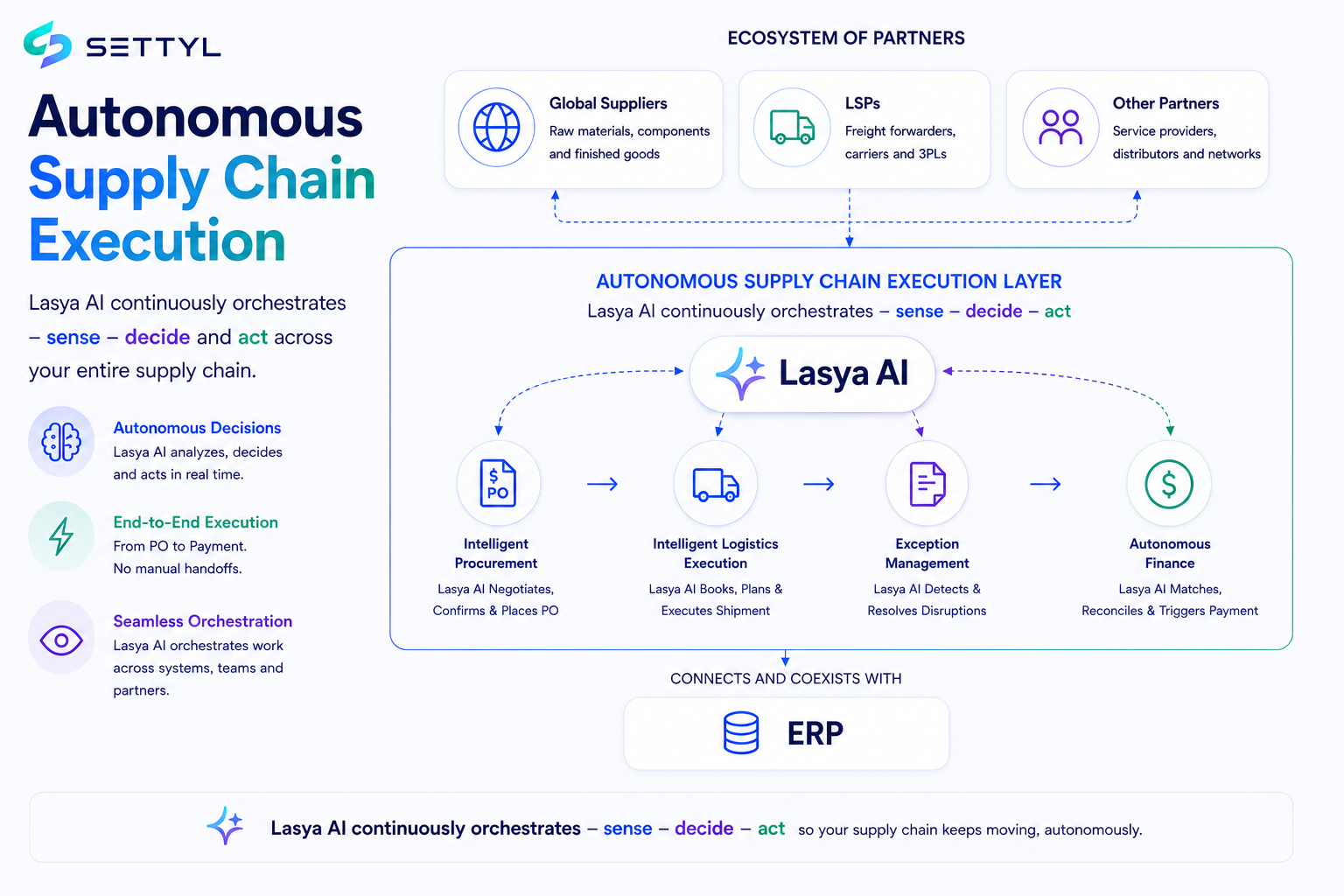
That is the role of a System of Execution. ERP remains the System of Record. The execution layer carries the work between records, systems, partners, and channels until the transaction reaches a verified outcome.
Autonomy therefore should not be measured only by how many agent actions were completed. The more important question is how much of the transaction journey completed without manual relay.
WHY IT MATTERS
Without a shared transaction state, enterprises can deploy more AI agents while preserving the same human coordination burden between them.
KEY TAKEAWAY
Agents are components of autonomy. The transaction is the unit that must remain coherent from intent to verified outcome.
From fragmented work to verified execution
Lasya AI is the System of Execution for supply chains. ERP remains the System of Record; Lasya carries transaction work across systems, partners, channels and exceptions to a verified outcome.