

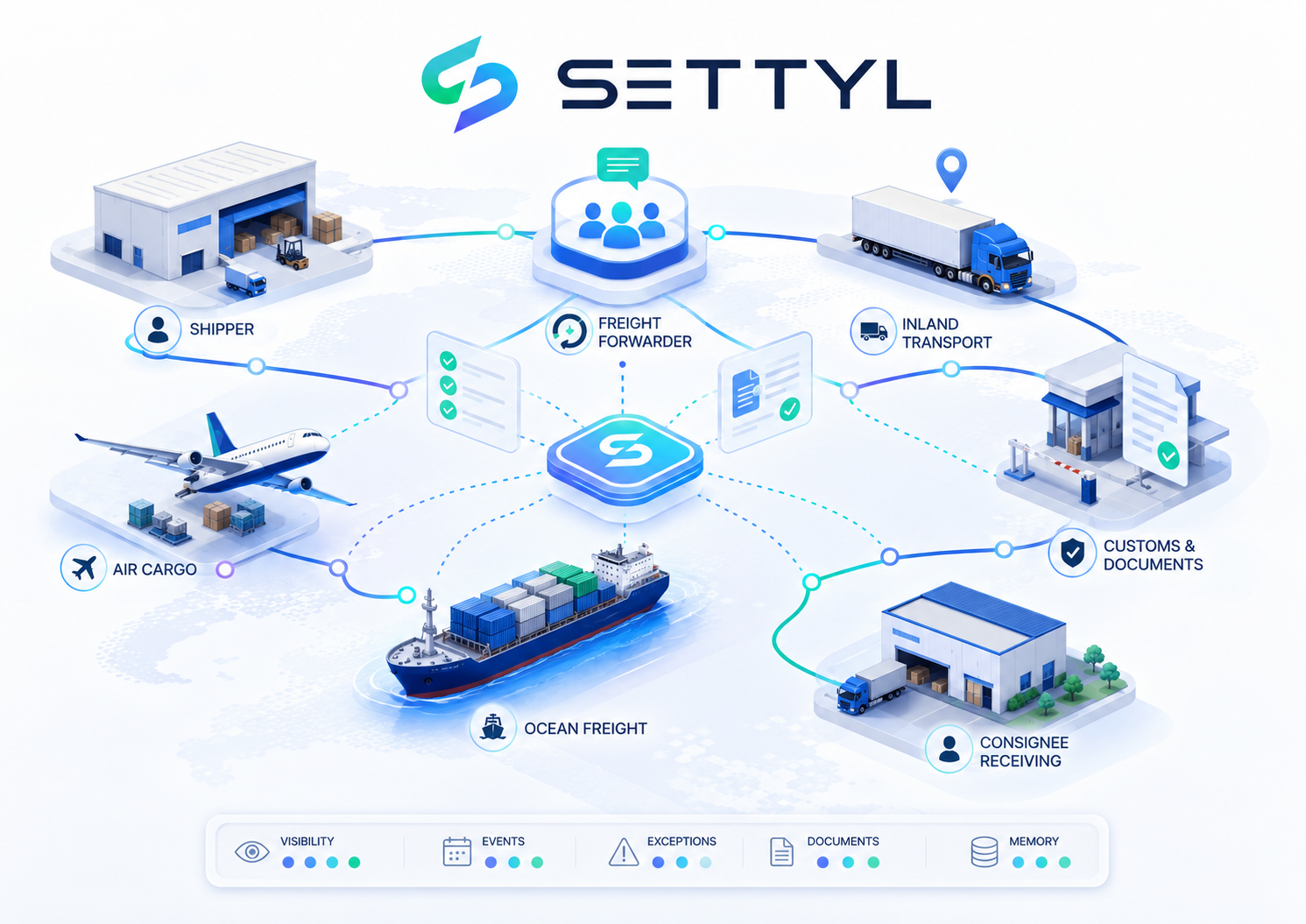
Logistics Chain Management: A Multi-Enterprise Guide
Logistics chain management looks simple on a process diagram.
Goods leave a supplier, move through one or more transport networks, clear customs when required and reach the receiving location.
In practice, the journey is a relay race between organizations that rarely share the same system.
A single shipment may involve a shipper, supplier, freight forwarder, road carrier, ocean or air carrier, customs broker, warehouse operator, consignee and finance team.
Each participant works with its own portal, documents, processes and version of the truth.
The functions of logistics are well understood.
The harder problem is coordinating those functions across company boundaries.
Logistics does not usually break because an organization cannot create a shipment. It breaks because the next organization does not receive the right information, document or decision at the right time.
That is why logistics is one of the clearest examples of multi-enterprise execution -the handoff between freight booking and customs clearance
Internal optimization cannot prevent disruption when the next handoff still depends on an email, phone call, spreadsheet or disconnected portal.
This guide explains what logistics chain management covers, who participates in it and why coordinating execution across enterprises matters more than optimizing any single logistics function.
What Logistics Chain Management Covers
Logistics chain management is the planning, coordination and execution of the physical movement of goods, together with the information, documents, approvals and financial activities required to complete that movement.
It begins before transportation is booked and continues after delivery.
A typical logistics transaction may follow this sequence:
Shipment requirement → carrier selection → booking → pickup → transportation → customs processing → delivery → proof of delivery → freight audit → settlement
Every stage creates more than a status update.
It can also create:
- A document
- A commercial commitment
- An approval
- An exception
- A partner response
- A financial obligation
- An ERP update
This is why logistics chain management cannot be reduced to transportation alone.
The core functions of logistics management
These functions are closely connected.
A supplier-readiness delay affects the booking. A missed booking affects the delivery date. A document error can stop customs clearance. A delivery discrepancy can block invoice approval.
Logistics chain management is therefore not a series of independent tasks.
It is one transaction moving across several functions and organizations.
Logistics Management vs Supply Chain Management
Logistics management and supply chain management are related, but they are not the same.
Supply chain management covers the broader flow of materials, information and money across sourcing, procurement, production, inventory, logistics and fulfilment.
Logistics management focuses more specifically on the storage, movement, tracking, delivery and settlement of goods.
The distinction is useful, but the two cannot operate independently.
A purchase order creates a future logistics requirement. A supplier delay changes the pickup plan. A shipment exception may affect production. A rejected delivery can delay payment.
Logistics is not a downstream process that starts after procurement finishes.
It is one stage in a transaction that moves through sourcing, procurement, transportation, receiving, finance and ERP update.
The Key Functions of Logistics Management
1. Planning and shipment readiness
Logistics execution begins with understanding what must move, from where, to where and by when.
The organization must confirm:
- Material availability
- Cargo-ready date
- Quantity, weight and dimensions
- Origin and destination
- Delivery priority
- Required transport mode
- Vehicle or container requirements
- Documentation requirements
Poor readiness information creates downstream problems.
A booking may be made before the goods are packed. The wrong vehicle may be allocated because dimensions changed. A delivery may be planned without considering a customer appointment or port cut-off.
The objective is not merely to collect a dispatch date.
It is to confirm that the goods, documents and operating conditions are all ready for execution.
2. Freight sourcing and carrier selection
Once the requirement is clear, the shipper must identify the right carrier, forwarder or logistics provider.
The decision may consider:
- Contracted rates
- Capacity availability
- Lane coverage
- Transit time
- Historical performance
- Equipment capability
- Compliance status
- Expected accessorial charges
- Service reliability
For repeat lanes, the shipment may be allocated against an existing rate contract.
For new or volatile lanes, the shipper may conduct a freight RFQ or auction.
The award must remain connected to subsequent execution.
Otherwise, the agreed rate stays in a sourcing tool or spreadsheet, while logistics books transportation using a different assumption and finance later receives an invoice with no reliable record of what was originally agreed.
3. Booking and transport execution
Booking converts a logistics plan into an operating commitment.
The selected carrier or forwarder confirms:
- Capacity
- Equipment
- Pickup date
- Reporting time
- Route
- Schedule
- Origin and destination details
- Delivery commitment
For international transportation, the booking may also include sailing or flight details, container requirements, transshipment points and cut-off dates.
The booking should remain linked to the shipment requirement, carrier award, rate terms and delivery objective.
Without that connection, procurement, logistics and finance may each work from a different version of the same transaction.
4. Documentation and EXIM compliance
Every shipment creates documents.
Depending on the transport mode and geography, these may include:
- Commercial invoice
- Packing list
- Delivery challan
- Bill of lading
- Air waybill
- Road consignment note
- Certificate of origin
- Insurance certificate
- Customs declaration
- Import or export permits
- Proof of delivery
The challenge is not just generating documents.
It is ensuring that:
- The correct version is used
- Mandatory fields are complete
- Data is consistent across documents
- Documents are submitted before deadlines
- The right partner receives them
- Corrections are reflected everywhere
A shipment may be physically ready but operationally blocked because a document is missing, inconsistent or awaiting approval.
This becomes even more important in international logistics, where a documentation error can affect customs clearance, storage charges, detention, delivery schedules and finance.
5. Multimodal tracking and exception management
Multimodal logistics involves moving goods through more than one transport mode.
A shipment might move:
Supplier by road → origin port → ocean carrier → destination port → rail or road → consignee
Every transition creates another handoff.
The same shipment may be identified by a purchase order, shipment number, container number, booking reference, bill of lading and delivery record.
Tracking one identifier or mode does not mean the entire journey is being managed.
Visibility shows what has happened. Execution determines what must happen next.
A vessel delay, for example, should not remain a status update on a dashboard.
The organization may need to:
- Identify affected orders and materials.
- Recalculate the delivery impact.
- Request alternatives from the forwarder.
- Route the decision for approval.
- Notify internal and external parties.
- Update delivery dates and connected systems.
That is the difference between shipment visibility and logistics execution.
The same principle applies to other exceptions:
- Vehicle not reported
- Cargo not ready
- Booking rejected
- Port cut-off missed
- Customs query raised
- Document mismatch
- Shipment damaged
- Delivery refused
- Proof of delivery missing
- Freight invoice disputed
Most shipments do not require constant intervention.
The exceptions do.
6. Delivery validation, freight audit and settlement
Delivery does not automatically complete the logistics transaction.
The organization must confirm:
- What was delivered
- When it was delivered
- Who accepted it
- Whether quantities matched
- Whether damage or shortages were recorded
- Whether contractual service levels were met
The carrier invoice must then be checked against the commercial and operational record.
That may include:
- Contracted rate
- Freight award
- Shipment booking
- Actual weight or volume
- Route
- Delivery evidence
- Detention records
- Fuel surcharges
- Accessorial approvals
- Taxes and adjustments
When these records are distributed across systems, inboxes and documents, finance must reconstruct the transaction manually.
Finance asks logistics for evidence.
Logistics contacts the carrier.
The carrier sends documents.
Another approval is requested.
This is not simply an invoice-processing issue.
It is the final cross-functional handoff in the logistics chain.
The Players in the Logistics Chain
Logistics is inherently multi-enterprise because no single organization controls every stage.
The shipper
The shipper initiates or controls the movement.
It defines what must move, the origin, destination, delivery requirement, commercial terms and preferred logistics partners.
However, it usually relies on external organizations to execute the movement.
The freight forwarder
The freight forwarder coordinates transportation on behalf of the shipper.
It may arrange capacity, manage multiple transport modes, prepare documents, coordinate customs activities and resolve exceptions.
A forwarder may orchestrate several carriers without physically operating the transportation assets.
The carrier
The carrier physically transports the goods.
A single journey may involve several carriers:
- First-mile road carrier
- Rail operator
- Ocean carrier
- Airline
- Destination road carrier
- Last-mile delivery partner
Each carrier may use different systems and provide different levels of information.
The customs broker
The customs broker supports customs declarations, classification, documentation and border-compliance processes.
It depends on information from the shipper, supplier, forwarder, carrier and finance team.
A missing or inconsistent document from one party can delay the entire transaction.
The consignee
The consignee receives the goods.
Its actions affect unloading, quantity acceptance, damage reporting, proof of delivery, returns and payment eligibility.
A carrier may report that a shipment was delivered while the consignee records a shortage or rejection.
Both events belong to the same transaction.
Other participants
Ports, terminals, warehouses, insurers, banks and finance teams may also influence the shipment.
Their involvement reinforces one fact:
End-to-end logistics execution cannot be managed entirely within one company’s systems.
Why Logistics Is Inherently a Multi-Enterprise Problem
Most logistics systems are designed from the perspective of one enterprise.
They manage that organization’s shipments, orders, rates, partners and documents.
But the physical transaction crosses company boundaries.
It moves through:
- Different legal entities
- Different systems
- Different data formats
- Different operating processes
- Different commercial incentives
- Different levels of digital maturity
One carrier may provide an API.
Another may work through a portal.
A freight forwarder may use email.
A customs broker may send spreadsheets and documents.
A receiving facility may update the ERP only after physical inspection.
The problem is not that these organizations have no software.
The problem is that their software does not execute the transaction together.
Traditional collaboration models often attempt to solve this by asking every partner to use another portal.
That can work for some large networks and high-volume partners.
But many suppliers, carriers, brokers and forwarders continue to work through email, EDI, spreadsheets, messaging applications and their own systems.
Multi-enterprise logistics cannot depend on every participant adopting the same interface.
It must coordinate execution across the channels partners already use.
Where Coordination Breaks Across Organizations
Procurement to logistics
Procurement selects a supplier or awards a carrier, but logistics does not receive the complete commercial and operating context.
The price may be available, while capacity assumptions, lead times, service commitments or exceptions remain buried in an attachment or email.
The transaction loses context before execution begins.
Supplier to shipper
The supplier confirms that goods are ready, but the confirmation may not include packing status, document readiness, actual quantity or pickup constraints.
Transportation is booked against incomplete information.
Shipper or forwarder to carrier
The booking request may omit cargo restrictions, loading requirements or delivery conditions.
The carrier confirms capacity based on one version of the requirement and later rejects, delays or reprices the movement.
Forwarder to customs broker
The broker receives incomplete or inconsistent documents.
It requests corrections over email while the shipment approaches a filing, vessel or port deadline.
The risk is visible to one participant but not to everyone affected.
Logistics to finance and ERP
Finance receives an invoice without the complete execution history.
The physical movement may also have changed without the system of record being updated.
The ERP may continue showing an outdated delivery date, incomplete receipt, unresolved invoice or incorrect accrual.
The ERP is not necessarily failing.
It is recording the information it has received.
The failure sits in the fragmented execution layer around it.
Why Visibility Alone Is Not Enough
Real-time shipment tracking is valuable.
It can show locations, milestones and revised arrival estimates.
But visibility answers only one question:
What changed?
Execution must answer several more:
- What is affected?
- Who must respond?
- Which document is missing?
- What decision is required?
- What alternatives are available?
- Who can approve the change?
- Which partners must be notified?
- What must be updated in the ERP?
- Has the exception been fully resolved?
A notification that a container missed its planned vessel does not resolve the problem.
Someone still has to identify the affected orders, assess the delivery impact, obtain alternatives, approve the additional cost, communicate the decision and update the connected systems.
A visibility tool detects the event.
A system of execution closes the loop.
What Autonomous Multi-Enterprise Execution Looks Like
Autonomous logistics does not mean removing people from every decision.
It means removing the manual relay work required to move information between partners, teams and systems.
An autonomous execution layer should coordinate five stages.
1. Understand the requirement
The system interprets the purchase order, shipment request, supplier confirmation or ERP event.
It identifies the cargo, route, required date, transport mode, commercial terms and documentation requirements.
2. Coordinate readiness and capacity
The system confirms material readiness, packing status, quantity, weight, dimensions, pickup timing and required documents.
It then applies contracted allocations or runs a freight-sourcing process to identify the appropriate partner.
3. Validate bookings and documents
The carrier or forwarder response is captured through the available channel.
Booking details and documents are checked against the shipment requirement and commercial decision.
Missing or inconsistent information is requested before it becomes a delay.
4. Monitor and resolve exceptions
Tracking events are connected to the relevant order, material, partner, commitment and delivery requirement.
When an exception occurs, the system gathers context, contacts the responsible party, recommends alternatives, routes approvals and communicates the decision.
Humans remain responsible for decisions involving material cost, risk or policy exceptions.
The manual coordination around those decisions is reduced.
5. Validate delivery, charges and ERP updates
Proof of delivery, receipt information, contracted rates, execution events and carrier invoices are brought together.
Valid charges can move forward.
Discrepancies become structured exceptions.
The ERP is updated after the execution outcome has been validated.
How Settyl Creates Cross-Enterprise Execution Continuity
Settyl does not position Lasya AI as another isolated transport application placed beside the ERP, visibility provider, procurement platform and finance system.
It replaces the fragmented execution layer around them.
Settyl natively connects:
- Sourcing
- Procurement
- Domestic logistics
- Multimodal transportation
- EXIM operations
- Real-time tracking
- Document validation
- Delivery confirmation
- Freight reconciliation
- Finance operations
- ERP updates
This matters because a logistics transaction rarely begins and ends within logistics.
It may begin with a sourcing decision, become a purchase order, trigger a shipment, generate EXIM documents, create delivery evidence and conclude with an invoice and ERP update.
When every stage is managed by a disconnected application, people must manually carry the context between systems.
Lasya AI owns the transaction from request to resolution.
The ERP remains the system of record.
Lasya AI runs the cross-enterprise work required to keep that record accurate.
Operational Memory: The Foundation for Logistics Autonomy
Automation completes a task.
Operational memory preserves why the task occurred, what affected it and how it connects to the broader transaction.
For each logistics movement, Lasya AI can preserve relationships across:
- Orders and shipment requirements
- Suppliers and consignees
- Carrier and forwarder responses
- Rates and commercial commitments
- Booking decisions
- Documents and document versions
- Tracking milestones
- Exceptions
- Partner communications
- Approvals
- Delivery evidence
- Invoice discrepancies
- ERP updates
This creates a compounding execution history.
When a similar issue occurs again, the system does not begin without context.
It can understand:
- Which carriers previously accepted or rejected the lane
- What caused earlier delays
- Which documents were repeatedly missing
- How similar exceptions were resolved
- What approvals were required
- Which charges were disputed
- Whether delivery commitments were met
Without operational memory, AI responds to the current message.
With operational memory, it understands the transaction.
Traditional Logistics vs Autonomous Multi-Enterprise Execution
The Future of Logistics Chain Management
The future of logistics chain management is not another dashboard.
Enterprises already have systems for transportation, procurement, tracking, documentation and finance.
The unresolved problem is the space between those systems.
That is where:
- A supplier confirmation becomes a booking
- A freight award becomes a carrier commitment
- A tracking event becomes an operational decision
- A customs query becomes a document correction
- A delivery exception becomes a financial adjustment
- A completed movement becomes an accurate ERP record
Today, people bridge these gaps manually.
They copy information, chase responses, interpret documents, reconcile conflicting statuses and remind the next participant to act.
Autonomous multi-enterprise execution changes that operating model.
It does not require every partner to adopt the same portal.
It does not replace the ERP.
It coordinates the work across existing systems and partner channels while preserving the context behind every decision, document, exception and update.
The ERP keeps the record. Lasya AI runs the work required to make that record accurate.
Frequently Asked Questions
What is logistics chain management?
Logistics chain management is the planning, coordination and execution of transportation, documentation, tracking, customs, delivery and freight-settlement activities required to move goods from origin to destination.
What are the key functions of logistics management?
The key functions include shipment planning, freight sourcing, carrier selection, booking, transport execution, document management, tracking, exception resolution, delivery confirmation, freight audit and settlement.
What is multi-enterprise logistics?
Multi-enterprise logistics is the coordination of activities across independent organizations such as shippers, suppliers, freight forwarders, carriers, customs brokers, warehouses and consignees.
How do shippers and carriers coordinate?
Shippers and carriers coordinate through transport platforms, portals, APIs, EDI, email, messaging, phone calls and spreadsheets.
An execution layer can connect these channels and preserve the responses within the shipment record.
What is the difference between logistics and supply chain management?
Supply chain management covers sourcing, production, inventory, logistics and fulfilment.
Logistics management focuses more specifically on the storage, movement, tracking, delivery and settlement of goods.
What is multimodal logistics?
Multimodal logistics is the movement of goods using more than one transportation mode, such as road, rail, ocean or air.
It requires coordination across multiple carriers, documents and transfer points.
Why do logistics handoffs fail?
Logistics handoffs fail when organizations use different systems, documents, identifiers and communication channels.
Information may arrive late, lose context or conflict with another participant’s records.
Does autonomous logistics replace the ERP?
No.
The ERP remains the system of record. An autonomous execution layer coordinates work across systems and partners, validates outcomes and updates the ERP with accurate information.
How is autonomous execution different from shipment visibility?
Shipment visibility shows milestones, location and estimated arrival.
Autonomous execution determines what is affected, coordinates the response, obtains approvals, communicates with partners and updates connected systems.
What is operational memory in logistics?
Operational memory is the preserved context across shipment requirements, communications, documents, milestones, exceptions, approvals, delivery evidence, invoices and ERP updates.
Related Guides
Why AI in One Function Won’t Fix Your Supply Chain
Learn why isolated AI tools create faster functional silos without solving the handoffs between procurement, logistics, EXIM, finance, and ERP workflows.
System of Execution for Supply Chains: Architecture, Components & How It Works
Explore how specialised AI agents, workflow orchestration, ERP connectivity, execution memory, and multi-enterprise coordination come together in one execution layer.
Supply Chain Trends 2026: The Shift From Visibility to Execution Memory
Understand why supply chain technology is moving beyond dashboards and alerts toward systems that can act, remember, and improve.
Bring last month's exceptions.
Leave with the ROI model.
30-minute working session for the CFO and Controller. We'll run your real exception backlog through Lasya, project the working-capital release, and walk through the audit-trail evidence your InfoSec team will request.