
Multi-Enterprise Transaction Execution: From Purchase Intent to Financial Closure

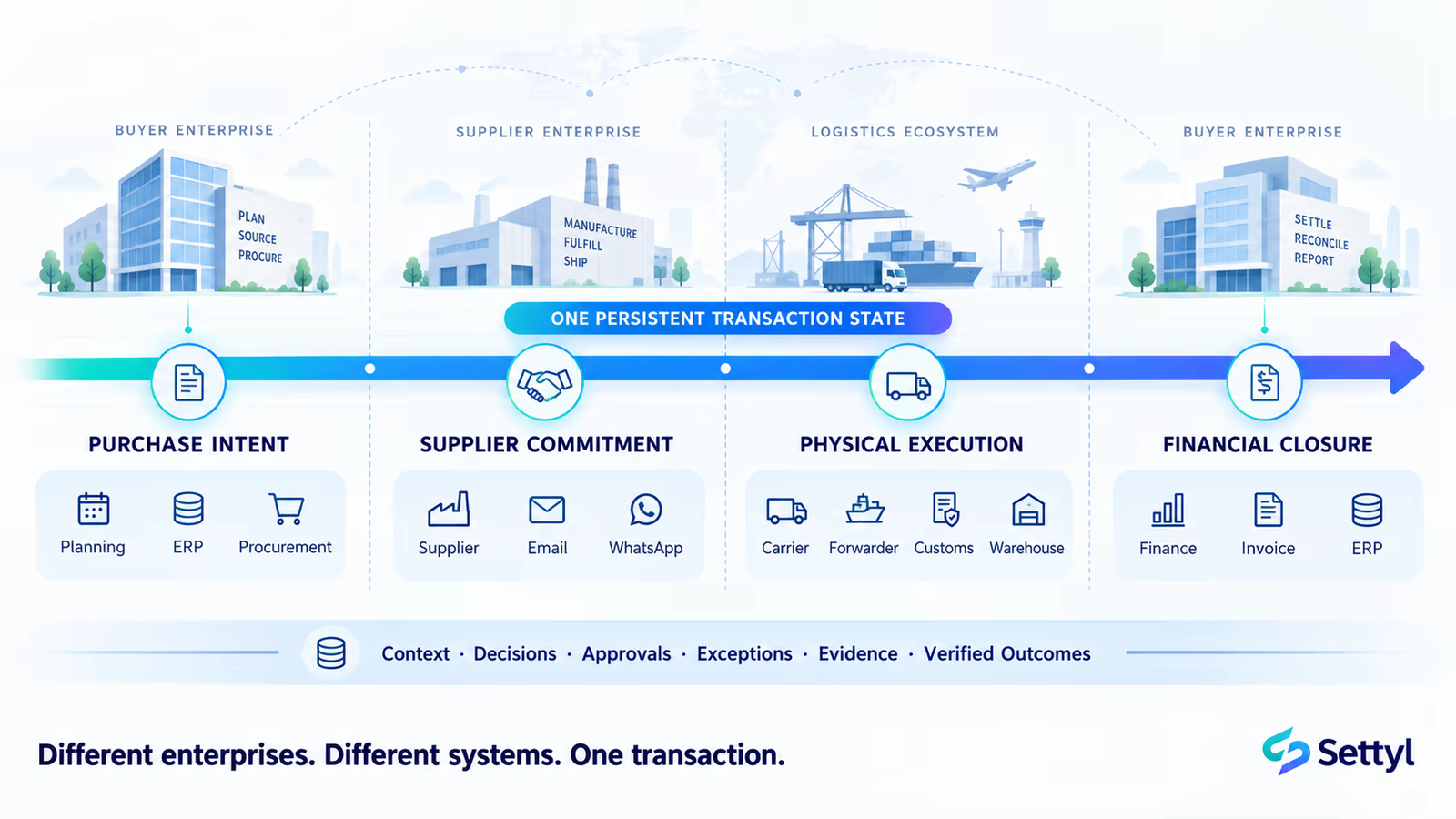
A supply-chain transaction rarely belongs to one application or one company.
A purchase requirement may begin in planning. Procurement turns it into an RFQ and purchase order. A supplier confirms what can actually be delivered. Logistics books capacity and moves the goods. A forwarder and customs broker manage documents and release. A warehouse records receipt. Finance validates the invoice and posts the final outcome to ERP.
Each participant may do its own job correctly. The transaction can still fail between them.
That is the central execution problem: the business outcome depends on one continuous transaction, but the work is distributed across enterprise systems, specialist tools, documents, email, WhatsApp, EDI, portals, spreadsheets and calls.
Operational Fragmentation is the condition created when no system continuously owns that work. People preserve the context, chase the next response, interpret changes, reconcile conflicting states and decide what should happen next.
Multi-Enterprise Transaction Execution is the practical model for carrying one transaction across those boundaries—from business intent to verified outcome—without requiring every participant to use one shared application.
The transaction is bigger than the purchase order
ERP is indispensable because it preserves authoritative records: material masters, suppliers, purchase orders, receipts, invoices, financial postings and audit history.
But an authoritative record is not the same as an executed outcome.
A purchase order can exist while the supplier has not confirmed the quantity or promise date. A shipment record can exist while the goods are not ready for pickup. A carrier milestone can show delivery while proof of delivery is missing. An invoice can pass a field-level match while the commercial reason for a freight charge remains unresolved.
The System of Record vs. System of Execution distinction makes the boundary clear:
The transaction therefore should not be defined by a single document. It should be defined by its progression through verified execution states.
Four states in one continuous lifecycle
1. Purchase intent
The transaction begins with a business requirement: a material shortage, a replenishment signal, a production requirement, a customer order, or another approved need.
Intent is more than an item and quantity. It can include target date, plant, quality requirements, commercial policy, approved supplier rules, delivery constraints and downstream urgency.
If this context is lost when sourcing begins, the first execution boundary has already failed.
2. Verified supplier commitment
Procurement executes supplier discovery, RFQ, comparison, negotiation, approval and PO creation. But procurement is not complete merely because ERP generated a PO number.
The operational output is a verified supplier commitment:
This is why Autonomous Sourcing & Procurement should be measured from purchase intent to supplier commitment—not only from requisition to PO creation.
3. Verified physical execution
Logistics should receive the supplier commitment as an execution state, not reconstruct it from a PO attachment and a buyer's email.
The physical transaction then progresses through readiness, capacity allocation, booking, dispatch, movement, customs, warehouse receipt and delivery evidence.
Its state includes more than location
Autonomous Freight & Logistics is therefore not a visibility problem alone. Visibility explains what happened. Execution determines what happens next and carries the corrective action to completion.
4. Verified financial closure
Finance should inherit the evidence created during procurement and physical execution.
An invoice cannot always be understood from the PO, receipt and invoice alone. Freight and ancillary charges may depend on route changes, detention, loading or unloading events, proof of delivery, approved exceptions, rate cards and commercial tolerances.
The financial state is complete when the relevant evidence has been assembled, mismatches have been resolved, approvals have been captured, the correct posting has reached ERP and the intended settlement outcome has been verified.
Autonomous Finance Operations closes the loop by carrying execution truth into matching, audit, posting, settlement and cash visibility.
Why the handoffs fail
The transaction usually breaks at three seams.
Sourcing to procurement
A sourcing event produces a commercial decision, but the reasoning behind the award may collapse into a few PO fields. Negotiated terms, supplier alternatives, approval conditions and expected commitments become difficult to recover when the supplier responds differently from the plan.
Procurement to logistics
The PO describes what was ordered. Logistics needs to know what the supplier will actually make available, when it will be ready, how it can be collected and what changed after the order was issued.
When procurement and logistics do not share the same transaction state, planners and buyers relay the difference manually.
Logistics to finance
Finance receives invoices after operational decisions have already been made. If route changes, detention, shortages, claims, delivery evidence and approvals are held in other systems or inboxes, finance must ask operations to reconstruct the transaction.
The cost is not simply slower data entry. It is delayed closure, weak accruals, avoidable disputes and repeated operational effort.
Multi-enterprise execution does not require one shared portal
The participants in a supply chain will continue using different technology.
A supplier may respond by email. A carrier may expose an API. A forwarder may send documents and WhatsApp updates. A broker may work through a customs portal. A warehouse may use a WMS. Finance and procurement may rely on ERP.
The objective is not to force every organization onto one interface. The objective is to maintain one governed transaction state while work continues through those channels.
That is the adoption principle behind Multi-Enterprise Execution: shared execution without requiring shared software.
What a System of Execution must preserve
To carry a transaction across boundaries, the execution layer needs more than integrations and agents.
It must preserve:
The technical architecture behind these capabilities is explained in System of Execution for Supply Chains.
The exception is where transaction ownership becomes visible
Happy-path automation can make several independent systems appear connected. The real test comes when reality changes.
Suppose a supplier can deliver only part of the quantity on the promised date.
That one signal may require the transaction to:
If a person must discover and coordinate every one of those actions, the applications may be automated but the transaction is not.
Autonomy is proven when the execution model can preserve the objective, coordinate the permitted recovery, use human authority only where required and verify that the intended outcome has been restored.
From execution history to Operational Memory
Every completed transaction contains knowledge that ERP records alone do not fully preserve:
When this governed history is retained as Operational Memory, the next transaction can begin with more relevant context.
This is not chat history. It is structured evidence from decisions, actions, approvals, exceptions and verified outcomes.
How to measure transaction execution
Feature adoption and agent counts do not prove autonomous execution. Measure what happens to the transaction.
Useful measures include:
The last measure is the Autonomy Rate: the share of eligible work that reaches a verified outcome within policy without requiring a person to carry state between systems or enterprises.
Where Lasya AI fits
Lasya AI is Settyl's System of Execution for supply chains.
It carries one transaction across sourcing, procurement, freight, EXIM and finance while ERP remains the System of Record. Specialized agents execute domain work against the same transaction state. Suppliers, carriers, forwarders and brokers can continue through the channels they already use.
The product boundary is deliberate:
For a direct comparison with ERP, procurement suites, TMS, control towers and standalone agents, see System of Execution Comparison.
Start with one transaction
Do not begin with an enterprise-wide promise to make the entire supply chain autonomous.
Choose one transaction with visible coordination cost:
Map the transaction from intent to verified outcome. Count the manual relays, duplicated states, waiting periods and exception loops. Then measure whether a System of Execution can carry more of that journey without human coordination.
The goal is not to automate every step at once. It is to establish continuous transaction ownership and expand from verified evidence.
Frequently asked questions
What is Multi-Enterprise Transaction Execution?
Multi-Enterprise Transaction Execution is the continuous execution of a business transaction across independent companies, functions, systems and communication channels while preserving state, context, ownership, policy and evidence until the intended outcome is verified.
Is Multi-Enterprise Transaction Execution a new Settyl category?
No. Settyl's category is the System of Execution for supply chains. Multi-Enterprise Execution is the framework, and transaction execution is the practical unit through which that framework produces Autonomous Supply Chain Execution.
Does this replace ERP?
No. ERP remains the System of Record for master data, approved transactions, financial records and auditability. The System of Execution carries the work between authoritative records and writes verified outcomes back.
Do suppliers and carriers need to adopt a new portal?
No. Participants can continue through email, WhatsApp, EDI, APIs, documents, existing portals and other appropriate channels while the execution layer maintains the transaction state.
How is this different from workflow automation?
A conventional workflow usually automates a predefined sequence inside a process or application. Multi-enterprise transaction execution preserves the objective and coordinates changing actions across systems and organizations, including governed exception recovery, until the outcome is verified.
What should a company implement first?
Start with one high-volume or exception-heavy transaction whose completion currently depends on manual follow-up, re-entry, reconciliation or cross-enterprise coordination. Establish a baseline for cycle time, touches and exception recovery before expanding.
What is the business outcome?
The outcome is a larger share of eligible supply-chain work reaching verified completion with less human relay—what Settyl defines as Autonomous Supply Chain Execution.
Related reading
CTA: Start with one procurement, freight, EXIM or finance transaction that still depends on human relay. Explore Lasya AI.
Bring last month's exceptions.
Leave with the ROI model.
30-minute working session for the CFO and Controller. We'll run your real exception backlog through Lasya, project the working-capital release, and walk through the audit-trail evidence your InfoSec team will request.