
Why Coordination Is the Hidden Engine of Supply Chain Success

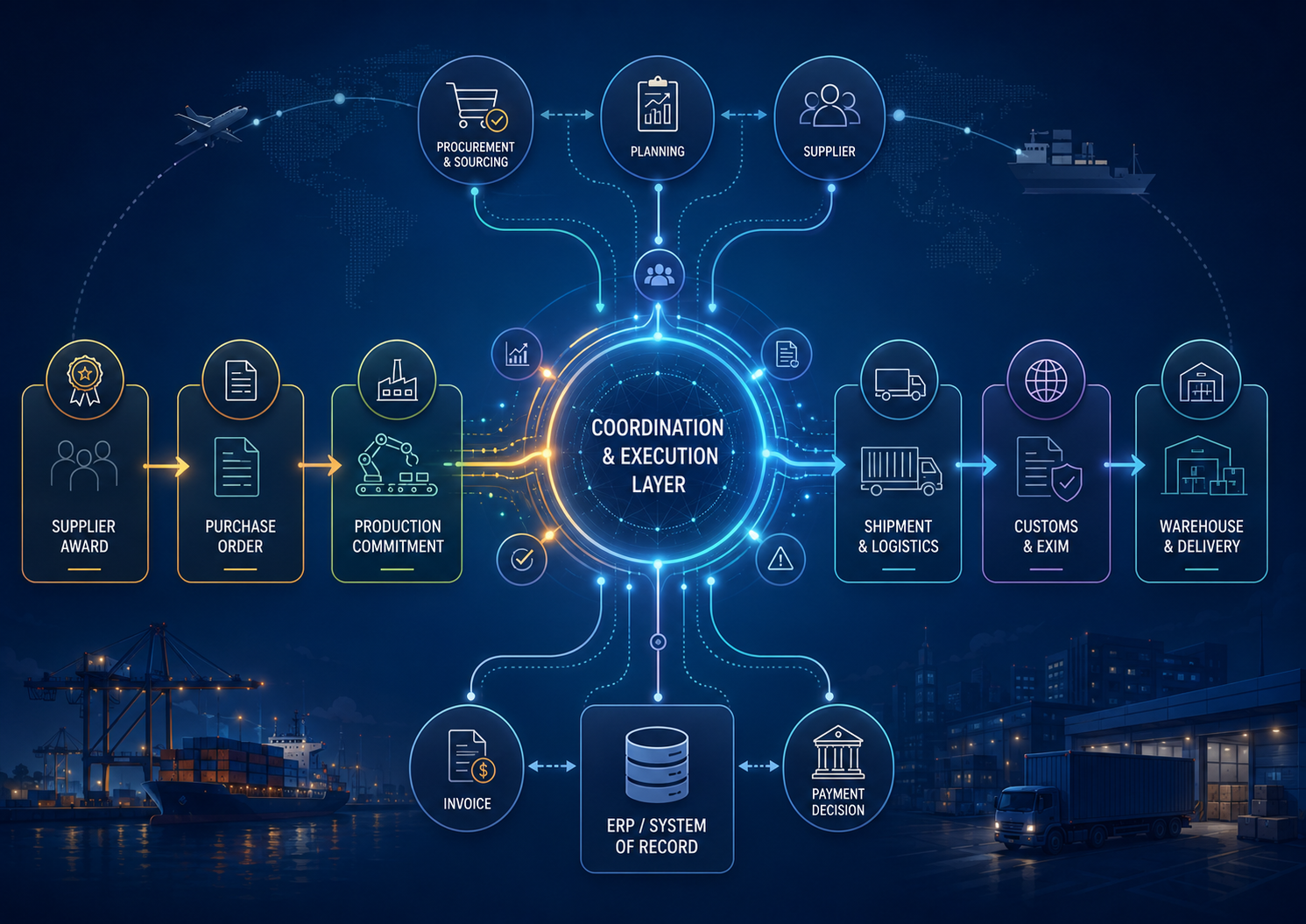
Why Coordination Is the Hidden Engine of Supply Chain Success
Ask ten supply chain leaders where performance comes from, and you will probably hear ten different answers.
You'll hear ten functions: sourcing, planning, logistics, finance. Each is right, and each is incomplete. Because the thing that actually decides whether your supply chain is fast or slow isn't any single function — it's the supply chain coordination between them. The handoffs. The seams. The places where one team's output becomes another team's manual data-entry.
You can have world-class procurement and still run a sluggish supply chain, because excellence inside a box does nothing for the work that happens between the boxes. This is the hidden engine — and almost no software is built to run it.
A supplier award becomes a purchase order. A purchase order becomes a production commitment. A production commitment becomes a shipment. A shipment becomes a customs filing. A delivery becomes an invoice. And an invoice becomes a payment decision.
Supply chain performance is created across that chain—not inside one isolated box.
You can have world-class procurement and still run a slow supply chain. You can have excellent shipment visibility and still resolve delays manually. You can automate invoices and still spend days establishing why a charge changed.
The software inside each function may work perfectly. The operation can still fail between them.
That is why coordination is the hidden engine of supply chain success.
Explore how specialised AI agents, workflow orchestration, ERP connectivity, execution memory, and multi-enterprise coordination come together in one execution layer - AI in Supply Chain
The Function Everyone Optimises—and the Seam Everyone Ignores
Most supply chain software is organised around individual functions.
Each system is designed to make its function faster, more accurate, or easier to control.
But very few systems own what happens when work leaves one function and enters another.
A sourcing platform can complete an award. But who ensures that the agreed commercial terms, delivery conditions, supplier commitments, documentation requirements, and logistics assumptions move correctly into the purchase order and shipment workflow?
A transportation platform can book a shipment. But who carries the context of a supplier delay into production planning, customer commitments, customs documentation, and finance?
An invoice platform can identify a mismatch. But who determines whether that mismatch came from an approved freight exception, a quantity shortfall, a route diversion, a customs charge, or a contract amendment?
That work usually falls to people.
They copy data, interpret emails, reconcile systems, identify the next owner, and explain why a transaction changed.
In practice, people become the coordination layer between applications.
The faster each function becomes, the more visible the coordination bottleneck becomes.
The bottleneck was not always the work inside the function.
It was the transition out of it.
Where Value Actually Leaks: The Handoffs Between Teams
Supply chain value does not usually disappear through one dramatic failure.
It leaks through thousands of small handoffs.
A contract is signed in procurement, but key terms are manually re-entered into another system. A supplier changes a committed date, but logistics learns about it through an email forwarded two days later. A carrier raises an invoice using a charge that finance cannot connect to the original operational exception.
A customs hold appears in one portal, while the recovery process happens through email, phone calls, and spreadsheets. A proof of delivery is uploaded, but the invoice remains blocked because no system connects the document to the finance workflow.
None of these events may appear as a major failure on a dashboard.
Instead, they appear as:
The cost is difficult to isolate because it is distributed across the operation.
It appears as ten minutes here, two emails there, another status call, another reconciliation, and another exception waiting for someone who understands the context.
Individually, these activities look small.
At scale, they become the operating cost of fragmentation.
Why Best-in-Class Procurement Can Still Produce a Slow Supply Chain
Procurement can run an excellent sourcing event. It can identify the right supplier, negotiate a competitive price, complete approvals, and issue the purchase order quickly.
But the purchase order does not end at procurement.
It becomes:
Each stage may belong to a different team, system, or external partner.
Optimising procurement alone therefore creates only local speed.
It may produce a faster on-ramp to a congested highway.
The same is true in every function.
A logistics team can predict a delay earlier, but that does not guarantee that procurement, production, finance, EXIM, and the customer response will be coordinated.
Finance can process invoices faster, but that does not help when the operational reason for a mismatch is trapped inside a logistics email.
Planning can produce a better forecast, but the benefit disappears if supplier commitments and shipment realities are not carried into execution.
Supply chain efficiency is not the sum of several isolated functional improvements.
It is a property of the complete workflow.
A Supplier Delay Is Never Just a Procurement Problem
Consider a supplier that informs procurement that an important material will be delayed by five days.
Procurement records the new commitment and informs the buyer. But the real operational impact extends much further.
When these functions use separate systems, someone must carry the context between them.
That person may need to:
- Read the supplier’s email.
- Find the affected purchase order.
- Contact logistics.
- Check material availability.
- Request an alternate freight option.
- Calculate the additional cost.
- Obtain approval.
- Update affected stakeholders.
- Revise relevant documents.
- Record the final outcome in ERP.
The supplier delay may have been detected digitally.
The response was still coordinated manually.
Knowing that something happened is different from ensuring that every affected party and system responds correctly.
This is why visibility alone does not create execution.
Coordination Is a Capability, Not a Meeting
Most enterprises still solve coordination through people.
A status call. A control-tower meeting. A shared spreadsheet. An email escalation. A war room. Or a highly experienced operator who knows whom to call and how to push the issue forward.
These mechanisms can work.
But they do not scale well.
They depend on individual memory, availability, experience, and relationships. When that person is absent, context disappears. When the same exception happens again, the response may begin from zero.
This is coordination as a meeting.
The shift is toward coordination as an operational capability.
Software should be able to:
Coordination should not depend on a human relaying information from one system to another.
It should be built into the execution architecture.
Integration and Coordination Are Not the Same Thing
Many organisations respond to fragmentation by adding integrations.
Integration is necessary.
But it is not sufficient.
An integration can move a status from one system to another. It does not necessarily understand:
- Why the status changed
- Which workflows are affected
- What policy applies
- Who must approve the response
- Which external partner should be contacted
- Whether the issue can be resolved automatically
- What outcome must be written back to ERP
- What operational context should be remembered
The distinction is important:
Integration connects data. Coordination connects decisions and actions.
A supply chain can have several well-integrated systems and still depend heavily on email, spreadsheets, calls, and manual exception management.
That is because data connectivity does not automatically create execution ownership.
A system of execution must not only know that information changed.
It must understand what should happen next.
Coordination Must Extend Beyond the Enterprise
Supply chains do not operate within one company.
They operate across networks of:
- Suppliers
- Contract manufacturers
- Carriers
- Freight forwarders
- Customs brokers
- Ports
- Warehouses
- Distributors
- Customers
- Financial institutions
This makes coordination a multi-enterprise problem.
A workflow may begin inside procurement, move to a supplier, continue through a freight forwarder, require action from a customs broker, and return to finance for settlement.
Each party may use a different system. Some may respond through portals. Others may rely on email, EDI, spreadsheets, documents, APIs, or messaging channels.
A company cannot create end-to-end execution by optimising only its internal applications.
It needs a coordination layer that can work across the entire partner ecosystem without requiring every participant to adopt the same software workflow.
That is the difference between internal process automation and multi-enterprise execution.
The Missing Foundation: Execution Memory
Coordination requires more than access to current data.
It requires memory.
ERP systems preserve transactions. They record the purchase order, shipment, receipt, invoice, and payment.
But the operational context around those transactions is often scattered.
Questions such as these are rarely answered by the transaction record alone:
- Why did the supplier miss the date?
- Which freight option was considered?
- Why was an expedite charge approved?
- What document delayed customs clearance?
- What did the carrier commit to during the escalation?
- Why was the invoice different from the original rate?
- Who approved the final exception?
- What ultimately resolved the issue?
This is execution memory.
Execution memory preserves the history of:
Without execution memory, coordination remains reactive. Teams reconstruct the situation from emails and disconnected applications every time a problem occurs.
With execution memory, the system can understand how the current situation developed, what decisions were made, and how similar exceptions were resolved before.
Execution memory allows the supply chain to run, remember, and improve.
What It Takes to Make Coordination Autonomous
Autonomous coordination does not mean removing people from every decision.
It means reducing the need for people to manually carry information, trigger routine actions, and reconstruct operational context.
It requires an execution layer that spans functions instead of living inside one of them.
That layer should coordinate workflows such as:
- Supplier delay to logistics replanning
- RFQ award to purchase-order issuance
- Purchase order to shipment booking
- Shipment exception to customer recovery
- EXIM document readiness to customs clearance
- Delivery proof to invoice validation
- Invoice exception to finance approval
- Final settlement to ERP update
To do this, the system must combine several capabilities.
Cross-functional context
The system must understand how one event affects procurement, logistics, EXIM, production, finance, and customer commitments.
Multi-enterprise participation
It must work with suppliers, carriers, forwarders, brokers, customers, and other partners across the channels they already use.
Workflow orchestration
It must trigger the correct actions, approvals, escalations, and system updates.
Specialised AI agents
Different agents may handle sourcing, logistics, documents, compliance, finance, and risk while sharing one execution context.
Execution memory
The system must preserve why actions occurred and how exceptions were resolved.
ERP connectivity
The ERP remains the system of record, while completed operational outcomes are written back into it.
Together, these capabilities turn coordination from a human dependency into a software capability.
From Functional Excellence to an AI Supply Chain Operating System
A sourcing platform can improve sourcing.
A transportation system can improve transportation.
An invoice platform can improve invoice processing.
But none of them is designed to own the complete operational thread across the supply chain.
That is the role of an AI Supply Chain Operating System.
It sits across functions, systems, and partners as the execution layer.
The ERP keeps the records.
The AI Supply Chain Operating System runs the work between those records.
It coordinates actions across procurement, logistics, EXIM, finance, compliance, suppliers, partners, documents, and enterprise systems.
It does not need to replace every application.
It needs to ensure that those applications no longer operate as disconnected islands.
This is the foundation of Autonomous Supply Chain Execution.
The objective is not to automate one more task.
It is to coordinate the outcome.
How to Identify a Coordination Problem
Your organisation likely has a coordination problem when:
These are not simply productivity issues.
They are signs that the execution architecture stops at functional boundaries.
What Supply Chain Leaders Should Measure
Traditional functional metrics remain important.
Procurement measures savings and supplier performance. Logistics measures on-time delivery and freight cost. Finance measures invoice accuracy and payment performance.
But organisations should also measure coordination itself.
Useful cross-functional measures include:
The final measure can be expressed as the Autonomy Rate.
Autonomy Rate measures the percentage of workflows or exceptions completed end to end without human intervention.
It reveals whether software is merely helping individual functions or actually coordinating execution.
How to Start Improving Supply Chain Coordination
Do not begin by trying to transform the entire supply chain.
Select one workflow where the cost of poor coordination is visible.
Good starting points include:
- Supplier delays
- Freight booking after purchase-order issuance
- Customs-document readiness
- Delivery-to-invoice reconciliation
- Supplier onboarding
- Freight-invoice disputes
- Purchase-order amendments
- Customer delivery exceptions
Map the workflow from beginning to end.
Identify:
Then ask a more useful question than:
“Can AI improve this task?”
Ask:
“Can one execution layer coordinate this workflow from event to outcome?”
That is where meaningful supply chain autonomy begins.
Conclusion: Performance Is Created Between the Functions
Procurement matters. Planning matters. Logistics matters. EXIM matters. Finance matters.
But none of them produces supply chain performance independently.
Performance is created in the transitions between them.
A supplier decision must become an executable purchase order. A purchase order must become a coordinated shipment. A shipment must become a compliant delivery. A delivery must become an accurate settlement.
Every step depends on the quality of the handoff before it.
That is why coordination is the hidden engine of supply chain success.
Functional systems optimise the boxes.
A system of execution owns the lines between them.
The future of supply chain performance will belong to organisations that can coordinate work across functions, systems, and partner ecosystems without relying on people to act as the integration layer.
That is the shift from fragmented operations to Autonomous Supply Chain Execution.
Related Guides
Why AI in One Function Won’t Fix Your Supply Chain
Learn why isolated AI tools create faster functional silos without solving the handoffs between procurement, logistics, EXIM, finance, and ERP workflows.
Autonomous Supply Chain Execution: The Complete Guide to the AI Supply Chain Operating System
Explore how specialised AI agents, workflow orchestration, ERP connectivity, execution memory, and multi-enterprise coordination come together in one execution layer.
Supply Chain Trends 2026: The Shift From Visibility to Execution Memory
Understand why supply chain technology is moving beyond dashboards and alerts toward systems that can act, remember, and improve.
Logistics Chain Management
Explore the planning, partner coordination, shipment execution, visibility, documentation, and settlement processes involved in modern logistics operations.
Frequently Asked Questions
What is supply chain coordination?
Supply chain coordination is the alignment of decisions, information, actions, documents, and responsibilities across functions and external partners. It ensures that work moves correctly between procurement, planning, logistics, EXIM, finance, suppliers, carriers, and enterprise systems.
Why is coordination important in supply chain management?
Supply chain outcomes depend on multiple functions acting together. A delay, document issue, shipment exception, or invoice mismatch rarely affects only one team. Strong coordination ensures that every affected function responds with the correct context and timing.
Why do supply chains fail at handoffs?
Supply chains fail at handoffs because each function often uses different systems, data models, workflows, and communication channels. When no system owns the complete process, people must manually carry information and context from one team to another.
What is the cost of poor supply chain coordination?
Poor coordination creates repeated data entry, delayed decisions, approval bottlenecks, expedite charges, detention and demurrage, invoice disputes, excess inventory, missed commitments, and slow exception resolution.
Much of the cost is distributed across small manual activities rather than appearing as one line item.
Why can best-in-class procurement still produce a slow supply chain?
Procurement may optimise sourcing and purchase-order issuance, but the resulting workflow continues through suppliers, production, logistics, customs, delivery, invoicing, and payment.
If those handoffs remain manual or fragmented, procurement excellence cannot produce end-to-end speed.
What is a cross-functional supply chain?
A cross-functional supply chain is an operating model in which procurement, planning, production, logistics, EXIM, finance, compliance, and customer-facing teams work through connected workflows rather than isolated departmental processes.
What is multi-enterprise execution?
Multi-enterprise execution is the coordination of operational work across a company and its external partner network, including suppliers, carriers, freight forwarders, customs brokers, warehouses, distributors, and customers.
What is the difference between supply chain integration and coordination?
Integration allows systems to exchange data.
Coordination determines what actions should happen because of that data, which teams or partners must participate, what approvals apply, and how the final outcome should be completed and recorded.
What is execution memory?
Execution memory is the operational context preserved across events, handoffs, decisions, exceptions, documents, approvals, and partner interactions.
It records how work happened and why decisions were made, rather than preserving only the final transaction.
What is a supply chain system of execution?
A supply chain system of execution coordinates operational work across functions, systems, documents, and external partners.
It complements ERP, which remains the system of record, by running the workflows and exceptions that occur between recorded transactions.
Does autonomous coordination replace human decision-making?
No.
Autonomous coordination automates routine handoffs, information gathering, workflow triggering, and policy-based actions. People remain involved when decisions require judgement, strategic trade-offs, or approval beyond the system’s authority.
How can an organisation improve supply chain coordination?
Start with one handoff-heavy workflow.
Map every function, partner, system, document, approval, and exception involved. Then identify where context is lost and introduce an execution layer that can coordinate the workflow from event to final outcome.
What is the Autonomy Rate?
Autonomy Rate is the percentage of workflows or exceptions completed end to end without human intervention.
It measures whether technology is only providing information or actually coordinating and completing operational work.
Does an AI Supply Chain Operating System replace ERP?
No.
ERP remains the system of record. An AI Supply Chain Operating System works alongside it as the system of execution, coordinating actions across functions and partners before writing completed outcomes back to ERP.
Bring last month's exceptions.
Leave with the ROI model.
30-minute working session for the CFO and Controller. We'll run your real exception backlog through Lasya, project the working-capital release, and walk through the audit-trail evidence your InfoSec team will request.