

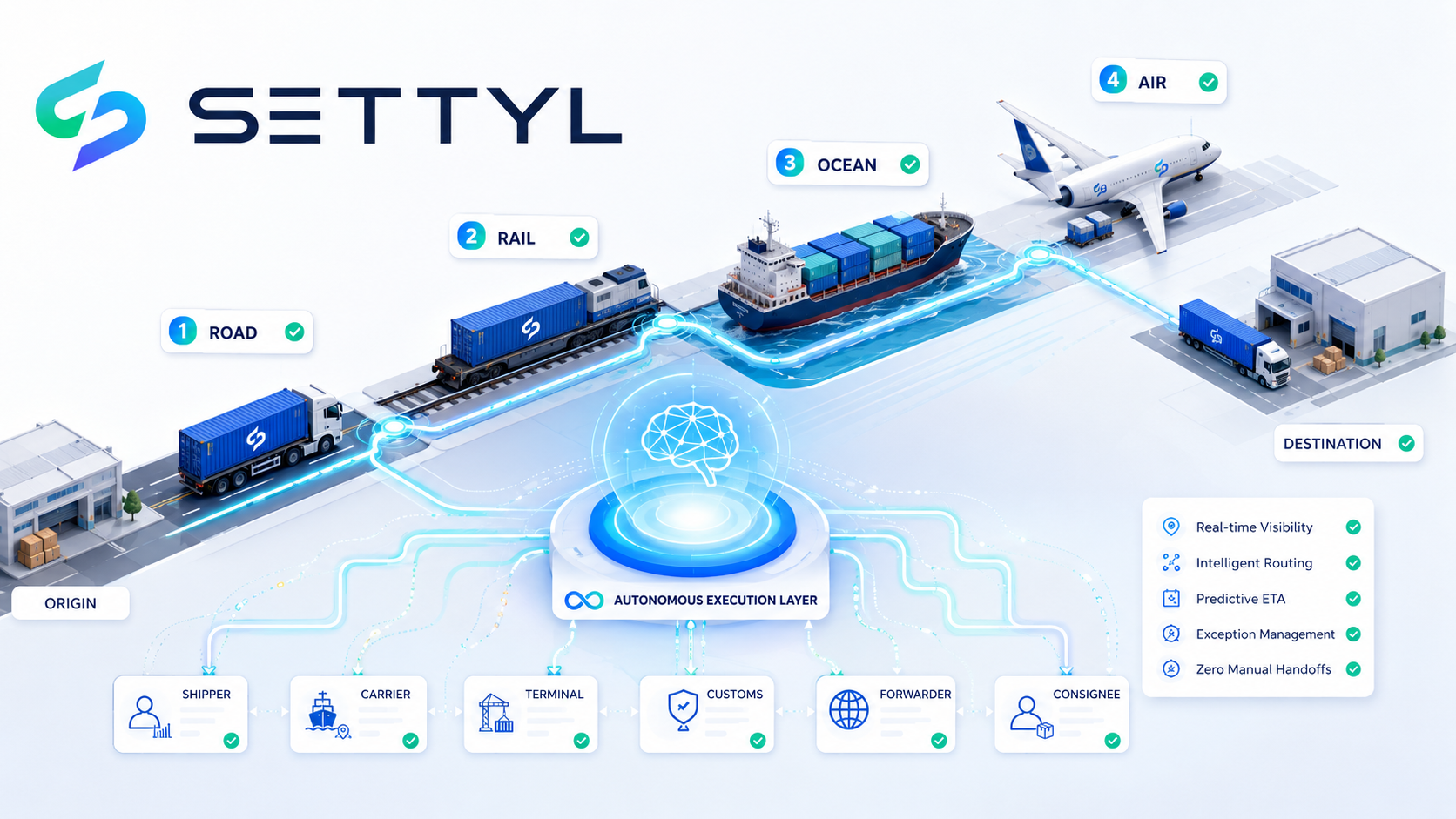
Autonomous Multimodal Logistics: How AI Executes Across Every Mode and Partner
A single international shipment can touch four transport modes and half a dozen companies before it arrives.
A truck collects the cargo from the supplier. A rail operator moves it to the port. An ocean carrier transports it across borders. Another truck completes the final delivery.
On paper, this appears to be one shipment.
Operationally, it is a chain of bookings, documents, approvals, status updates and partner commitments that must remain synchronized from origin to destination.
Every mode switch—truck to rail, rail to ocean, ocean to last-mile—is a handoff. And every handoff creates another opportunity for information to arrive late, documents to go missing, capacity to become unavailable or one partner’s delay to disrupt the rest of the journey.
The complexity of multimodal logistics is not simply moving freight across different modes. It is coordinating every organization, decision and dependency involved in the movement.
This is where autonomous execution changes the operating model - the mode-switch is where freight coordination breaks
Instead of relying on a coordinator to move between emails, carrier portals, spreadsheets, freight platforms and ERP screens, an autonomous execution layer can book capacity, sequence transport modes, validate documents, monitor milestones and coordinate the next action.
Human teams remain in control of policies and important decisions. But they no longer have to manually carry information from one stage of the shipment to the next.
What multimodal logistics means—and why it is hard
Multimodal logistics is the movement of goods using two or more transport modes under a coordinated shipment plan.
Those modes may include:
- Road
- Rail
- Ocean
- Air
- Inland waterways
- Parcel or last-mile delivery
A manufacturer, for example, may move cargo by truck from a plant to an inland container depot, by rail to a seaport, by ocean vessel to another country and by road to the final consignee.
The physical journey is only one part of the process.
Each leg may involve a different carrier, service provider, contract, rate structure, document set, tracking system and operating schedule.
The shipment succeeds only when these activities occur in the correct sequence.
A delay in the first-mile pickup can cause the cargo to miss its rail connection. A missed rail connection can affect the port cut-off. A missed port cut-off can result in a rolled booking, storage charges and a revised delivery commitment.
The problem is therefore not isolated transportation management.
It is cross-company execution.
Multimodal logistics versus intermodal transportation
Multimodal and intermodal transportation are often used interchangeably, but they describe slightly different commercial structures.
In practice, both models create the same operational requirement:
Someone—or something—must coordinate the complete journey, even when no single carrier controls every leg.
Traditional logistics systems often manage individual modes effectively. A transport management system may manage road freight. A freight forwarding platform may manage international bookings. A visibility provider may track ocean containers.
But the shipment does not experience those systems as separate processes.
It moves through one continuous chain of commitments.
The coordination tax of switching modes
Every time freight changes modes, the shipment crosses an operational boundary.
The incoming carrier considers its work complete. The outgoing carrier may not yet consider its work started. Between those two points, the shipper, forwarder, customs broker or logistics coordinator must ensure that the cargo, information and documents move together.
This is where the coordination tax appears.
The coordination tax is the time, labour and operational risk created by manually connecting systems, partners and processes that were never designed to work as one execution flow.
It includes work such as:
- Checking whether a carrier accepted a booking
- Confirming whether equipment has been allocated
- Following up on pickup schedules
- Re-entering shipment data into another portal
- Sending documents to customs brokers
- Verifying whether customs clearance is complete
- Updating estimated departure and arrival times
- Informing downstream carriers about delays
- Revising warehouse or customer delivery appointments
- Reconciling freight invoices against actual shipment events
- Updating the ERP after the movement is completed
No individual task appears particularly complex.
The difficulty comes from the volume, timing and dependency of these tasks.
A mode switch is also an information switch
When cargo moves from truck to rail, the physical unit may remain unchanged. But the operational context changes.
The rail operator needs terminal, wagon and schedule information. The port may need container and customs status. The shipping line needs documentation before its cut-off. The destination transporter needs arrival and release information.
This context is often transferred through:
- Email threads
- Phone calls
- Carrier portals
- Freight forwarder systems
- Messaging applications
- Spreadsheets
- PDF documents
- ERP transactions
- Tracking platforms
When the information does not move with the cargo, teams spend time reconstructing what happened.
They search for the latest booking confirmation, compare versions of documents, ask partners for status updates and determine who is responsible for the next action.
That is why visibility alone does not solve multimodal execution.
A visibility platform may show that a container has arrived at a port. It does not necessarily ensure that the import documents were submitted, the customs broker was notified, the clearance was completed and the final-mile carrier was rescheduled.
Visibility tells the enterprise what is happening. Execution ensures that the right action happens next.
The cost of a broken handoff
A weak handoff can create several downstream consequences.
These are not separate incidents.
They are connected events within the same transaction.
Yet many enterprises manage them through different teams and applications. Procurement may manage the freight contract. Logistics may manage the booking. EXIM teams may manage customs documentation. Finance may review freight invoices. ERP records may be updated after each team completes its part.
The shipment becomes fragmented because the execution responsibility is fragmented.
How autonomous execution books, routes and tracks across modes
Autonomous multimodal logistics requires more than generating an optimized route.
A route recommendation is useful, but it does not book the carriers, collect the documents, validate the shipment, monitor the commitments or respond when reality changes.
An autonomous execution layer must be able to act across the complete shipment lifecycle.
1. Understand the transportation requirement
The execution process begins with a shipment requirement.
That requirement may originate from:
- A purchase order
- A sales order
- A stock transfer
- A production plan
- A supplier dispatch request
- A project shipment
- A customer delivery commitment
The execution layer reads the relevant commercial and operational context:
- Origin and destination
- Cargo description
- Weight and dimensions
- Required delivery date
- Incoterms
- Material handling requirements
- Customs and compliance conditions
- Approved logistics contracts
- Carrier eligibility
- Budget and service constraints
This information may already exist across ERP records, emails, documents and logistics systems.
The execution layer does not replace the ERP as the system of record. It uses ERP data as part of the operating context while managing the work required to complete the shipment.
2. Build the multimodal movement plan
The system evaluates possible mode combinations based on business priorities.
These may include:
- Cost
- Transit time
- Capacity availability
- Reliability
- Cut-off schedules
- Cargo restrictions
- Route feasibility
- Customs requirements
- Contracted rates
- Emissions targets
- Delivery urgency
The lowest-cost option is not always the right option.
A cheaper rail connection may create a high risk of missing the vessel cut-off. An airfreight option may reduce transit time but require different documentation and handling. A direct road movement may cost more but reduce the number of transfers.
The system therefore needs to evaluate the journey as a connected sequence—not as a set of independent freight legs.
3. Source and book capacity
Once the movement plan is approved, the execution layer can identify available contracted capacity or initiate a freight sourcing event.
Depending on enterprise policy, it may:
- Select a contracted carrier
- Request rates from approved partners
- Run a freight auction
- Compare carrier responses
- Validate the rate against the contract
- Route the recommendation for approval
- Issue the booking request
- Confirm carrier acceptance
- Reserve equipment or space
Autonomous freight booking does not mean allowing an AI model to make unrestricted purchasing decisions.
It means executing within defined commercial policies, approval limits, carrier qualification rules and operational constraints.
Routine bookings can proceed automatically. High-value shipments, non-contracted rates or policy deviations can be routed to the appropriate person.
4. Coordinate every mode-switch handoff
This is the central requirement of autonomous multimodal logistics.
Before one leg is completed, the system prepares the next leg.
For example, while a road carrier moves the cargo towards a rail terminal, the execution layer can verify:
- Whether the rail booking is confirmed
- Whether terminal instructions have been received
- Whether the cargo will arrive before the cut-off
- Whether required documents are available
- Whether downstream schedules remain valid
If the truck is delayed, the system does not merely create an alert.
It evaluates the operational consequence.
Can the rail connection still be made? Is another departure available? Will the revised arrival still meet the vessel cut-off? Should the shipping line, terminal or forwarder be notified?
The value lies in connecting the event to the next required decision.
5. Validate EXIM and shipment documents
International multimodal logistics depends heavily on documents.
These may include:
- Commercial invoice
- Packing list
- Purchase order
- Certificate of origin
- Shipping instructions
- Bill of lading
- Air waybill
- Insurance certificate
- Export declaration
- Import declaration
- Customs permits
- Dangerous goods declarations
- Proof of delivery
An autonomous execution layer can collect documents from email, portals, partners or enterprise systems and validate them against the transaction.
It can identify issues such as:
- Mismatched quantities
- Incorrect consignee details
- Missing classification information
- Inconsistent values
- Invalid document versions
- Missing certificates
- Dates that conflict with shipment milestones
- Shipment references that do not match the booking
Rather than waiting for a coordinator to discover the problem at the port or during customs clearance, the system can flag it earlier and initiate the corrective workflow.
6. Track the complete journey
Tracking a multimodal shipment requires more than displaying several status feeds on one screen.
The execution layer must normalize events from different partners and determine what each event means for the transaction.
A road carrier may report “vehicle departed.” A rail operator may provide terminal milestones. A shipping line may report “gate in,” “loaded on vessel” and “transshipment.” A customs system may report filing, assessment, payment and release events.
These events must be connected to a common shipment plan.
The system should escalate genuine exceptions—not every status change.
That reduces alert fatigue and allows logistics teams to focus on decisions requiring commercial judgment, partner negotiation or risk acceptance.
7. Connect delivery to financial closure
The shipment is not operationally complete when the cargo arrives.
The execution continues through:
- Proof-of-delivery validation
- Freight invoice receipt
- Rate and surcharge verification
- Contract comparison
- Accessorial charge validation
- Tax verification
- Approval routing
- Payment reconciliation
- ERP posting or update
A carrier may invoice waiting charges, demurrage, detention, fuel surcharges or additional handling fees. Those charges should be evaluated against the booking, contract, shipment milestones and documented exceptions.
When procurement, logistics and finance operate from the same execution history, the enterprise no longer has to reconstruct the shipment during invoice approval.
The transaction already contains the evidence required to validate the charge.
What autonomous multimodal execution actually owns
The distinction between automation and autonomous execution is transaction ownership.
A workflow tool may automate one step. A tracking tool may provide an event. A freight platform may process a booking.
An autonomous execution layer owns the continuity between those activities.
The ERP remains essential.
It continues to hold purchase orders, sales orders, material records, accounting entries and other enterprise data.
But an ERP is not designed to continuously monitor an email response, validate a freight document, follow up with a forwarder, rebook a missed connection, collect proof of delivery and resolve an invoice exception across external organizations.
That fragmented work traditionally sits around the ERP.
This is the layer Lasya AI is designed to replace. Settyl co-exists with ERP while providing native capabilities across sourcing, procurement, logistics, EXIM, real-time tracking and finance operations.
That allows Lasya AI to own the transaction from request to resolution while preserving operational memory across:
- Carrier selections
- Freight quotes
- Approvals
- Bookings
- Partner communications
- Shipment documents
- Tracking milestones
- Exceptions
- Corrective decisions
- Delivery evidence
- Invoice validations
- ERP updates
This operational memory matters because multimodal logistics rarely proceeds exactly as planned.
When an exception occurs, the system needs to understand more than the current status. It needs to know what was promised, what changed, who responded, which decision was approved and what downstream commitments are now affected.
A worked example: one shipment, four modes, zero manual handoffs
Consider a manufacturer transporting industrial components from an inland supplier in India to a customer distribution centre in Europe.
The shipment uses four transport modes:
- Road from the supplier to an inland rail terminal
- Rail from the inland terminal to the export port
- Ocean freight from India to Europe
- Road from the destination port to the customer warehouse
This is a hypothetical example, but it reflects the operational structure of a typical multimodal transaction.
Stage 1: Shipment requirement
A purchase order and supplier dispatch request indicate that the components will be ready on 12 August and must reach the customer by 25 September.
Lasya AI reads the shipment context from the ERP and related documents:
- Supplier location
- Destination
- Cargo dimensions
- Delivery requirement
- Purchase order reference
- Incoterms
- Approved freight contracts
- Export documentation requirements
The ERP remains the source of the commercial record. Lasya begins executing the work around that record.
Stage 2: Route and capacity planning
The system evaluates available options.
The rail-ocean option is selected because it meets the delivery date and remains within the approved logistics budget.
Stage 3: Carrier selection and booking
Lasya checks contracted rates and available carriers for each leg.
It then:
- Confirms the first-mile road carrier
- Reserves rail capacity
- Sends the ocean booking request
- Verifies container availability
- Requests destination transport capacity
- Connects all booking references to the same shipment
No team member needs to manually copy the cargo information into four separate follow-up trackers.
Where partner portals or APIs are available, the system exchanges data directly. Where partners operate through email or documents, Lasya continues the workflow through those channels.
Partners are not forced into a new portal simply to participate.
Stage 4: Origin execution
The supplier confirms that the cargo will be ready as planned.
Lasya schedules the vehicle and sends pickup instructions. It also checks whether the container, loading slot and rail terminal cut-off remain aligned.
On the morning of pickup, the supplier reports a four-hour loading delay through email.
A traditional tracking system might display the delay.
The autonomous execution layer evaluates the consequence.
It determines that the original rail cut-off is at risk and identifies a later rail departure that can still meet the vessel cut-off. The rail booking is adjusted, the road carrier receives the revised terminal instructions and the downstream schedule is updated.
A logistics manager is informed of the change but does not need to coordinate each individual response.
Stage 5: Export and ocean handoff
As the cargo moves towards the port, Lasya collects and validates:
- Commercial invoice
- Packing list
- Certificate of origin
- Shipping instructions
- Export declaration data
- Container and seal information
The system detects that the package count in the shipping instructions does not match the packing list.
It sends the discrepancy to the responsible party, obtains the corrected document and records the revised version before the documentation cut-off.
Once the container arrives at the port, Lasya connects the gate-in event with customs and vessel-loading readiness.
The system confirms that:
- The cargo has arrived
- Export clearance is complete
- The ocean booking remains valid
- The container is assigned to the expected vessel
Stage 6: In-transit exception
During the ocean movement, the carrier changes the transshipment schedule. The estimated arrival moves by two days.
The system calculates the effect on:
- Import clearance preparation
- Destination transport booking
- Customer delivery appointment
- Expected delivery date
Because the revised schedule still meets the customer commitment, Lasya reschedules the final-mile pickup and updates the relevant parties.
The event is recorded, but it is not escalated as a critical exception.
Had the delay threatened the required delivery date, the system would have presented the available recovery options for approval.
Stage 7: Import clearance and final delivery
Before vessel arrival, Lasya verifies that the customs broker has the required import documents.
When the cargo is released, the system triggers the final-mile carrier confirmation and provides:
- Terminal release information
- Container details
- Delivery location
- Customer appointment
- Required delivery documents
The cargo is collected and delivered to the customer warehouse.
The electronic proof of delivery is received and matched against the shipment, purchase order and delivery requirement.
Stage 8: Invoice verification and ERP closure
Invoices are received from the road carrier, rail operator, ocean carrier and destination transporter.
Lasya compares them against:
- Contracted rates
- Approved booking amounts
- Shipment milestones
- Recorded exceptions
- Supporting documents
- Proof of delivery
A destination carrier has added waiting charges.
The operational memory shows that the carrier arrived within the confirmed delivery slot, but the consignee delayed unloading. The charge is routed for review with the supporting timeline already attached.
Approved values are sent to the finance workflow and the relevant ERP records are updated.
The shipment has moved from request to delivery and financial closure without a human coordinator manually carrying the transaction between every participant.
Zero manual handoffs does not mean zero human involvement. It means people intervene for decisions and exceptions—not to copy data, chase routine confirmations or reconstruct what already happened.
How AI optimizes multimodal routing
AI can improve multimodal routing by evaluating more variables than a static route rule or cost table.
These variables may include:
- Historical carrier performance
- Current capacity
- Transit-time reliability
- Mode schedules
- Port and terminal cut-offs
- Customs processing requirements
- Weather or disruption information
- Cargo restrictions
- Contract rates
- Spot-market options
- Delivery commitments
- Downstream warehouse availability
But routing intelligence is only useful when it is connected to execution.
A system may identify a better route but still require a person to contact carriers, compare responses, obtain approval, update bookings and notify downstream partners.
Autonomous execution closes that gap.
It converts the routing decision into a sequence of governed actions.
The objective is not to remove every human decision.
It is to prevent human teams from becoming the integration layer between disconnected systems and companies.
What enterprises need before automating multimodal freight booking
Autonomous logistics requires operating controls.
Before automating freight booking and mode-switch decisions, enterprises should define:
Approved decision boundaries
The system needs clear policies covering:
- Approved carriers
- Rate tolerances
- Maximum booking values
- Mode restrictions
- Service-level requirements
- Escalation thresholds
- Approval requirements
- Compliance conditions
Connected transaction context
Shipment decisions should not be made from transportation data alone.
The execution layer may also require:
- Purchase or sales order details
- Material and cargo information
- Supplier commitments
- Customer delivery requirements
- Contracted rates
- Customs documents
- Financial controls
Partner-channel flexibility
Not every carrier, supplier, broker or forwarder will use the same platform.
The execution layer must be able to work through the channels partners already use, including email, EDI, APIs, portals, spreadsheets and documents.
Otherwise, the enterprise replaces internal fragmentation with another external adoption problem.
Exception governance
The organization should define which exceptions the system can resolve automatically and which require human judgment.
For example:
Autonomy should be governed, explainable and auditable.
Every system action must be tied to the policy, data and operational context that justified it.
From fragmented freight activity to one execution flow
Most enterprises already have systems for ERP, transportation, carrier visibility, customs, documents and finance.
The problem is not necessarily the absence of software.
The problem is that each system manages only part of the shipment while employees coordinate the gaps between them.
Multimodal logistics makes those gaps more visible because every journey crosses multiple functional and organizational boundaries.
An autonomous execution layer changes the role of enterprise teams.
Instead of manually coordinating every booking, document and status update, teams establish the policies within which execution can occur. The system manages routine progression, maintains the transaction context and escalates decisions requiring human attention.
ERP continues to preserve the official enterprise record. Lasya AI runs the work required to create, validate and update that record across sourcing, procurement, logistics, EXIM, tracking and finance operations. The result is not simply faster freight booking. It is a shipment that remains one connected transaction from the initial requirement to final financial resolution—even when it moves across four modes, six companies and a dozen systems.
Frequently asked questions
What is multimodal logistics?
Multimodal logistics is the coordinated movement of goods using two or more transport modes, such as road, rail, ocean and air. The modes are managed as parts of one end-to-end shipment journey, even when different carriers or service providers execute each leg.
What is the difference between multimodal and intermodal logistics?
Both involve multiple transport modes. Multimodal logistics often refers to an end-to-end movement managed under a unified arrangement, while intermodal transportation commonly involves separate carriers or contracts for different legs. Operationally, both require careful coordination at every mode-switch handoff.
Why is multimodal logistics difficult to manage?
Multimodal logistics involves different carriers, schedules, documents, systems, contracts and regulatory requirements. A delay or data error in one leg can affect every subsequent leg, making cross-partner coordination more difficult than managing a single transport mode.
How can multimodal freight booking be automated?
Multimodal freight booking can be automated by connecting shipment requirements, approved carriers, contracted rates, capacity information, routing rules and approval policies. An autonomous execution layer can request rates, compare responses, issue bookings, confirm capacity and coordinate downstream legs within defined business controls.
How does AI optimize multimodal routing?
AI can compare route combinations using cost, transit time, reliability, carrier performance, capacity, cut-offs, cargo restrictions and delivery requirements. When connected to an execution layer, it can also initiate bookings, respond to disruptions and update affected partners.
Does autonomous logistics replace ERP?
No. ERP remains the system of record for enterprise, material, commercial and financial data. An autonomous logistics execution layer manages the fragmented work around ERP, including bookings, partner communications, documents, tracking events, exceptions and transaction updates.
Does autonomous execution remove people from logistics operations?
No. It removes routine coordination work from people. Human teams continue to establish policies, approve significant deviations, negotiate complex commercial issues and make decisions that require judgment. The system manages repetitive actions and escalates genuine exceptions.
Can autonomous execution work with carriers that do not use the same platform?
Yes. A multi-enterprise execution layer should be able to communicate through APIs, EDI, email, portals, spreadsheets and documents. Partners should not have to adopt a new application for every shipper they serve.
What is operational memory in multimodal logistics?
Operational memory is the connected history of the shipment, including quotes, approvals, bookings, communications, documents, tracking milestones, exceptions, decisions, delivery evidence, invoice validations and ERP updates. It allows the system and enterprise teams to understand why an action occurred—not merely what the latest status is.
Related Guides
Logistics Chain Management
Autonomous multimodal logistics — AI coordinating sea, air and road handoffs across forwarders, carriers and customs brokers
Why AI in One Function Won’t Fix Your Supply Chain
Learn why isolated AI tools create faster functional silos without solving the handoffs between procurement, logistics, EXIM, finance, and ERP workflows.
System of Execution for Supply Chains: Architecture, Components & How It Works
Explore how specialised AI agents, workflow orchestration, ERP connectivity, execution memory, and multi-enterprise coordination come together in one execution layer.
Supply Chain Trends 2026: The Shift From Visibility to Execution Memory
Understand why supply chain technology is moving beyond dashboards and alerts toward systems that can act, remember, and improve.
Bring last month's exceptions.
Leave with the ROI model.
30-minute working session for the CFO and Controller. We'll run your real exception backlog through Lasya, project the working-capital release, and walk through the audit-trail evidence your InfoSec team will request.