
The Enterprise Boundary Is the Wrong Boundary for Supply-Chain AI

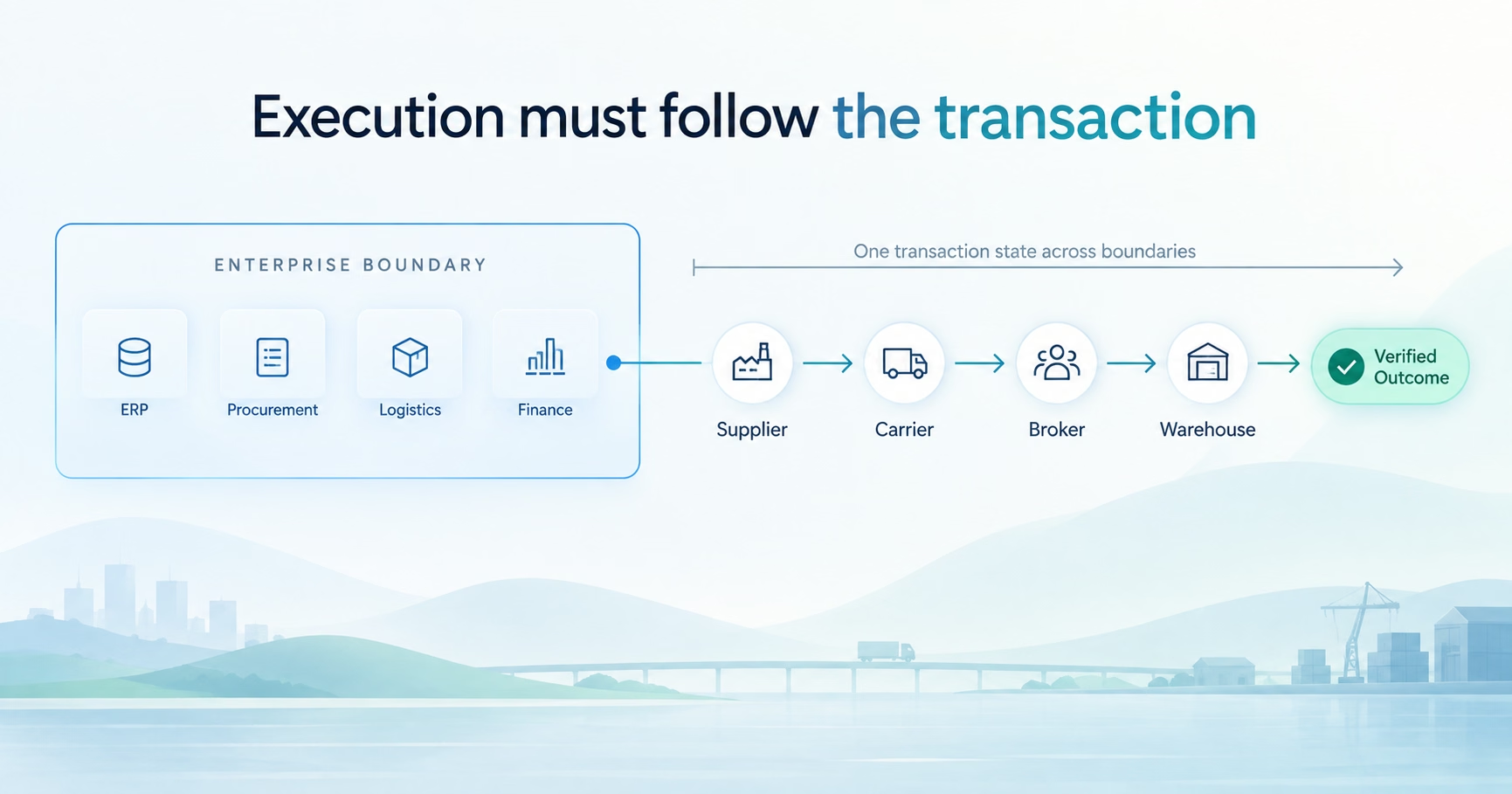
Most enterprise AI is being built around a boundary the business transaction does not respect: the company.
The models sit inside one organization. Permissions stop at its identity layer. Agents act through its applications. Governance follows its policies. That is sensible for security and authority.
It is incomplete for supply-chain execution.
A supplier changes a commitment by email. That change affects production, freight, inventory and cash. A carrier rejects capacity. A broker requests another document. A warehouse reports a short receipt. The next required action often belongs to another company using another system and another communication channel.
If AI can act only where one enterprise has direct application access, it may automate internal tasks while preserving the human work of carrying the transaction across organizational boundaries.
The enterprise is the right boundary for authority. It is often the wrong boundary for execution.
This is the architectural distinction I believe supply-chain leaders need to confront.
The architecture stops before the work does
Enterprise software was designed around the legal and operational perimeter of the company. ERP became the authoritative source for orders, receipts, inventory, invoices and financial postings. Procurement, logistics and finance applications organized work within their respective domains.
AI is now being added to that landscape. Procurement agents interpret supplier messages. Logistics agents detect disruption. Finance agents investigate discrepancies. Each improvement is useful.
But a more capable node does not automatically create an executable transaction.
Imagine that a supplier cannot meet the requested quantity and proposes a split delivery. An AI assistant may extract the revised dates correctly. Yet the transaction still needs a governed response: determine the operational impact, decide whether the change is acceptable, coordinate transport, update the authoritative record and verify that the revised outcome occurred.
Some actions belong to the buyer. Others depend on the supplier, carrier or forwarder. If a person must preserve the context and chase every external step, the application has become more intelligent while the operating model remains human-relayed.
This is one expression of Operational Fragmentation: the systems hold pieces of the truth, but people remain responsible for keeping the work coherent between them.
The transaction is larger than every participant
A multi-enterprise transaction is not a loose collection of messages. It has intent, commitments, policies, dependencies, evidence and an expected outcome.
Each participant sees only part of it. The buyer may hold the purchase order. The supplier knows what can be produced. The carrier controls capacity. The forwarder coordinates movement. The broker manages a regulatory submission. The warehouse observes receipt. Finance records commercial closure.
No participant owns every system, and no single application contains every decision.
That is why designing autonomy around an application—or even around one enterprise—creates a premature stopping point. The more useful unit is the governed transaction: the business objective that must continue even as responsibility moves across companies.
The detailed operating model is covered in Multi-Enterprise Transaction Execution: From Purchase Intent to Financial Closure. The important architectural point here is simpler: execution ownership must survive a change in company, system or channel.
Shared execution does not require shared software
The usual answer to cross-enterprise coordination has been to bring every participant into a common network or portal. That can work when the ecosystem has sufficient scale, standardization and incentive to adopt it.
But real supply chains remain heterogeneous. One supplier responds through email. Another uses a portal. A carrier exposes an API or EDI connection. A forwarder handles an exception through WhatsApp. A broker works through a government system.
Portals remain useful where they fit. The architectural mistake is making universal portal adoption a prerequisite for transaction continuity.
A transaction execution layer should instead meet participants through the channels they already use, resolve each signal into the correct transaction context and carry the next governed action forward. Settyl describes this model in Shared Execution Without Shared Software.
This does not make the ecosystem less governed. It separates participation from application adoption. Each enterprise retains its own systems and authority while the transaction preserves shared execution context.
Three boundaries should not be treated as one
Enterprise AI discussions often collapse three different boundaries:
The first two belong firmly under enterprise governance. Cross-enterprise execution does not mean unrestricted access, shared credentials or uncontrolled action.
The third boundary is different. A system can remain responsible for moving a transaction forward without violating another company's authority. A supplier can confirm a revised date without entering the buyer's ERP. A carrier can accept a tender without seeing the buyer's internal planning data. A broker can return customs evidence through an existing channel.
The transaction remains continuous while permissions and decision rights remain bounded.
That separation is essential. Otherwise organizations face a false choice between secure enterprise control and end-to-end execution. A governed architecture can provide both.
A System of Record cannot own work it was not designed to observe
ERP should remain the System of Record. It protects authoritative enterprise state, controls and financial integrity.
But much of the work required to create the next valid record happens elsewhere: in correspondence, partner systems, documents, approvals and physical events. ERP can store a revised delivery date after it is validated; it is not designed to conduct every interaction required to obtain, evaluate and fulfil that commitment.
This creates the need for a System of Execution for supply chains: an execution layer responsible for the work between records.
Within Settyl's model, Multi-Enterprise Execution is the framework that carries that responsibility across independent companies, systems and channels. Lasya AI is the product that interprets signals, maintains transaction context, applies policy, coordinates permitted actions and writes verified outcomes back to authoritative systems.
The division of responsibility is deliberate:
ERP preserves the authoritative record. Lasya runs the governed work required to create the next verified record.
The intended outcome is Autonomous Supply Chain Execution: eligible transactions progressing across functions and enterprises with minimal human relay, within defined controls.
The exception is where the boundary becomes visible
Routine automation can hide an architectural weakness. Exceptions expose it.
When everything proceeds as expected, messages can be mapped and records synchronized. When a commitment changes, the transaction must be understood as a whole. What was intended? What changed? Which downstream obligations are affected? Who has authority to decide? What evidence is sufficient? Which action is permitted now?
If the architecture loses ownership at the enterprise boundary, a person reconstructs that context and becomes the integration layer.
If the execution layer retains the governed transaction state, it can determine whether the exception can be resolved autonomously, needs a deterministic service, or requires a human decision. The person intervenes because judgment is valuable—not because the system cannot follow work beyond its own perimeter.
Over time, verified decisions and outcomes form Operational Memory: evidence of how commitments changed, which actions worked and what partners actually delivered. That memory becomes useful because it is tied to completed execution, not merely stored conversation.
The design question I now start with
When I look at an enterprise AI architecture, I no longer begin with, “What can this agent automate?”
I begin with a harder question:
What happens when the next required action belongs to a company we do not control?
If the answer is that a buyer sends an email, a planner calls the carrier, an analyst reconciles the spreadsheet or a finance team searches for context, the execution boundary still ends too early.
The goal is not to erase enterprise boundaries. Data access, policy and authority must remain governed. The goal is to stop treating those controls as the point where responsibility for the business outcome must end.
Supply chains are multi-enterprise by design. Their execution architecture must be able to follow the same reality.
The enterprise should govern the action. The transaction should define the boundary of execution.
Frequently Asked Questions
Does cross-enterprise execution require every partner to use Settyl?
No. Participants can continue through existing channels such as email, WhatsApp, EDI, APIs, documents and portals. The execution layer maintains transaction context without requiring universal application adoption.
Does a System of Execution replace ERP?
No. ERP remains the System of Record for authoritative data, controls and financial integrity. The System of Execution coordinates the governed work between records and across external participants.
What is Multi-Enterprise Execution?
Multi-Enterprise Execution is Settyl's framework for carrying one transaction across independent enterprises, systems and channels while preserving context, ownership, policy and evidence until the outcome is verified.
Why is the transaction the better execution boundary?
Because the business objective continues when responsibility moves from buyer to supplier, carrier, forwarder, broker, warehouse or finance. The transaction provides the persistent context that no single participant or application owns.
Continue Reading
Bring last month's exceptions.
Leave with the ROI model.
30-minute working session for the CFO and Controller. We'll run your real exception backlog through Lasya, project the working-capital release, and walk through the audit-trail evidence your InfoSec team will request.