
Shared Execution Without Shared Software
Supply-chain autonomy should not depend on every supplier, carrier, forwarder and broker adopting the same portal. Shared execution requires one transaction state to survive across the channels partners already use.
THE THESIS
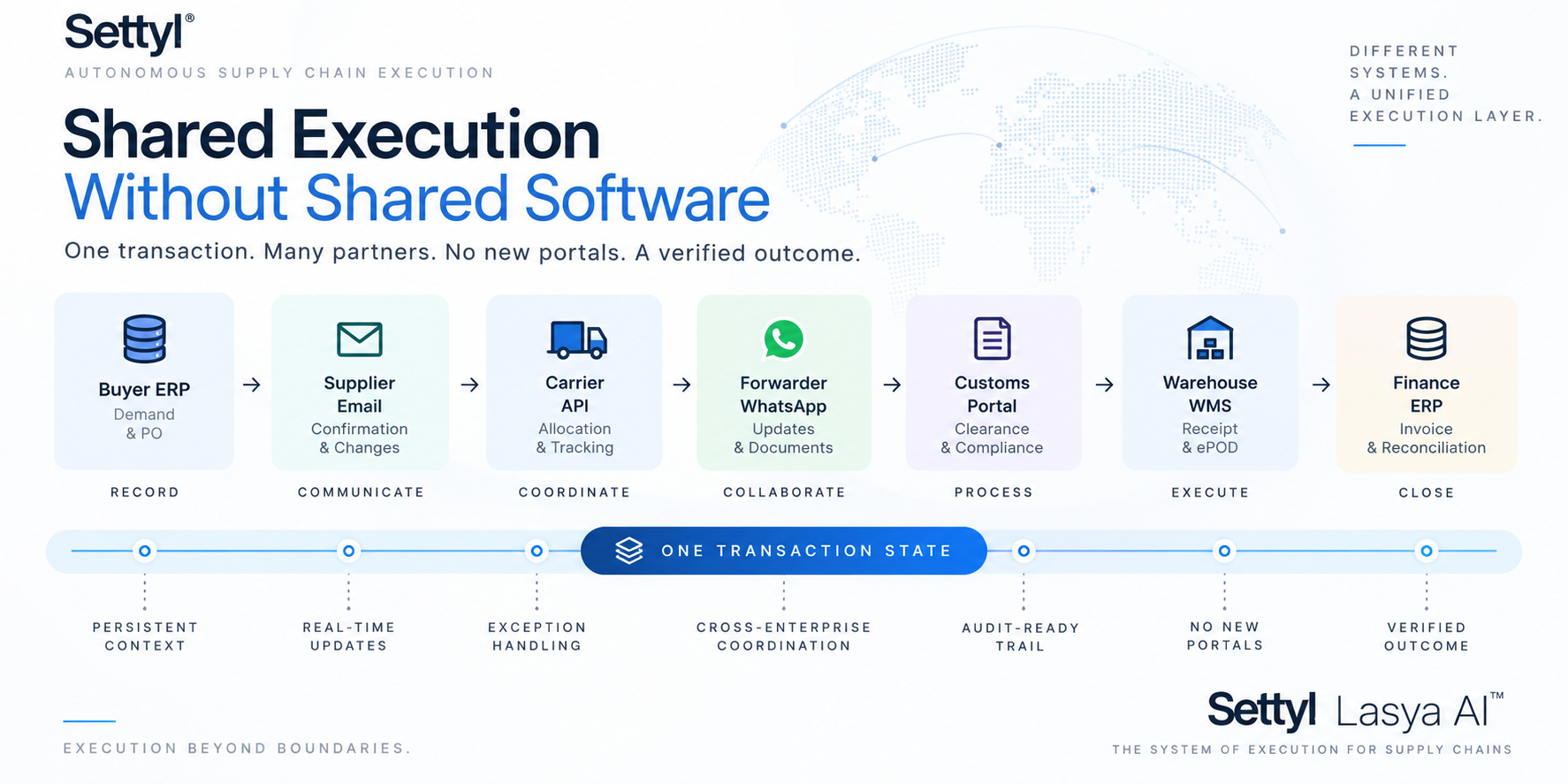
Shared execution does not require every participant to use the same application; it requires one persistent transaction state to survive across enterprises, systems and channels.
THE BRIEF
Shared execution does not require everyone to use the same application
Supply chains are multi-enterprise by design.
A single transaction can involve a buyer, supplier, carrier, freight forwarder, customs broker, warehouse, finance team and multiple enterprise systems.
Those participants rarely operate on one technology stack.
One supplier may respond through email. Another may use a customer portal. A carrier may provide an API. A forwarder may rely on WhatsApp. A customs broker may work through documents and a government system. The buyer may run SAP, Oracle or Dynamics.
Trying to make every participant adopt one shared application before the transaction can move creates a second problem: software adoption becomes a prerequisite for execution.
That is the wrong dependency.
The transaction should survive the channel
The business transaction is larger than any interface used to communicate about it.
A supplier confirmation received by email should still update the same transaction state.
A carrier acceptance received through an API should continue that state.
A document sent by a forwarder should become execution evidence for the same journey.
A customs response received through a portal should determine what happens next without forcing somebody to reconstruct the history manually.
The architectural requirement is therefore not one shared user interface.
It is one persistent execution state.
This is the role of Multi-Enterprise Execution
Multi-Enterprise Execution is the framework for carrying a transaction across independent enterprises, systems and communication channels while preserving its context, ownership and next action.
That means the execution layer must be able to:
- identify which transaction an external signal belongs to;
- understand what changed;
- determine whether an action is permitted;
- coordinate the next participant;
- preserve the evidence behind the decision;
- continue until the intended business outcome is verified.
The participant does not need to understand the execution architecture.
They continue working through the channel appropriate to them.
No-new-portal is an architectural principle
“No new portal” should not be interpreted as “portals disappear.”
Portals remain useful.
The principle is that universal portal adoption should not be required for transaction continuity.
The supplier can remain on email.
The carrier can remain on its API.
The broker can remain in its existing portal.
The warehouse can remain in its WMS.
ERP can remain the System of Record.
The System of Execution carries the transaction across those boundaries.
Why this matters for autonomous supply chains
Autonomy that stops at the enterprise boundary is incomplete.
An internal procurement agent may create an RFQ autonomously. But if a supplier response arrives by email and a person must manually carry that response into the next step, the transaction is still human-relayed.
The same is true when logistics, customs or finance become the next owner.
Autonomous Supply Chain Execution therefore depends on the transaction retaining state when responsibility moves outside the enterprise.
Shared execution does not require shared software.
It requires the transaction to remain continuous regardless of where each participant works.
That is the architectural shift from connecting applications to owning execution.
Related: Supply Chain Transaction Completion, Autonomy Rate, and The Transaction Is the Unit of Autonomy.
Lasya AI is the System of Execution for supply chains — carrying transaction state across enterprises, systems and channels while ERP remains the System of Record.
WHY IT MATTERS
Supply-chain autonomy breaks when external partners must adopt the same portal before work can continue. Multi-Enterprise Execution preserves transaction continuity across the channels partners already use.
KEY TAKEAWAY
Shared execution does not require shared software. It requires one persistent transaction state to survive across enterprises, systems and channels.
From fragmented work to verified execution
Lasya AI is the System of Execution for supply chains. ERP remains the System of Record; Lasya carries transaction work across systems, partners, channels and exceptions to a verified outcome.