

Invoice Matching Is Not Financial Closure: Why Finance Needs Execution Context
A clean match can validate the invoice. It cannot explain the transaction that produced it.
Accounts-payable automation is often described as a sequence: capture the invoice, match it against the purchase order and goods receipt, route an exception if something differs, approve the result and post it to ERP.
That model works when the commercial and physical transaction followed the original plan.
Supply-chain transactions often do not.
A supplier may partially deliver. A carrier may incur detention after an approved delay. A freight route may change. A quantity can be accepted with tolerance. A customs charge can arise from an execution exception. A price can change through an approved amendment. Delivery evidence can show what actually happened even when the original PO does not.
At that point, invoice matching becomes an evidence problem.
The finance team does not merely need another record. It needs the operational history that explains why the current record is valid.
That is why Autonomous Finance Operations must begin with execution context, not with invoice OCR.
Three-Way Match Validates Records, Not the Entire Transaction
A traditional three-way match compares the purchase order, goods receipt and invoice. A four-way match may add inspection or acceptance evidence.
These controls remain useful. The problem appears when the authoritative business outcome depends on evidence that sits outside those records.
Consider a freight invoice containing a detention charge. The PO and contracted rate can show the original commercial terms. The shipment record can show the movement. But the validity of the detention charge may depend on when the vehicle reported, when loading actually started, whether the shipper caused the delay, whether the charge was approved during execution and what evidence the carrier supplied.
The accounting decision is inseparable from the operational history.
Finance is frequently asked to settle a transaction whose evidence was created outside finance.
The Evidence Finance Actually Needs
Depending on the transaction, financial closure may depend on:
- purchase orders and amendments;
- contracts and rate cards;
- supplier acknowledgements and revised commitments;
- goods receipt and quality outcomes;
- shipment bookings and actual milestones;
- proof of delivery;
- weight, quantity and route evidence;
- approved detention, demurrage or accessorial charges;
- customs and tax documents;
- emails or partner responses that changed the commercial outcome;
- exception decisions and approval history.
In fragmented environments, this evidence is distributed across ERP, TMS, procurement tools, shared drives, email, spreadsheets, portals and the memory of the people who handled the transaction.
Finance then performs forensic reconstruction after the fact.
That is a form of Operational Fragmentation: the transaction is continuous, but the context needed to settle it is not.
Why Invoice Exceptions Become Coordination Work
An invoice exception often looks like a finance problem because finance is where the discrepancy becomes visible.
The root cause may belong elsewhere.
A quantity mismatch can originate from a partial supplier confirmation. A freight variance can originate from a route change. A duplicate charge can arise from a replacement shipment. A tax difference can depend on a corrected document. A price variance may be the result of an approved commercial amendment.
When finance cannot see that history, the analyst begins a coordination loop:
- identify the mismatch;
- contact procurement or logistics;
- locate the responsible operator;
- request documents;
- reconstruct what changed;
- obtain approval;
- return to the invoice;
- post or reject the transaction.
The work is not caused by poor accounting logic. It is caused by missing transaction continuity.
Financial Closure Requires Transaction Ownership
A System of Execution addresses a different responsibility from ERP or AP automation.
ERP remains the System of Record for the purchase order, receipt, invoice and financial posting. The System of Execution preserves the transaction journey required to determine what the correct posting should be.
That means finance does not start with a disconnected invoice. It starts with a transaction that already contains the evidence created during sourcing, procurement, logistics, EXIM and delivery.
The target operating model is:
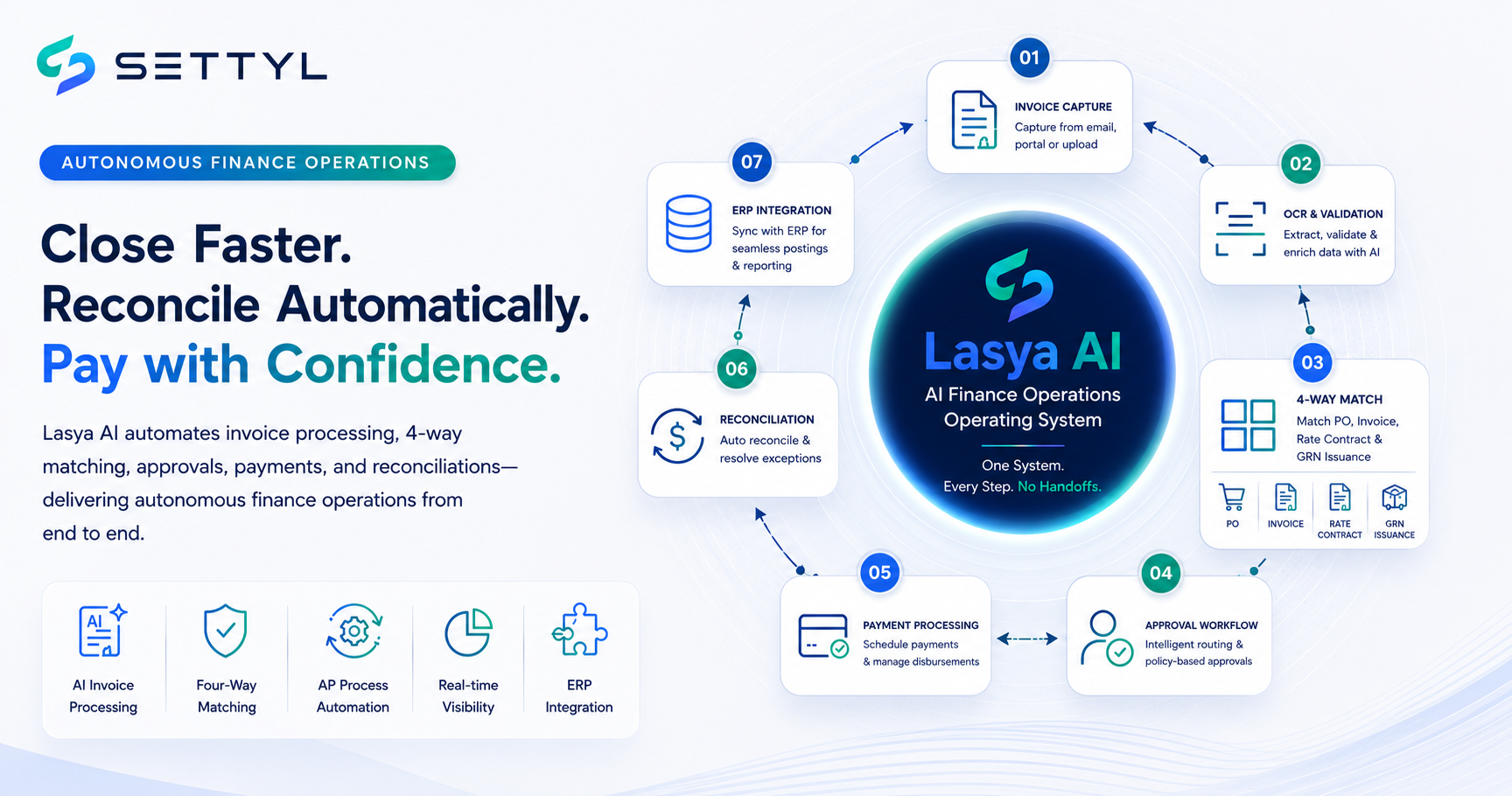
Invoice received → transaction resolved → evidence assembled → policy applied → exception resolved → approval completed → ERP posted → outcome verified.
This is financial execution, not merely invoice processing.
What Autonomous Finance Should Do
1. Resolve the invoice to the transaction
The system identifies the supplier, PO, shipment, receipt, contract, rate card and other relevant execution objects.
2. Assemble the evidence
It brings together the records and operational context required to test the invoice.
3. Apply deterministic controls first
Taxes, tolerances, duplicate checks, contractual rates, quantity rules and approval thresholds should remain governed and explainable.
4. Investigate exceptions using execution context
AI can help interpret unstructured evidence and determine why the invoice differs, but the conclusion should be grounded in transaction data and policy.
5. Route only material judgment
Routine, policy-compliant invoices should progress automatically. Material commercial or compliance decisions should be routed with the evidence already assembled.
6. Post the validated outcome
ERP remains authoritative. The approved result is written back with traceable references.
7. Verify closure
The system confirms that the expected posting occurred and retains the evidence behind the decision.
Operational Memory Makes Finance Better Over Time
Repeated exceptions create reusable knowledge.
If a carrier repeatedly raises the same surcharge, if a supplier frequently submits invoices before goods receipt, or if a specific document mismatch causes recurring payment holds, those patterns should not be rediscovered from scratch every month.
Execution evidence becomes operational and transaction memory when the system preserves the relationship between the signal, the decision, the policy, the action and the verified outcome.
The loop is:
Transaction → Financial Exception → Verified Resolution → Operational Memory → Better Future Execution
This is how finance automation compounds safely: through governed evidence, not by simply trusting a model more.
What to Measure
Useful finance-execution metrics include:
- eligible invoices processed without manual coordination;
- exception-resolution time;
- manual evidence-retrieval touches per exception;
- percentage of exceptions resolved with complete transaction context;
- ERP posting success rate;
- verified financial closure rate;
- repeat-exception recurrence by supplier, carrier or rule.
These metrics reveal whether AI is removing coordination or merely accelerating one step inside the finance queue.
Lasya AI: From Execution Evidence to Financial Closure
Lasya AI Autonomous Finance Operations carries finance from invoice intake through contract and execution validation, exception resolution, approvals and ERP write-back.
The distinction is architectural:
ERP keeps the financial record. Lasya carries the operational evidence required to close it correctly.
That is why invoice matching is important—but not sufficient.
The business outcome is verified financial closure.
Frequently Asked Questions
Why is invoice matching not the same as financial closure?
Invoice matching tests selected records. Financial closure requires the broader execution context, approved exceptions, supporting evidence, required approvals and successful authoritative posting.
What execution evidence does finance need?
Depending on the transaction, finance may need contracts, rate cards, supplier commitments, goods receipts, proof of delivery, shipment events, quantity changes, accessorial approvals, customs documents and exception history.
Does autonomous finance replace ERP?
No. ERP remains the System of Record. The System of Execution coordinates the work required to determine and post the correct financial outcome.
What is verified financial closure?
It means the transaction has been reconciled, required exceptions are resolved under policy, approvals are complete, the authoritative posting succeeded and the supporting evidence is retained.
Related Reading
Bring last month's exceptions.
Leave with the ROI model.
30-minute working session for the CFO and Controller. We'll run your real exception backlog through Lasya, project the working-capital release, and walk through the audit-trail evidence your InfoSec team will request.