
Build vs Buy Is the Wrong AI Question for Manufacturing. Build vs Own Is Better.

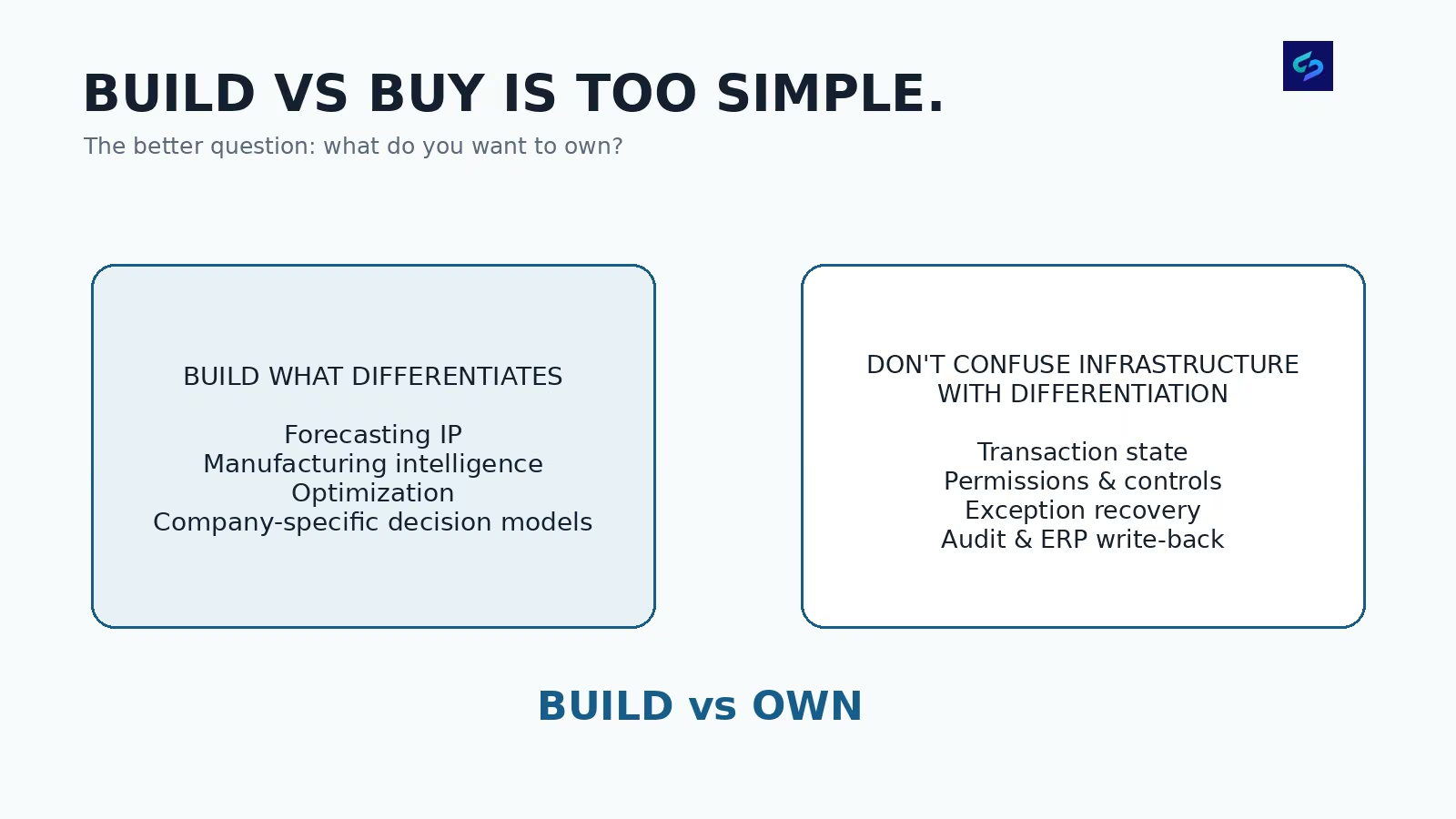
“Can we build this ourselves?” is becoming one of the most common questions in manufacturing AI.
In many cases, the answer is yes.
That is precisely why build vs buy is becoming an incomplete decision framework.
When models, agent frameworks and APIs make software easier to create, the strategic question moves from initial construction to long-term ownership.
Do not ask only whether your team can build it. Ask whether this is infrastructure your company wants to own for the next five years.
AI changed the economics of the first version
A manufacturer no longer needs a large software program to prove a useful AI concept. Internal teams can assemble a model, tools and workflow quickly. That is a meaningful change.
It also creates a risk: prototypes make two very different things look similar.
The first is differentiated intelligence—knowledge and decision logic unique to the manufacturer.
The second is execution infrastructure—the machinery required to safely carry transactions through systems, approvals, external parties, exceptions and authoritative records.
Both can be built. They do not create the same strategic value.
Build where differentiation lives
Manufacturers should build aggressively when the capability reflects company-specific advantage.
Examples include:
- production scheduling optimized for proprietary constraints;
- specialized forecasting methods;
- quality and defect intelligence derived from unique process history;
- engineering knowledge specific to product design;
- yield and throughput optimization;
- company-specific cost models;
- customer promise logic;
- specialized decision models that competitors cannot simply buy.
Owning these capabilities can be rational because the intelligence itself is strategic.
Then identify the infrastructure wrapped around the intelligence
Consider an internal procurement AI.
The differentiated portion may be supplier scoring, category logic or a specialized negotiation strategy.
But production execution also requires:
- email and document intake;
- supplier identity resolution;
- transaction state;
- RFQ follow-up;
- permissions;
- approval boundaries;
- ERP connectivity;
- retry behavior;
- exception routing;
- audit history;
- observability;
- partner-channel integration;
- evidence retention;
- Operational Memory.
Those are important capabilities. But a manufacturer should explicitly decide whether owning all of them is part of its competitive strategy.
Build cost and ownership cost are different
Build cost is visible. Teams estimate engineering weeks, cloud usage and integration work.
Ownership cost appears later.
ERP upgrades break interfaces. Model behavior changes. Security policies evolve. Suppliers respond in new formats. APIs change. Exception coverage expands. Business rules accumulate. Audit expectations increase. Teams reorganize. The original developers move on.
A workflow that looked inexpensive to build can become expensive to operate because it now sits inside the company's critical execution path.
This is especially important when the software can change purchase orders, book freight, approve commercial exceptions or write financial outcomes to ERP.
Point ownership compounds across functions
Manufacturers may start with one internal agent in procurement, another in logistics and another in accounts payable.
Each local business case can be sensible.
But the same supply-chain transaction crosses all three. A supplier delay changes the PO, which changes logistics, which changes the eventual invoice and accrual.
If every function builds its own execution state, the organization eventually has to integrate those agents just as it previously integrated applications.
We should not spend the next decade replacing application silos with agent silos.
The alternative is one governed execution layer where specialized intelligence can participate against the same transaction state.
The transaction is a useful architecture boundary
Settyl's view is that the transaction is the unit of autonomy.
Agents can remain specialized. Procurement can have procurement intelligence. Logistics can have logistics intelligence. Finance can have finance intelligence.
But the transaction should retain one execution context as responsibility moves between them.
This is the role of a System of Execution. It does not demand one universal model or one universal application. It maintains the governed state and carries work toward verified completion.
Keep the System of Record
The build-vs-own framework also clarifies ERP's role.
Manufacturers do not need AI to replace authoritative enterprise systems. ERP remains the System of Record for governed master data, approved transactions, ledgers and financial integrity.
The execution layer owns what happens between records: external signals, decisions, cross-functional actions, partner communication, exceptions and verification.
That separation lets an organization innovate quickly in AI without turning every experimental agent into a new System of Record.
A practical decision framework
Before building an enterprise execution capability internally, ask five questions.
1. Does the intelligence itself differentiate us?
If yes, there is a strong reason to own it.
2. Will this capability become part of a mission-critical transaction path?
If yes, evaluate long-term availability, security and support requirements—not only prototype effort.
3. Does the workflow cross multiple systems or enterprises?
If yes, the problem is likely larger than one agent.
4. Are we prepared to own governance and exception recovery?
Production autonomy is defined by what happens when the expected sequence fails.
5. Does rebuilding the execution substrate create competitive advantage?
If not, internal engineering capacity may be better spent on proprietary manufacturing intelligence.
The architecture can be hybrid
This is not an argument for outsourcing all AI.
A manufacturer can build internal models, agents and decision services and connect them to a System of Execution. It can keep SAP, Oracle or Dynamics as the System of Record. It can use specialized applications where they remain valuable.
The execution layer provides the continuity between them.
Build what makes your operation uniquely better. Buy or reuse what merely has to work reliably across every transaction.
From build vs buy to build vs own
AI has lowered the barrier to software creation. That should encourage manufacturers to build more—not less.
But it should also make architecture decisions more disciplined.
The ability to create an agent does not automatically imply that an enterprise should own the complete execution infrastructure surrounding that agent.
The better question is:
What do we want our engineering organization to be uniquely responsible for?
That is the distinction between building AI and becoming the long-term software vendor for your own supply-chain execution layer.
Frequently Asked Questions
What should manufacturers build with AI?
Prioritize proprietary intelligence: process optimization, engineering knowledge, quality models, forecasting, manufacturing-specific decision logic and other capabilities that create competitive differentiation.
What does build vs own mean?
It separates the ability to create a first version from the permanent obligation to operate, secure, integrate, upgrade, audit and support the capability in production.
Related Reading
Bring last month's exceptions.
Leave with the ROI model.
30-minute working session for the CFO and Controller. We'll run your real exception backlog through Lasya, project the working-capital release, and walk through the audit-trail evidence your InfoSec team will request.