
Your Manufacturing Team Can Build an AI Agent. Should It Build the Execution System Too?

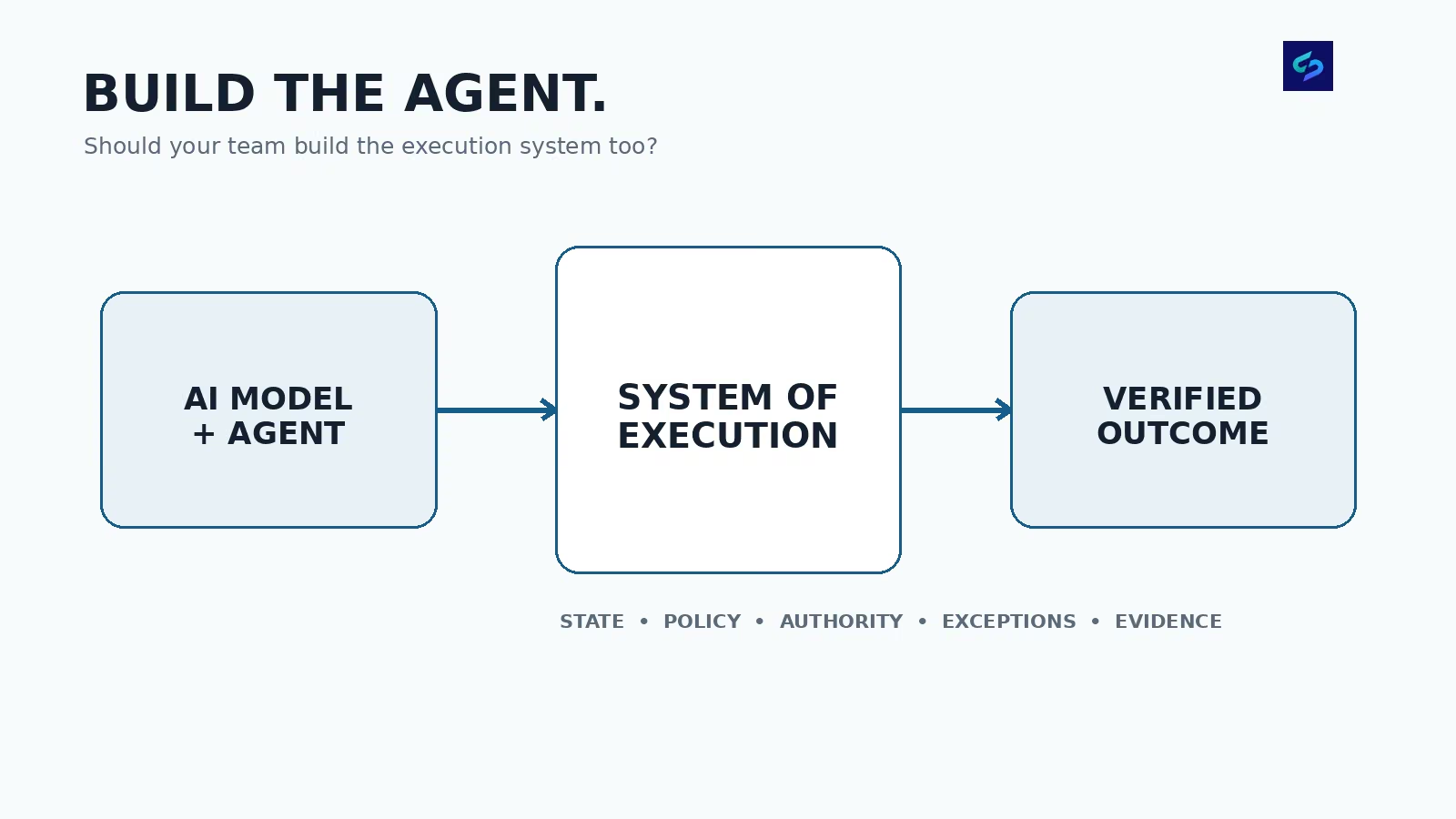
Manufacturing companies are increasingly asking a reasonable question: why buy another AI solution when our own technology team can build the agent?
That question deserves a better answer than “buy instead of build.” Modern model platforms have made it dramatically easier to prototype useful agents. A capable internal team can build an agent that reads supplier email, extracts an RFQ, compares quotations, calls an ERP API, summarizes a logistics exception or classifies an invoice.
The agent is no longer the hard part. The harder question is what your company is choosing to own after the agent works.
Yes, manufacturers should build AI
If a capability contains proprietary manufacturing knowledge, unique optimization logic, product engineering intelligence, forecasting IP or business-specific decision models, building internally can be strategically sensible.
The mistake is treating every layer around that intelligence as equally differentiating.
Consider a procurement agent. The demonstration may be straightforward: receive a requirement, create an RFQ, read supplier responses and recommend an award. In production, the transaction continues. A supplier changes quantity. Another changes the delivery date. Technical documentation is incomplete. An approval threshold is crossed. The selected supplier later misses a commitment. Logistics has already planned capacity. Finance eventually receives an invoice that reflects the revised reality rather than the original PO.
The business problem is no longer “can the model understand the message?” It becomes: who owns the transaction as reality changes?
An agent performs work. An execution system carries responsibility.
A useful distinction is:
Model → Agent → Workflow → System of Execution.
The model provides reasoning capability. The agent uses tools to perform a bounded task. A workflow connects several actions. A System of Execution carries the transaction across systems, functions and enterprise boundaries until the intended business outcome is verified.
That last layer requires more than prompts and APIs. It needs persistent transaction state, identity, permissions, approval boundaries, deterministic business rules, exception recovery, retries, audit evidence, ERP write-back, partner communication and a reliable record of what actually happened.
The build decision expands quickly in manufacturing
A single manufacturing transaction may touch planning, sourcing, procurement, suppliers, logistics, EXIM, warehousing, quality, finance and ERP.
Take a supplier commitment change. The supplier replies by email that 8,000 units can arrive Friday and 2,000 on Monday instead of the original 10,000-unit Friday commitment.
An internal agent can extract the new dates. But production execution still needs answers:
- Is the split delivery acceptable under policy?
- Does production need to re-sequence?
- Should an alternate supplier be activated?
- Does the freight booking need to change?
- Does the revised plan require commercial approval?
- Which system contains the current authoritative state?
- What happens if the supplier changes the commitment again?
- What evidence should finance inherit later?
If each question becomes another point workflow or another agent owned by another team, the company can move from application fragmentation to agent fragmentation.
This is why Settyl treats Multi-Enterprise Execution as an architectural problem rather than a collection of chatbots.
The real cost is permanent ownership
The build cost is not only the first development sprint. Production execution creates a long-lived software obligation.
Your team must maintain model changes, ERP releases, API contracts, identity policies, approval logic, observability, retries, transaction versioning, security controls, exception cases and the integrations required to reach suppliers, carriers, brokers and internal systems.
None of these capabilities is impossible to build. The relevant question is whether rebuilding and operating them creates competitive advantage for the manufacturer.
Build the intelligence that differentiates your business. Question whether rebuilding execution infrastructure does.
Bring your models. Keep your ERP.
The choice does not have to be “internal AI or Lasya.”
A manufacturer can retain its preferred model stack and continue developing proprietary intelligence. ERP remains the System of Record for authoritative state, financial integrity and controls.
Lasya AI sits between them as the execution layer. It carries governed transaction state, coordinates actions across procurement, logistics, EXIM and finance, works with external partners through existing channels, and writes verified outcomes back to authoritative systems.
That division of responsibility is intentional:
Your models can decide and reason. Lasya carries the transaction. ERP preserves the verified record.
What manufacturers should build internally
Internal teams should be aggressive about AI where company-specific knowledge creates advantage. Examples include:
- plant and production optimization;
- proprietary forecasting models;
- engineering and quality intelligence;
- product configuration knowledge;
- specialized cost models;
- customer or market-specific decision logic;
- company-specific copilots and employee experiences.
What manufacturers should challenge before building
Before assigning an internal team to recreate procurement, logistics or finance execution, ask whether it also wants to own:
- cross-system transaction state;
- agent identity and authorization;
- approval thresholds and segregation of duties;
- idempotent ERP write-back;
- exception recovery and retry semantics;
- partner communication across email, APIs, documents and messaging;
- audit evidence;
- workflow observability;
- long-running transaction versioning;
- operational memory from verified outcomes.
This is the part often hidden by a successful prototype.
The most useful build-vs-buy question
The old question was: can our team build this application?
The AI-era question should be more precise:
Which layer creates differentiation, and which layer merely creates permanent infrastructure ownership?
Manufacturers should keep building AI. But they should distinguish the intelligence they want to own from the execution substrate required to safely turn that intelligence into real-world outcomes.
The transaction—not the agent—is the unit that ultimately has to complete.
Frequently Asked Questions
Can a manufacturing company build its own AI agents?
Yes. Modern AI platforms make useful agents increasingly accessible. The strategic decision is whether the enterprise also wants to own the production execution architecture around those agents.
What is the difference between an agent and a System of Execution?
An agent performs a bounded task. A System of Execution preserves state, policy, authority, evidence and exception handling across systems and external parties until the outcome is verified.
Does Lasya replace internal AI or ERP?
No. Manufacturers can keep internal models and ERP. Lasya provides the execution layer between intelligence and the authoritative System of Record.
Related Reading
Bring last month's exceptions.
Leave with the ROI model.
30-minute working session for the CFO and Controller. We'll run your real exception backlog through Lasya, project the working-capital release, and walk through the audit-trail evidence your InfoSec team will request.