

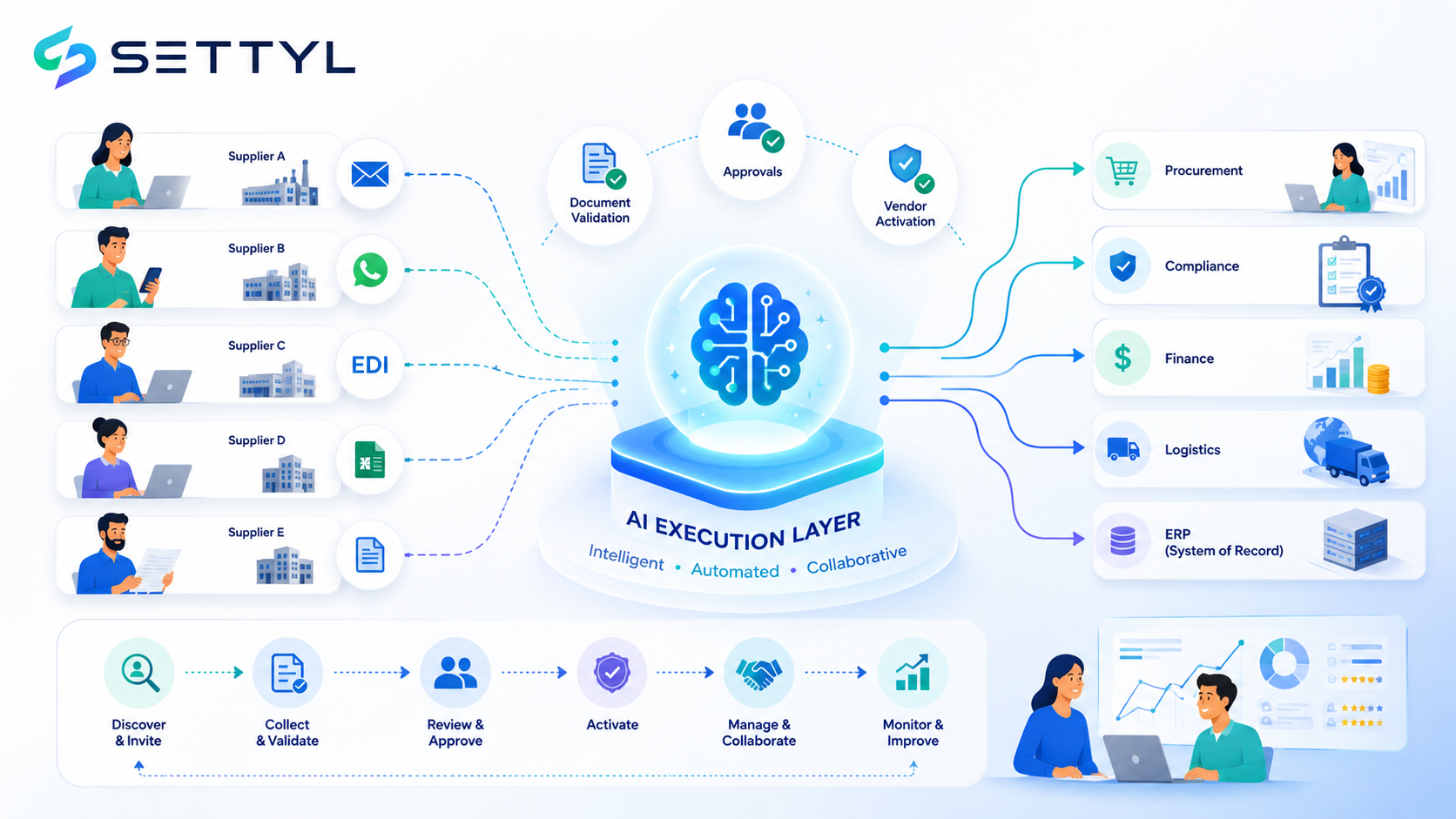
Supplier Onboarding & Management in the AI Era
Every supplier you add is a new company you have to coordinate with—their data, their documents, their timelines, and their systems.
Done by hand, supplier onboarding becomes a slow, document-heavy process that gets harder with every vendor you add. Done well, it becomes the foundation of a supply chain that can expand its partner ecosystem without expanding operational headcount at the same rate.
But there is a deeper problem with the traditional approach.
Most supplier onboarding systems assume that the supplier must first adopt the buyer’s process. Vendors are asked to create another account, learn another portal, remember another password, and repeatedly enter information that may already exist in their emails, documents, ERP exports or internal systems.
The result is predictable:
- Suppliers delay registration.
- Procurement teams send repeated reminders.
- Documents arrive through different channels.
- Information is manually copied into enterprise systems.
- Compliance checks happen outside the workflow.
- Updates disappear into emails and spreadsheets.
- The supplier relationship begins with friction.
The AI-era alternative is not simply a faster supplier portal.
It is an adopt-nothing execution model that meets suppliers through the channels they already use—email, WhatsApp, EDI, spreadsheets, documents or existing systems—and coordinates the onboarding work on their behalf.
The supplier should not have to adopt new software before the buyer can automate the relationship.
This guide covers the complete lifecycle, from first contact and document collection through approval, activation and ongoing supplier management.
It also explains why supplier onboarding is ultimately a form of multi-enterprise execution: enabling two organizations that share no common system to operate as one coordinated network.
What Supplier Onboarding Really Involves
Supplier onboarding is often described as a registration process.
That description is incomplete.
Entering a supplier name, address and tax number into a procurement system is only one small part of the work. A complete vendor onboarding process involves collecting, validating, approving and activating everything required for the supplier to transact with the buyer.
Depending on the industry, geography and supplier category, this may include:
- Company and legal entity information
- Tax registrations
- Banking details
- Supplier classifications
- Product and service categories
- Manufacturing capabilities
- Quality certifications
- Insurance documents
- Environmental and social compliance information
- Information security assessments
- Financial and credit checks
- Beneficial ownership information
- Sanctions and watchlist screening
- Contract acceptance
- Payment terms
- Logistics and delivery capabilities
- Import and export documentation
- ERP vendor-master creation
- Internal approvals
A supplier may also operate through several locations, legal entities, bank accounts and fulfilment points. The information provided during onboarding must therefore be connected to the correct entity, geography, business unit and transaction type.
That makes supplier onboarding more than a form.
It is a coordinated process across procurement, compliance, finance, quality, legal, logistics, information security and the supplier itself.
The supplier onboarding lifecycle
The process does not end when a vendor code is created.
That is where the operational relationship begins.
Supplier certificates expire. Bank details change. Contacts move. Product capabilities evolve. Risk conditions emerge. Delivery and quality performance fluctuate. Contracts are renewed. New plants and categories are added.
Effective supplier management must therefore maintain a continuous, trusted record of the relationship—not a one-time snapshot captured during registration.
The Manual Onboarding Tax—and Why It Scales Badly
Manual supplier onboarding appears manageable when an organisation has a small supplier base.
A procurement coordinator sends a spreadsheet. The supplier returns it by email. Supporting documents arrive as attachments. Someone reviews the information, follows up on missing fields, collects approvals and creates the supplier in the ERP.
The process may feel inexpensive because it relies on tools the company already has.
But the actual cost is distributed across hundreds of small tasks.
Where the work accumulates
A typical onboarding process can involve:
- Preparing and sending registration forms
- Explaining field requirements
- Following up with unresponsive suppliers
- Downloading email attachments
- Renaming and organising documents
- Re-entering information into internal systems
- Comparing form data with submitted documents
- Checking tax and banking information
- Routing approvals to several departments
- Answering supplier status enquiries
- Correcting rejected data
- Creating or updating the vendor master
- Maintaining audit evidence
None of these tasks is individually complex.
The problem is their volume, repetition and dependency on human coordination.
Manual supplier onboarding does not usually fail because the organisation lacks a form. It fails because no system owns the work between the form, the supplier, the reviewers and the ERP.
As supplier volume grows, the number of coordination paths grows with it.
A single supplier may interact with procurement, legal, compliance, quality and finance. Each department may use a different system or spreadsheet. Every missing document generates another email. Every discrepancy creates another approval loop.
This produces what can be called the manual onboarding tax: the cumulative time and operating cost created by fragmented communication, repeated data entry, validation effort, delayed approvals and unresolved exceptions.
Why supplier portals do not eliminate the problem
Supplier portals can centralise information, but they introduce a different challenge: adoption.
The supplier must:
- Open the invitation.
- Create an account.
- Verify the account.
- Learn the portal.
- Understand the buyer’s terminology.
- Locate the required documents.
- Enter the requested information.
- Return later to address corrections.
- Remember the portal for future updates.
Large strategic suppliers may tolerate this process.
Smaller suppliers, logistics partners, brokers, service providers and occasional vendors may not. They already deal with many customers, each with its own portal and process.
The portal may organise work for the buyer while transferring additional work to the supplier.
That is why onboarding delays are frequently an engagement problem rather than a software-access problem.
The hidden consequences of delayed onboarding
Supplier onboarding delays affect more than procurement administration.
They can postpone:
- Sourcing event participation
- Contract award activation
- Purchase-order issuance
- Material availability
- Production schedules
- Shipment bookings
- Import documentation
- Invoice processing
- Supplier payments
- New product launches
A vendor-master issue that appears administrative can quickly become a production, logistics or finance issue.
The cost of poor onboarding therefore cannot be measured only in the number of hours spent processing registration forms. It must also include the downstream delay created when a supplier is not transaction-ready.
Step by Step: A Modern, Automated Supplier Onboarding Flow
Modern onboarding should not begin by asking, “How do we digitise our registration form?”
It should begin with a different question:
How can the supplier become validated, approved and transaction-ready with the least possible effort for both organisations?
AI can support this by interpreting documents, extracting data, checking inconsistencies, coordinating communications, routing approvals and maintaining the context of the entire onboarding process.
A modern flow can work as follows.
Step 1: Initiate the supplier request
A supplier onboarding request may originate from:
- A sourcing event
- A business-user request
- A contract award
- A new product requirement
- A logistics or service requirement
- An approved supplier-development programme
- An ERP or procurement workflow
- An email from an authorised employee
The request should establish why the supplier is being added, which category it supports, which legal entity will transact with it and which checks are required.
This context determines the onboarding path.
A raw-material supplier may require manufacturing, quality and sustainability certifications. A carrier may require fleet, insurance and statutory transport documents. A customs broker may require licences and authorisations. A software provider may require security and data-privacy assessments.
The workflow should adapt to the supplier type instead of sending every vendor the same questionnaire.
Step 2: Engage the supplier through an existing channel
The supplier receives a structured request through a channel it already uses.
This may be:
- EDI
- API
- Spreadsheet
- Secure form
- Existing supplier portal
- Direct system integration
The objective is not to eliminate portals in every situation. Portals can remain useful for suppliers that prefer them.
The objective is to remove forced adoption as a prerequisite for automation.
A supplier should be able to respond by replying to an email, attaching documents or completing a lightweight form without becoming a trained user of another enterprise application.
Step 3: Collect data and documents dynamically
The information requested should reflect the supplier’s:
- Country
- Category
- Legal structure
- Risk level
- Transaction type
- Goods or services supplied
- Tax obligations
- Logistics responsibilities
- Payment requirements
Instead of presenting one long static form, the workflow can progressively request only the information that is relevant.
For example, an India-based supplier may be asked for PAN, GST registration, MSME status and bank details. An overseas supplier may require tax residency, import-export, sanctions and correspondent-bank information.
The system should also recognise previously submitted information and avoid asking for the same data repeatedly.
Step 4: Extract information from submitted documents
AI can read supplier documents and extract relevant fields such as:
- Legal company name
- Registration number
- Tax number
- Registered address
- Bank account number
- Routing or bank codes
- Certificate number
- Validity dates
- Authorised signatory
- Product or service classification
This reduces manual data entry and enables the information in a form to be compared with the supporting evidence.
The extraction itself is not the final decision.
The system must retain links between the extracted value, the original document, the supplier’s declaration and the validation result so that reviewers can understand how a conclusion was reached.
Step 5: Validate the supplier information
Validation may involve checking:
- Whether the legal name matches the registration document
- Whether the tax number is active
- Whether the bank-account holder matches the supplier entity
- Whether addresses are consistent
- Whether certificates are valid and unexpired
- Whether mandatory fields are complete
- Whether the supplier already exists
- Whether duplicate bank or tax information appears elsewhere
- Whether the supplier is subject to sanctions or adverse findings
- Whether supporting documents have been altered or are unreadable
Straight-through cases can proceed automatically.
Exceptions should be routed to the appropriate reviewer with a clear explanation of what failed, which evidence is involved and what action is required.
Step 6: Run risk and compliance checks
Not every supplier requires the same level of due diligence.
The system can assign checks based on the supplier’s risk profile.
The purpose of automation is not to remove governance.
It is to ensure that the required governance happens consistently and that low-risk cases are not delayed by unnecessary manual work.
Step 7: Coordinate internal approvals
Supplier onboarding frequently stalls inside the buyer’s organisation.
One team completes its review, but the next team is unaware that action is required. An approver is on leave. A rejected field is returned without an explanation. Procurement cannot tell the supplier what remains pending.
An execution layer should manage:
- Approval sequencing
- Parallel reviews
- Conditional approvals
- Escalation rules
- Delegation
- Service-level expectations
- Rejection reasons
- Resubmission requests
- Status communication
Approvers should receive the evidence and context needed to make a decision—not a generic task instructing them to “review supplier.”
Step 8: Resolve exceptions without restarting the process
Most onboarding cases are not completely correct on the first submission.
A certificate may be expired. A bank letter may be missing. The tax name may differ from the company name. A document may be illegible. An approver may request an explanation.
The system should isolate the exception and request only the missing or corrected information.
It should not force the supplier to restart the registration process or re-enter unaffected fields.
The previous submission, communication history, reviewer decision and new evidence should remain connected to the same supplier record.
Step 9: Create or update the ERP vendor master
Once the supplier is approved, validated information can be transferred to the ERP or master-data system.
The ERP remains the system of record for:
- Vendor codes
- Accounting data
- Purchasing organisation assignments
- Payment terms
- Tax information
- Company-code relationships
- Posting controls
But the ERP does not need to coordinate every conversation, document request, validation and approval that precedes the final record.
The ERP should preserve the approved supplier record. The execution layer should run the work required to create and maintain that record.
This distinction is essential.
AI should not create an uncontrolled alternative vendor master. It should govern the process, evidence and decisions that produce a trusted ERP record.
Step 10: Activate the supplier across downstream processes
Supplier activation should connect directly with the business process that initiated onboarding.
Depending on the context, the supplier may need to be activated for:
- RFQ participation
- Reverse auctions
- Contract execution
- Catalogue publication
- Purchase-order receipt
- Shipment booking
- Import or export documentation
- Invoice submission
- Payment processing
Onboarding is complete only when the supplier can participate in the intended transaction—not merely when a registration status changes to “approved.”
From Onboarding to Ongoing Supplier Management
A supplier record begins to age the moment it is approved.
Certificates approach expiry. Contacts change. New bank accounts are added. Performance data accumulates. Risk conditions evolve. The supplier may expand into new categories, plants or countries.
That is why supplier onboarding and supplier relationship management should not be treated as separate islands.
The same execution context created during onboarding should support the ongoing relationship.
Maintain supplier information continuously
Supplier data should be monitored for events such as:
- Certificate expiration
- Insurance renewal
- Tax-registration changes
- Bank-account updates
- Address changes
- Ownership changes
- New legal entities
- New production locations
- Category expansion
- Compliance-status changes
Instead of periodically asking suppliers to repeat the entire registration exercise, the system can request targeted updates when information changes or approaches expiry.
Connect engagement to real transactions
Supplier engagement is often measured through surveys, meetings and portal activity.
Those signals can be useful, but the most meaningful evidence comes from actual execution.
For example:
- How quickly does the supplier respond to an RFQ?
- Does it acknowledge purchase orders?
- Are promised dates reliable?
- Are shipment documents complete?
- How often are invoices disputed?
- How quickly does the supplier resolve exceptions?
- Does it maintain valid compliance documents?
- Does it communicate delays before they affect production?
A supplier that logs into a portal frequently is not necessarily a high-performing supplier.
A supplier that executes reliably across sourcing, ordering, logistics and finance is.
Create a shared operational history
Supplier management becomes stronger when interactions are not scattered across employee inboxes.
The organisation should retain a connected history of:
- Information submitted
- Documents received
- Validations performed
- Approvals granted
- Exceptions raised
- Corrective actions taken
- Contracts awarded
- Purchase orders issued
- Deliveries completed
- Quality incidents
- Invoices processed
- Payments resolved
- Supplier communications
This operational memory allows teams to understand not only the supplier’s current status, but also how the relationship reached that state.
It prevents context from disappearing when an employee changes roles, a supplier contact leaves or a transaction moves from procurement to logistics and then to finance.
Supplier Management as Multi-Enterprise Execution
Supplier relationships cross organisational boundaries.
The buyer controls its own employees, policies and systems. It does not control the supplier’s technology, staffing, internal approvals or preferred communication channels.
Yet both organisations must coordinate around the same transaction.
A purchase order issued by the buyer must be accepted by the supplier. A production date promised by the supplier affects the buyer’s planning. A shipment document prepared by one party is needed by another. An invoice generated in the supplier’s system must reconcile with records in the buyer’s ERP.
This is why supplier management is fundamentally a multi-enterprise execution problem.
Two companies, no shared operating system
A typical supplier transaction may involve:
- The buyer’s ERP
- The supplier’s ERP
- Email conversations
- Procurement software
- Sourcing tools
- Contract systems
- Logistics providers
- Customs systems
- Invoice-processing systems
- Spreadsheets
- PDFs and scanned documents
- Messaging applications
No single participant sees the entire process.
The supplier sees its commitments. Procurement sees the order. Logistics sees the shipment. Finance sees the invoice. The ERP stores approved records but may not contain the conversations, exceptions and decisions that produced them.
The execution gap exists between these systems and teams.
What an AI execution layer changes
An AI execution layer can coordinate work across channels while maintaining transaction context.
It can:
- Invite the supplier through email or another existing channel
- Interpret returned documents
- Validate submitted information
- Request missing evidence
- Route internal approvals
- update the supplier on status
- Create the approved ERP record
- Activate the supplier for sourcing and procurement
- Track document expiry
- connect supplier performance with orders, shipments and invoices
- preserve the history of every decision and exception
This is different from deploying a point solution that automates only document extraction or only vendor registration.
The value comes from continuity.
The same execution context can follow the supplier from:
Onboarding → sourcing → contract → purchase order → shipment → EXIM documentation → delivery → invoice → payment → ERP update
Where Settyl fits
Settyl co-exists with the enterprise ERP.
The ERP remains the system of record, while Settyl replaces the fragmented execution layer surrounding it.
Lasya AI can coordinate supplier-facing and internal work across Settyl’s native capabilities in:
- Sourcing
- Procurement
- Supplier management
- Domestic and global logistics
- EXIM operations
- Real-time shipment tracking
- Invoice and finance operations
This allows Lasya AI to maintain ownership of the transaction from request to resolution instead of handing the work from one disconnected application or team to another.
Operational memory is preserved across:
- Supplier responses
- Submitted data
- Documents
- Validations
- Approvals
- Contracts
- Purchase orders
- Shipment events
- Compliance decisions
- Invoice exceptions
- Finance resolutions
- ERP updates
The objective is not to force every supplier into Settyl.
It is to let the buyer run a controlled, auditable process while suppliers participate through the channels that work for them.
Your suppliers do not need another software implementation. Your enterprise needs an execution layer capable of working across both sides of the relationship.
Best Practices for Supplier Management
Technology can accelerate supplier processes, but poor process design will still create poor results.
The following practices help build a scalable supplier-management model.
Segment suppliers before designing the workflow
Do not subject every supplier to the same process.
Segment suppliers by factors such as:
- Strategic importance
- Spend
- Category
- Operational criticality
- Geography
- Compliance exposure
- Data access
- Substitutability
- Financial risk
- Supply continuity risk
A low-value local service provider and a sole-source global component manufacturer should not follow identical review paths.
Request only what is necessary
Long questionnaires reduce completion rates and increase review work.
Each requested field should have a clear business, legal, compliance or operational purpose.
Dynamic questionnaires can adapt to the supplier’s type and answers, reducing unnecessary effort.
Reuse verified information
Do not repeatedly request data that the supplier has already provided and that remains valid.
Maintain approved information with its evidence, validation date and expiry status. Ask for updates only when the information changes or becomes outdated.
Make exceptions visible
A status such as “pending” is not operationally useful.
The system should show:
- What is missing
- Who must act
- Why action is required
- When the task became pending
- What happens next
- Whether the supplier has been informed
Keep humans accountable for material decisions
AI can collect evidence, compare information and recommend outcomes.
Decisions involving significant legal, financial, compliance or operational risk should remain governed by the appropriate policy and accountable reviewer.
Automation should make the decision process faster and better informed—not obscure responsibility.
Connect onboarding with downstream performance
Supplier selection and onboarding decisions should be tested against actual outcomes.
A supplier may pass every initial check but perform poorly in delivery, quality or responsiveness. Another supplier may initially require more support but become a highly reliable strategic partner.
Performance data should continuously refine supplier segmentation, risk monitoring and engagement strategy.
Design for supplier convenience
Supplier experience is not a cosmetic consideration.
A confusing or burdensome onboarding process can:
- Reduce supplier participation
- Delay competitive sourcing
- Discourage smaller or innovative vendors
- Increase procurement effort
- Damage the relationship before it begins
The best supplier experience is not necessarily the most visually sophisticated portal.
It is the process that asks for the right information, avoids repetition, communicates clearly and reaches a decision quickly.
Metrics That Prove Supplier Success
The success of supplier onboarding should not be measured only by the number of vendors registered.
A high registration volume can hide poor data quality, long approval delays or low supplier participation.
Metrics should cover speed, quality, engagement, compliance and downstream execution.
Supplier onboarding metrics
Ongoing supplier-management metrics
Measure the handoffs
Traditional metrics measure each department separately.
Procurement measures onboarding. Logistics measures delivery. Finance measures invoice processing. Compliance measures document validity.
But the supplier experiences one relationship.
Organisations should therefore measure the handoffs between functions:
- Approval to ERP creation
- ERP creation to sourcing activation
- Contract award to purchase-order issuance
- PO issuance to supplier acknowledgement
- Dispatch readiness to shipment booking
- Delivery confirmation to invoice validation
- Invoice exception to payment resolution
These transitions often reveal more friction than the individual functions themselves.
Measure supplier effort
A process can appear efficient internally while creating excessive supplier work.
Useful supplier-effort indicators include:
- Number of fields requested
- Number of documents requested
- Number of follow-ups required
- Number of systems the supplier must access
- Number of times the same information is entered
- Number of resubmission cycles
- Time required to obtain onboarding status
Reducing supplier effort can improve completion rates, sourcing participation and relationship quality.
How Long Does Supplier Onboarding Take?
There is no universal onboarding duration.
The time required depends on:
- Supplier category
- Geography
- Regulatory requirements
- Risk level
- Number of internal approvers
- Document availability
- Data quality
- ERP-master-data processes
- Supplier responsiveness
- Complexity of validation
A simple, low-risk supplier with complete documentation may be approved quickly.
A strategic overseas manufacturer requiring legal, quality, financial, security and trade-compliance reviews will take longer.
The better question is not, “Can every supplier be onboarded in a few hours?”
It is:
Can every avoidable delay be removed, and can every legitimate risk review begin as soon as the required evidence is available?
AI can compress the administrative portion of onboarding by automating data capture, validation, communication and routing.
It cannot—and should not—eliminate necessary due diligence.
The objective is risk-based speed: fast processing for clean, low-risk cases and focused human attention for material exceptions.
From Supplier Registration to Supplier Execution
Traditional supplier onboarding was designed around data entry.
The AI-era model is designed around execution.
It does not stop after collecting supplier information. It coordinates the work required to validate the supplier, obtain approvals, create the ERP record, activate the relationship and maintain it over time.
It also recognises a practical reality:
Suppliers will not all use the same software.
They will continue to operate through their own systems, inboxes, documents, spreadsheets and preferred communication channels.
Enterprises therefore need an execution model that works across that fragmentation rather than pretending it does not exist.
A modern supplier-management process should be able to:
- Meet suppliers through their existing channels
- Collect only relevant information
- Interpret and validate documents
- Coordinate approvals
- Resolve exceptions without restarting the process
- Update the ERP as the system of record
- Connect onboarding with sourcing, procurement, logistics and finance
- Maintain operational memory throughout the relationship
That is the shift from supplier onboarding as a registration task to supplier management as multi-enterprise execution.
The supplier does not need to adopt another software platform before the relationship can begin.
The enterprise needs a system capable of owning the execution—wherever the work happens.
Frequently Asked Questions
What is the supplier onboarding process?
The supplier onboarding process is the set of activities required to collect, validate, approve and activate a new supplier. It typically includes company-data collection, document verification, tax and banking validation, risk checks, internal approvals and vendor-master creation in the ERP.
How can supplier onboarding be automated?
Supplier onboarding can be automated by using AI and workflow orchestration to collect data, extract information from documents, validate supplier records, identify missing information, route approvals, communicate with suppliers and update approved information in the ERP.
Does automated supplier onboarding require a supplier portal?
No. A portal may remain one participation option, but suppliers can also respond through email, WhatsApp, EDI, APIs, spreadsheets or document uploads. The process should not require every supplier to adopt a new software interface.
How long does supplier onboarding take?
Supplier onboarding time varies according to supplier type, geography, risk, documentation and approval requirements. Automation can reduce administrative waiting and manual processing, while complex or high-risk suppliers may still require detailed human review.
What is the difference between supplier onboarding and supplier management?
Supplier onboarding covers the initial collection, validation, approval and activation of a supplier. Supplier management continues throughout the relationship and includes performance tracking, document renewal, risk monitoring, supplier engagement, corrective actions and data updates.
What are the best practices for supplier management?
Key practices include segmenting suppliers by risk and importance, requesting only necessary information, reusing verified data, tracking document expiry, making exceptions visible, connecting onboarding with downstream performance and measuring supplier effort.
What supplier onboarding metrics should companies track?
Important metrics include onboarding cycle time, first-time-right rate, supplier completion rate, approval time, exception rate, straight-through processing rate, ERP creation time, abandonment rate and cost per onboarded supplier.
How does AI improve supplier relationship management?
AI can maintain a connected history of supplier data, documents, communications, decisions, transactions and exceptions. It can identify emerging risks, trigger document renewals, coordinate corrective actions and provide teams with the context needed to manage the relationship.
Does an AI execution layer replace the ERP?
No. The ERP remains the system of record for approved supplier and financial data. The execution layer coordinates the communications, documents, validations, approvals and exceptions required to create and maintain those records.
What does “no forced software adoption” mean?
No forced software adoption means suppliers can participate through tools and channels they already use instead of being required to learn and regularly access another vendor portal. The buyer can still maintain a controlled, automated and auditable workflow behind those interactions.
Related Guides
Procure-to-Pay AI Execution Flow
Procure to pay process flow showing AI execution layer handling each handoff from PO to invoice
Why AI in One Function Won’t Fix Your Supply Chain
Learn why isolated AI tools create faster functional silos without solving the handoffs between procurement, logistics, EXIM, finance, and ERP workflows.
System of Execution for Supply Chains: Architecture, Components & How It Works
Explore how specialised AI agents, workflow orchestration, ERP connectivity, execution memory, and multi-enterprise coordination come together in one execution layer.
Supply Chain Trends 2026: The Shift From Visibility to Execution Memory
Understand why supply chain technology is moving beyond dashboards and alerts toward systems that can act, remember, and improve.
Bring last month's exceptions.
Leave with the ROI model.
30-minute working session for the CFO and Controller. We'll run your real exception backlog through Lasya, project the working-capital release, and walk through the audit-trail evidence your InfoSec team will request.