

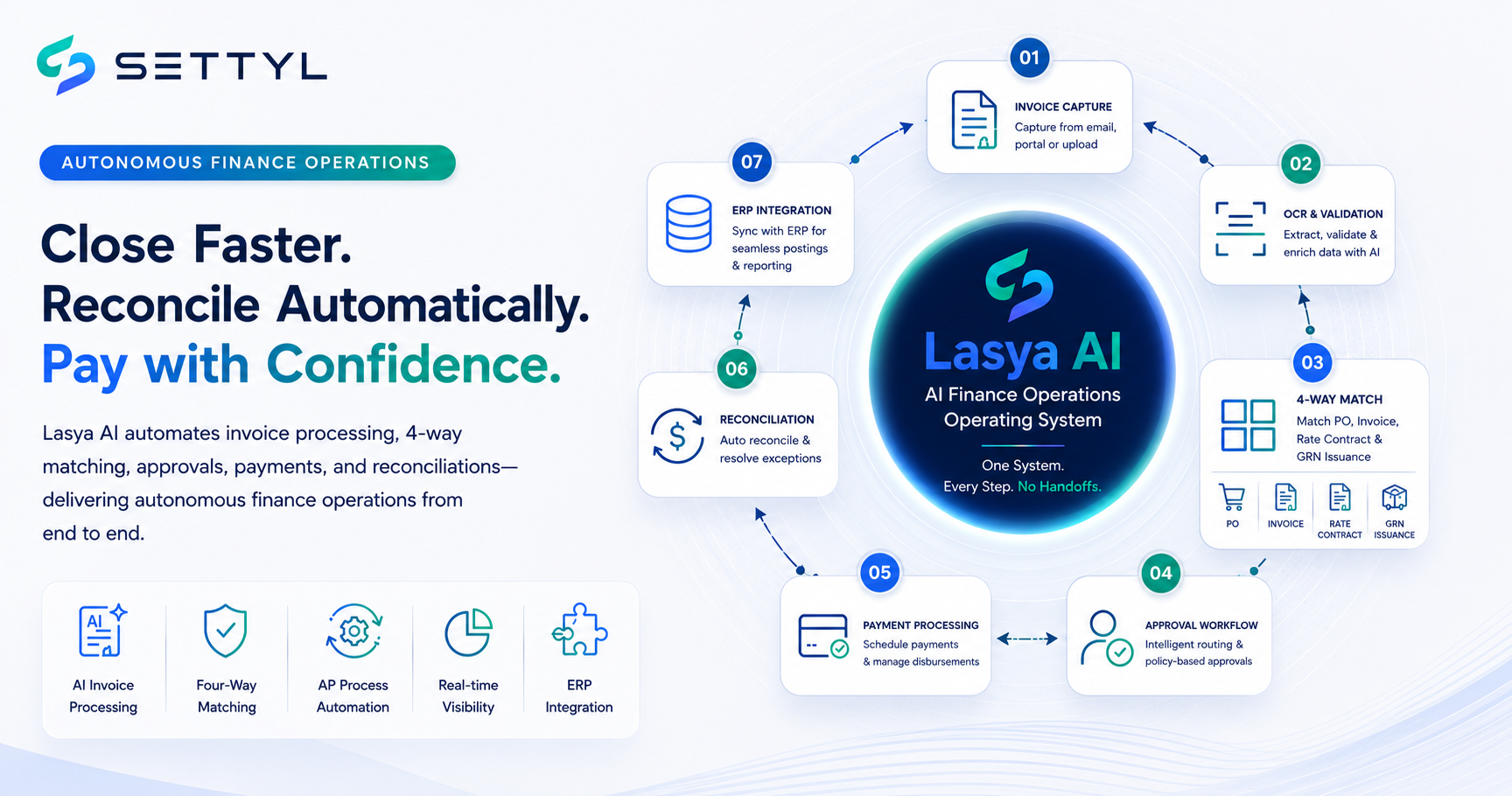
Autonomous Accounts Payable: From Invoice Intake to Verified ERP Posting
OCR can read the invoice. Autonomy begins when the system can carry the invoice to a verified business outcome.
Accounts-payable automation has improved dramatically. Document AI can extract invoice fields. Matching engines can compare purchase orders and receipts. Workflow tools can route approvals. ERP can post validated invoices.
Yet many AP teams still spend substantial effort on the work between those capabilities: identifying the correct transaction, locating missing evidence, interpreting why values differ, contacting procurement or logistics, chasing approvals, re-entering corrected information and confirming that the final posting succeeded.
That is the remaining execution layer.
Autonomous Finance Operations treats the invoice as part of a longer supply-chain transaction rather than as an isolated document-processing task.
What Autonomous Accounts Payable Actually Means
A stronger definition is:
Autonomous accounts payable is the governed execution of eligible invoice work from intake to verified ERP posting without avoidable human coordination.
The phrase eligible matters. Not every invoice should be fully touchless. Material commercial, compliance or policy exceptions can require human judgment.
The objective is to remove humans from routine relay work while preserving explicit controls for consequential decisions.
The Invoice Is Not the Transaction
An invoice is a financial representation of earlier operational events.
For a direct-material purchase, the relevant transaction may include:
purchase intent → sourcing → supplier commitment → PO → delivery → receipt → invoice → approval → posting → settlement.
For freight, it may include:
shipment requirement → carrier award → booking → movement → delivery → accessorial events → freight invoice → audit → posting.
The invoice inherits meaning from those earlier stages.
If AP processes the invoice without that context, every exception becomes a new investigation.
Stage 1: Invoice Intake Across Real Channels
Invoices arrive through structured and unstructured channels: EDI, APIs, supplier portals, email, PDFs, scans and spreadsheets.
The system should capture the document without requiring every supplier to adopt a new portal.
This preserves Settyl's no-new-portal principle: the enterprise can structure execution while external partners continue using the channels available to them.
Document intelligence can then extract invoice number, supplier, tax identifiers, dates, PO references, line items, quantities, prices, taxes and other fields.
Extraction is the start—not the outcome.
Stage 2: Resolve the Invoice to the Correct Transaction
The system must determine what the invoice belongs to.
That may require matching supplier identities, purchase orders, contracts, receipts, shipment references, delivery documents and prior amendments.
This is especially important when invoice references are incomplete or when suppliers use their own identifiers.
A reliable execution layer should resolve the invoice into persistent transaction context before deciding what to do next.
Stage 3: Validate Commercial and Operational Evidence
Validation should combine authoritative records with execution evidence.
Examples include:
- PO price and quantity;
- contract or rate-card terms;
- goods receipt;
- quality or acceptance status;
- proof of delivery;
- approved amendments;
- freight milestones and accessorial evidence;
- tax documentation;
- supplier or carrier commitments.
For clean transactions, deterministic rules should make the decision quickly.
For exceptions, the system should explain what differs and what evidence is missing.
Stage 4: Treat Exceptions as Execution Work
A mismatch is not merely an alert. It is unfinished work.
The execution layer should determine:
- what changed;
- where the discrepancy originated;
- whether an approved exception already exists;
- which party must provide evidence;
- which policy or tolerance applies;
- whether the issue can be resolved automatically;
- who must approve the final decision.
For example, a price variance may already have an approved PO amendment. A freight surcharge may already have an execution approval. A quantity variance may correspond to an accepted partial delivery.
If the evidence exists in the transaction, AP should reuse it rather than recreate the investigation.
Stage 5: Keep AI Inside Governance
AI is useful for interpreting emails, documents, exception narratives and ambiguous references. It can help explain why an invoice differs and recommend the appropriate resolution.
But authority should remain explicit.
Deterministic controls should govern:
- duplicate rules;
- tax logic;
- contract tolerances;
- monetary thresholds;
- supplier eligibility;
- segregation of duties;
- approval limits.
AI should operate within those constraints.
The objective is not unrestricted model autonomy. It is maximum eligible execution within governed authority.
Stage 6: Approval Should Receive the Complete Decision Context
When human approval is necessary, the approver should not receive a bare invoice and a generic exception code.
The approval package should explain:
- what the invoice claims;
- what the underlying transaction shows;
- what differs;
- what evidence supports the difference;
- which policy applies;
- what action is recommended;
- what will be posted if approved.
This shortens decision time and improves auditability.
Stage 7: ERP Posting Is Part of the Outcome
Many automation flows treat approval as completion.
It is not.
The validated invoice must be posted successfully to the authoritative System of Record, and the system should verify that the expected posting occurred.
A failed ERP write-back is an execution exception, not a technical footnote.
The System of Execution should retain responsibility until the intended financial state is confirmed.
This is the boundary described in System of Record vs. System of Execution.
Operational Memory Should Learn From Verified Resolutions
Every resolved invoice exception creates evidence.
The system can preserve which supplier created the issue, what caused it, which rule applied, what evidence resolved it, who approved it and what ERP outcome followed.
Repeated patterns can then inform future execution.
Examples include recurring supplier tax errors, frequent PO-reference omissions, common freight accessorial disputes or predictable timing gaps between delivery and invoice receipt.
The system becomes more effective through governed execution history—not simply through more prompts.
Autonomous AP vs. Traditional AP Automation
| Capability | Traditional AP automation | Autonomous AP execution |
|---|---|---|
| Invoice intake | Capture and OCR | Capture across channels and resolve to transaction |
| Matching | Compare selected records | Validate authoritative records plus execution evidence |
| Exceptions | Create queue | Investigate, coordinate and resolve under policy |
| Approvals | Route invoice | Route decision context and recommended outcome |
| ERP | Post when ready | Write back and verify authoritative outcome |
| Memory | Store invoice history | Preserve governed transaction-resolution history |
What to Measure
Useful AP execution measures include:
- eligible invoice Autonomy Rate;
- straight-through processing rate;
- manual touches per exception;
- exception-resolution cycle time;
- percentage of exceptions resolved using existing transaction evidence;
- approval latency;
- ERP posting success rate;
- repeat-exception rate.
These reveal whether the architecture is removing coordination rather than simply digitizing documents.
Lasya AI: Autonomous Finance as a System of Execution
Lasya AI is Settyl's System of Execution for supply chains.
For finance, that means carrying invoice work across supplier channels, procurement evidence, logistics evidence, approvals and ERP until the financial outcome is verified.
ERP keeps the financial record. Lasya runs the work required to create the correct record.
Frequently Asked Questions
What is autonomous accounts payable?
It is the governed execution of eligible invoice work from intake through transaction identification, validation, exception resolution, approval, ERP posting and verified closure with minimal manual relay.
How is autonomous AP different from OCR?
OCR extracts fields. Autonomous AP determines what transaction the invoice belongs to, validates it against commercial and operational evidence, resolves exceptions and completes the authoritative posting.
Should AI decide every invoice exception?
No. Deterministic controls and explicit authority should govern material decisions. AI can interpret unstructured evidence and recommend actions inside those boundaries.
Does autonomous AP replace ERP?
No. ERP remains the System of Record. The System of Execution performs and coordinates the work required to create a validated ERP posting.
Related Reading
Bring last month's exceptions.
Leave with the ROI model.
30-minute working session for the CFO and Controller. We'll run your real exception backlog through Lasya, project the working-capital release, and walk through the audit-trail evidence your InfoSec team will request.