
Data Gravity Built the Last Enterprise Stack. Execution Gravity May Build the Next One.

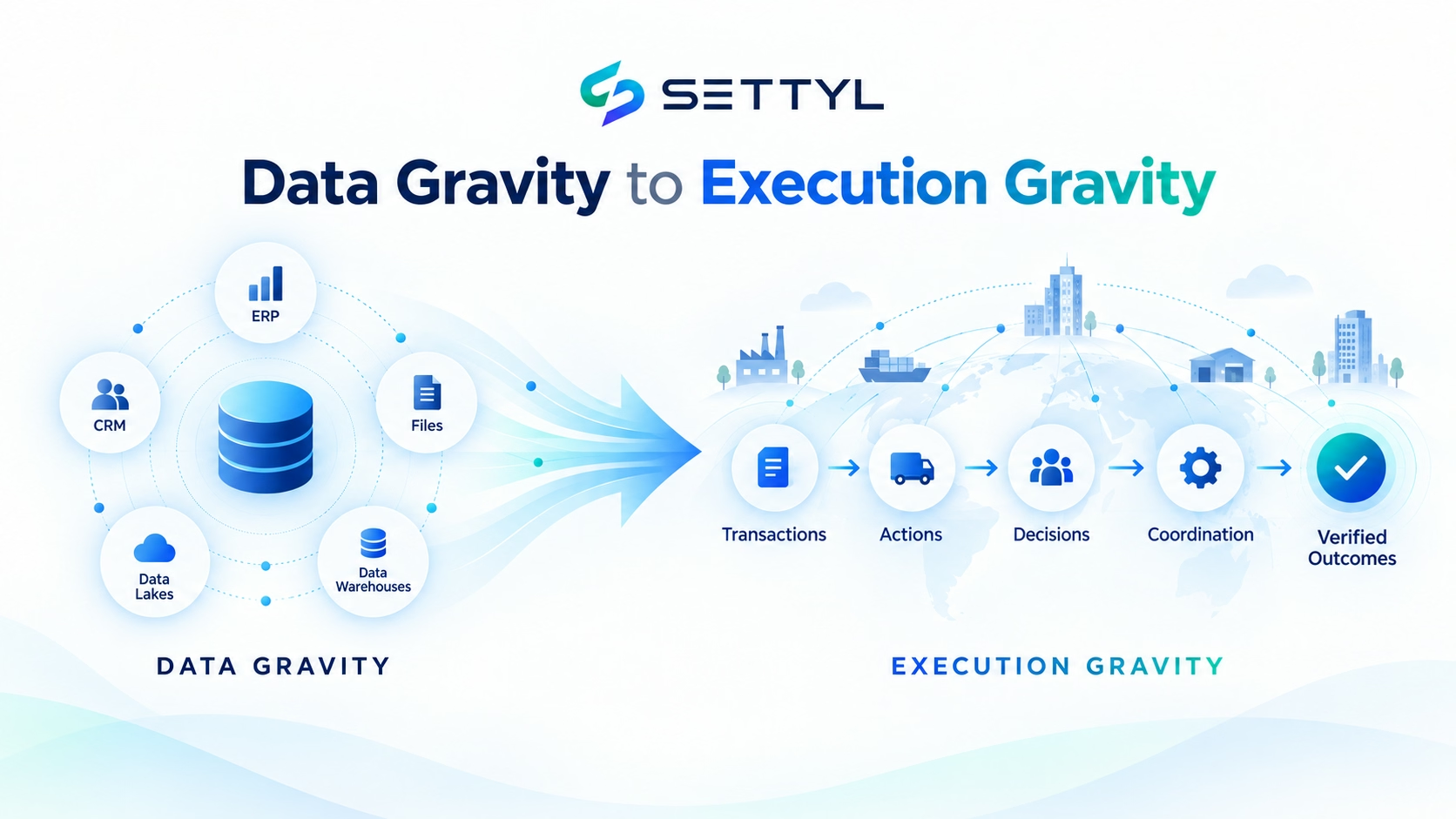
For most of the modern enterprise software era, the most strategically important systems became important because they accumulated authoritative data.
ERP became the home for financial transactions, purchase orders, inventory and master data. CRM accumulated customer relationships and commercial history. Planning systems accumulated forecasts, models and scenarios. Once those systems became authoritative, applications, integrations and workflows naturally gathered around them.
That effect is often described as data gravity. The more important data a system holds, the more other systems depend on it, governance forms around it, and it becomes part of the enterprise architecture rather than simply another application.
I think AI introduces a second kind of gravity that may become equally important in supply chains: execution gravity.
Execution gravity does not come from owning more enterprise data. It comes from taking responsibility for more of the work required to move a business transaction from intent to a verified outcome.
Data gravity solved the problem of authoritative state
Enterprise systems were designed around an essential requirement: the business needs to know what is true. What is the approved purchase order? What inventory exists? What was received? What invoice was posted? Which supplier is active? Which customer order is committed?
These questions require controlled, authoritative records. ERP became exceptionally valuable because it could preserve that state with governance, controls and auditability. It was never simply a database; it became the System of Record around which large parts of the enterprise were organized.
That responsibility is not becoming less important because of AI. If anything, AI makes authoritative state more important because agents need trustworthy master data, governed permissions, financial controls and reliable records of what the enterprise believes to be true.
So I do not think the next enterprise architecture emerges by replacing the systems that already own authoritative data. The more interesting opportunity is in the work that happens between those authoritative states.
The business does not experience records. It experiences transactions.
A purchase order inside ERP is an authoritative record, but the business objective is not to create a purchase order. The objective is to obtain the required material from the right supplier, under agreed commercial terms, delivered when needed, received correctly and financially closed.
Between PO creation and that final outcome, a large amount of execution has to happen. The supplier confirms quantity and date. A commitment changes. Procurement decides whether the change is acceptable. Logistics allocates a carrier. The carrier responds. A forwarder handles documents. Customs may request additional information. The warehouse records receipt. Finance reconciles the invoice against what actually happened.
The transaction may move through ERP, email, APIs, WhatsApp, customs portals, WMS and finance systems before it is finished. Each system may hold an important piece of the truth, yet historically no single system has remained responsible for carrying the transaction across all of those boundaries.
People have done that. They interpret what changed, determine what should happen next, chase external parties, preserve context, resolve exceptions and eventually update the Systems of Record. This is one of the operating patterns behind Operational Fragmentation.
This is where execution gravity begins.
Execution gravity forms around responsibility, not storage
Imagine two enterprise systems. The first stores a great deal of information but its responsibility largely ends when a transaction leaves its configured workflow. The second may store less authoritative data, but it remains responsible for progressing the transaction: interpreting external signals, understanding current execution state, determining the next governed action, coordinating participants, managing exceptions, collecting evidence and verifying whether the intended business outcome has actually occurred.
Over time, the second system accumulates something different from data gravity. More transactions pass through it, more exceptions are resolved through it, more partner commitments are interpreted through it, more operational decisions are governed through it and more outcomes are verified through it.
The system does not become strategically important because it owns every record. It becomes important because an increasing amount of work depends on it to get completed. That is what I mean by execution gravity.
Execution gravity becomes more important when the transaction crosses enterprise boundaries
Inside a single enterprise, many application boundaries can be addressed with workflow and integration. Supply chains are harder because the transaction itself leaves the company.
A supplier may respond by email. A carrier may work through an API or EDI connection. A freight forwarder may coordinate an exception through WhatsApp. A customs broker may depend on a government portal. A warehouse may use a completely different WMS.
The usual response has been to pull more participants into a common application or portal. Sometimes that works, but universal adoption is difficult because every external partner has its own operating environment and priorities.
The alternative is what Settyl describes as Multi-Enterprise Execution: carrying one transaction across independent enterprises, systems and channels while preserving execution state, context, ownership, policy and evidence.
The supplier does not need to become a user of the buyer's ERP. The carrier does not need another portal simply to participate in execution. The broker does not need access to internal systems. The execution layer carries the transaction context across those boundaries while each enterprise retains its own authority.
This is where execution gravity becomes more powerful than application workflow alone.
The next strategically important layer may be the one that owns progression
Historically, platform importance was closely linked to what data a system owned. In an AI-native architecture, another question becomes increasingly important: which system remains responsible for progressing the transaction when the work leaves the record?
A System of Record can tell us that the purchase order exists. A System of Execution needs to know whether the supplier accepted it, whether the commitment changed, whether that change affects planning, whether logistics must respond, whether the next action is permitted under policy and whether the final outcome was verified.
The System of Execution does not replace the System of Record. It complements it. The division of responsibility is clearer when expressed this way:
The System of Record preserves authoritative state. The System of Execution runs the governed work required to create the next verified state.
This is the architectural role Settyl is building Lasya AI to perform.
Execution gravity should not be confused with orchestration
An orchestration engine can sequence tasks. An integration platform can move data. An agent can perform a local action. A workflow system can route an approval. All of these capabilities can participate in execution, but execution gravity appears only when one layer retains responsibility for the transaction itself.
That means knowing where the transaction is in its lifecycle, what commitments currently exist, which exception is active, what decision was taken, what evidence has been received and what condition would constitute completion.
If the transaction moves from procurement to logistics and the context has to be reconstructed, execution ownership has broken. If the supplier changes a commitment and a person must manually explain its operational impact to another team, execution ownership has broken again. The same is true when a logistics exception is resolved but finance cannot understand the commercial consequence without reconstructing an email chain.
Execution gravity requires transaction continuity. A practical end-to-end example is covered in Multi-Enterprise Transaction Execution: From Purchase Intent to Financial Closure.
Operational Memory makes execution gravity compound
The more execution a system carries, the more governed history it observes. It sees what changed, which exception occurred, which decision was approved, which partner fulfilled a commitment, which recovery action succeeded, what evidence proved completion and what final outcome was written back to the System of Record.
At Settyl, that accumulated execution history is Operational Memory. It is not valuable simply because the system remembers more. It becomes valuable because future execution can begin with evidence from previous execution.
A supplier delay can be understood in the context of prior commitments and recoveries. A freight exception can be compared with how similar situations were resolved. An invoice discrepancy can be linked back to the operational event that created it.
The compounding loop is simple: execution creates evidence; evidence creates Operational Memory; Operational Memory improves future execution. The more governed work a System of Execution successfully carries, the more useful context it has for the next transaction.
The architecture is not ERP versus AI
Enterprise AI discussions can become unnecessarily binary: either AI replaces the application, or the application absorbs the AI. I do not think that is the most useful way to view the architecture.
ERP remains the authoritative System of Record. Planning systems continue to define important demand and supply intent. Specialized systems continue to perform functions they are good at. The System of Execution carries the transaction through the work that occurs between records and across enterprise boundaries.
Intent can originate in planning or ERP. The System of Execution takes responsibility for progressing the transaction, coordinates suppliers, carriers, forwarders, brokers, warehouses and internal teams through the channels available to them, handles exceptions under policy, preserves evidence and returns the verified result to the appropriate System of Record.
That is not a replacement architecture. It is a new division of labour. For the broader architecture, see the System of Execution comparison.
AI makes broader execution ownership possible
Traditional enterprise software struggled to own work across boundaries because so much of that work was unstructured. Supplier responses arrived in email, carrier updates came through calls or portals, forwarders sent documents and brokers worked through external systems. People interpreted those signals and carried the context forward.
AI can increasingly interpret many of those signals, reason against transaction context, determine governed next actions and interact through multiple channels. That means software can begin taking responsibility for work that previously depended on people acting as the coordination layer.
The strategic shift is therefore not simply from manual work to automated work. It is from software that supports execution to software that can increasingly own execution within defined governance.
Data gravity will remain. Execution gravity can sit beside it.
Execution gravity does not replace data gravity. The enterprise still needs authoritative records, governed master data and systems designed for financial and operational integrity.
The point is that strategic importance may no longer come only from owning those records. A second center of gravity can emerge around the layer that owns the progression of work and connects intent with outcome, internal systems with external participants, AI reasoning with governed action and current transactions with Operational Memory.
The enterprise stack can therefore organize around two complementary responsibilities: Systems of Record preserve authoritative truth; Systems of Execution create verified outcomes.
The first built much of the enterprise software architecture we know today. The second may define an important part of what comes next.
From data gravity to execution gravity
For years, the strongest enterprise platforms became stronger because more applications depended on the data they owned. AI creates the possibility that another kind of dependency becomes equally important: more transactions depending on one layer to complete the work.
That is execution gravity. In supply chains, where transactions routinely cross companies, systems and communication boundaries, the concept becomes particularly relevant.
The next enterprise architecture question may therefore be less about where all the data should live and increasingly about which system owns responsibility for getting the transaction to the intended outcome.
At Settyl, that is the role we are building Lasya AI around: the System of Execution for supply chains, carrying transactions across enterprises, systems and channels until the intended business outcome is verified. The outcome is Autonomous Supply Chain Execution.
ERP keeps the authoritative record. Lasya runs the work.
Frequently Asked Questions
What is data gravity in enterprise software?
Data gravity is the tendency for applications, integrations, workflows and governance to gather around systems that hold important authoritative enterprise data. ERP is a strong example because other processes depend on the records and controls it preserves.
What is execution gravity?
Execution gravity is the strategic pull created when one layer takes responsibility for progressing more business transactions from intent to verified outcome. Its value comes from execution ownership, governed action, transaction continuity and accumulated execution evidence rather than from replacing authoritative Systems of Record.
How is a System of Execution different from a System of Record?
A System of Record preserves authoritative enterprise state. A System of Execution carries the governed work required to create the next verified state across systems, functions and external participants, then writes the validated outcome back to the appropriate System of Record.
Does execution gravity mean replacing ERP?
No. ERP remains foundational for master data, approved transactions, financial integrity, controls and auditability. Execution gravity describes a complementary center of responsibility around progressing work between records and across enterprise boundaries.
Why does execution gravity matter particularly in supply chains?
Supply-chain transactions routinely cross suppliers, carriers, forwarders, brokers, warehouses and internal teams using different systems and channels. A System of Execution can preserve one governed transaction state across those boundaries instead of relying on people to repeatedly relay context.
Related Reading
- System of Record vs. System of Execution in Supply Chain — the architectural division between authoritative state and transaction progression.
- The Enterprise Boundary Is the Wrong Boundary for Supply-Chain AI — why execution ownership must follow the transaction across companies.
- Multi-Enterprise Execution — the framework for carrying one transaction across independent enterprises, systems and channels.
- Operational Memory in Supply Chains — why verified execution history becomes a compounding source of context.
- Lasya AI — Settyl's System of Execution for supply chains.
Bring last month's exceptions.
Leave with the ROI model.
30-minute working session for the CFO and Controller. We'll run your real exception backlog through Lasya, project the working-capital release, and walk through the audit-trail evidence your InfoSec team will request.