Why ERP Completion Is Not Supply-Chain Transaction Completion
An ERP can record a finished order or invoice while the business transaction underneath is still open.
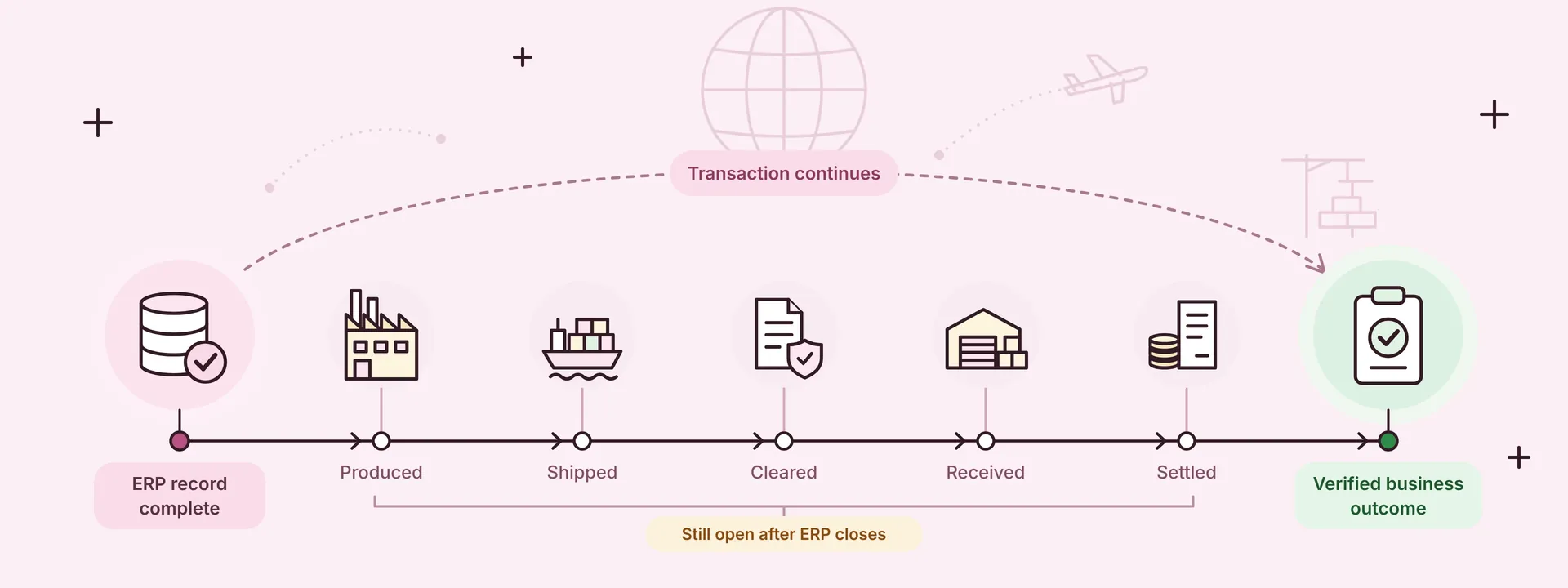
Enterprise systems are very good at recording that something happened.
A purchase order was created. A supplier was selected. A shipment was booked. A goods receipt was posted. An invoice was entered.
From the perspective of each application, these events can look complete.
But from the perspective of the business, the transaction may still be unresolved.
The supplier may have changed the promised quantity. The carrier may not have accepted the load. Customs may be waiting for a document. The warehouse may have received less than expected. Finance may be holding the invoice because freight charges no longer match the commercial reality of the shipment.
This is one of the most important distinctions in modern supply-chain execution:
Application completion is not the same as transaction completion.
ERP remains essential because it is the authoritative System of Record for enterprise transactions. But the supply-chain transaction does not begin and end inside ERP.
It travels across planning systems, procurement workflows, suppliers, carriers, forwarders, brokers, warehouses, finance teams, communication channels and external companies.
That is where the execution problem begins.
Settyl describes this failure of continuity as Operational Fragmentation: the transaction crosses multiple systems and enterprises, but its context, responsibility and next action repeatedly fall back to people.
A truly autonomous supply chain therefore cannot be built simply by automating more screens inside existing applications.
It requires a different unit of execution.
That unit is the transaction itself.
The ERP Record Can Be Complete While the Business Outcome Is Still Open
Consider a simple procurement transaction.
A manufacturing plant needs 10,000 units of a component by October 20.
Planning identifies the requirement. A requisition is approved. Procurement creates a purchase order. ERP now contains a valid purchasing record.
From the perspective of the ERP workflow, an important stage is complete.
But the business outcome is nowhere near complete.
The supplier still has to commit to the quantity, requested date, commercial terms, manufacturing or readiness schedule and potentially the shipment plan.
Suppose the supplier responds: “We can supply 7,000 units by October 20 and the remaining 3,000 on October 27.”
The ERP transaction exists. But now someone has to determine what that supplier response means operationally.
None of these questions disappears because the purchase order exists.****
The record is complete. The execution is not.
This is the central architectural gap a System of Execution is designed to address.
Systems of Record Were Never Designed to Own the Entire Transaction
ERP systems are extraordinarily important.
They maintain authoritative enterprise data for materials, suppliers, purchase orders, inventory, financial postings, invoices, accounting and many other critical records.
They should continue doing that.
The mistake is expecting the System of Record to also own every piece of operational work required between those records.
Supply-chain execution happens in a much more fluid environment.
A single transaction may touch:
Planning → Procurement → Supplier → Logistics → Forwarder → Customs → Warehouse → Finance → ERP
Each stage may use a different application. Each external partner may use a different communication channel.
The supplier may work through email. The carrier may work through a portal. The forwarder may send a spreadsheet. The customs broker may exchange PDFs. A warehouse may update a WMS. Finance may work inside ERP.
The transaction continues across all of them.
The System of Record
The System of Record answers questions such as:
The System of Execution
The execution layer answers a different set of questions:
These responsibilities complement each other.
Settyl does not position Lasya AI as a replacement for ERP. ERP remains the System of Record. Lasya AI is the System of Execution that carries the work between authoritative records until the business outcome is verified.
For a detailed architectural comparison, see System of Execution vs ERP, planning, procurement, TMS and AI agents.
A Supply-Chain Transaction Is Larger Than a Purchase Order
One reason enterprises struggle with autonomous execution is that transactions are often defined according to application objects.
Procurement sees a PO. Logistics sees a shipment. A warehouse sees a receipt. Finance sees an invoice.
Each of those objects matters. But none represents the full business transaction.
The transaction is the continuous chain of intent, commitments, actions, evidence and outcomes connecting them.
A useful transaction spine is:
Business Intent → Verified Supplier Commitment → Verified Physical Execution → Verified Financial Closure → ERP Authoritative Record
This distinction changes how automation should be designed.
Instead of asking, “Can AI automate purchase-order follow-up?” the better question becomes: “Can the transaction progress from approved intent to verified supplier commitment without a person carrying context between systems?”
Instead of asking, “Can AI automate freight booking?” ask: “Can the same transaction carry supplier commitment into physical execution and recover when transportation conditions change?”
Instead of asking, “Can AI match an invoice?” ask: “Can financial closure use the actual execution history of the transaction to determine whether the commercial claim is correct?”
The transaction is larger than any individual application object.
That is why the transaction - not the application - must become the unit of autonomy.
Stage 1: Business Intent
Every supply-chain transaction begins with a business reason.
The enterprise needs something to happen. It may need material for manufacturing, finished goods to fulfill customer demand, a spare part for maintenance, inventory transferred between plants or transportation capacity.
That need can originate in demand planning, MRP, production planning, customer orders, maintenance, inventory policies, project demand or another governed planning process.
Planning systems are extremely valuable here. They determine what should happen.
But once the intent is approved, execution begins.
The transaction now needs to carry material or service identity, quantity, required date, destination, business priority, approved budget, commercial constraints, sourcing policy, source references and approval context.
If that context disappears when procurement begins, people must reconstruct it later.
That is one of the earliest forms of Operational Fragmentation.
The data may exist. The continuity does not.
Stage 2: Purchase Order Created Does Not Mean Supplier Commitment
One of the most common supply-chain misconceptions is treating PO creation as procurement completion.
A purchase order is important because it formalizes buyer intent. But the supplier still has to execute against it.
Real supplier responses frequently introduce new conditions.
The business transaction therefore cannot treat PO creation as the end of procurement execution.
The meaningful milestone is verified supplier commitment.
That means the system knows what the supplier has actually committed to and whether the enterprise has accepted that commitment.
Settyl’s Autonomous Sourcing & Procurement capability focuses on carrying purchase intent through supplier interaction, sourcing, negotiation, approvals, PO creation and verified commitment.
Procurement completion is not “PO created.” It is the point at which the required commercial outcome has been verified sufficiently for the transaction to move into physical execution.
Stage 3: Supplier Commitment Must Become Physical Execution State
Once the supplier commits, the transaction moves into the physical world.
This introduces a new set of participants: carriers, freight forwarders, customs brokers, warehouses, ports, terminals, third-party logistics providers and potentially customers.
The physical execution stage may include material readiness, pickup planning, carrier allocation, booking, dispatch, milestones, multimodal movement, customs documentation, customs clearance, transshipment, delivery, receipt, POD and exception recovery.
The crucial architectural principle is that this should not become a separate transaction.
The logistics team should not have to rebuild the commercial context from scratch. The carrier should not receive a disconnected shipment instruction without the state required to understand what is being executed. The finance team should not later have to reconstruct why a shipment split occurred.
One transaction should continue.
This is the role of Multi-Enterprise Execution.
A supply-chain transaction should be able to cross buyer, supplier, carrier, forwarder, broker, warehouse and finance boundaries without losing its state every time it crosses an enterprise boundary.
Shared execution does not require every participant to use the same application.
It requires the transaction to preserve continuity across applications and channels.
Enterprise Boundaries Are Where Transaction Context Usually Breaks
Most supply chains are not executed inside one company. They are networks.
That creates a fundamental problem for traditional application architecture.
Internal enterprise software assumes controlled users, controlled workflows and controlled data structures. External supply-chain execution is different.
Suppliers may respond through email. Carriers may use WhatsApp or their own portals. Forwarders may work through spreadsheets. Brokers may send documents. Small vendors may have no integrated systems at all.
If the enterprise requires everyone to adopt the same portal before automation works, autonomy becomes dependent on ecosystem adoption.
That is often unrealistic.
Multi-Enterprise Execution therefore has to operate across existing channels such as email, WhatsApp, EDI, APIs, portals, documents, spreadsheets and voice interactions.
The goal is not to force every company into one software interface.
The goal is to maintain one coherent transaction state regardless of how each participant communicates.
That is what allows the transaction to remain executable across enterprise boundaries.
Stage 4: Tracking Is Not the Same as Execution
Modern supply chains have become much better at visibility.
Organizations can see shipments in transit. They can predict ETAs. They can detect delays. They can generate alerts.
These capabilities are valuable.
But visibility answers: What happened?
Execution answers: What should happen next?
Suppose an inbound shipment is predicted to arrive 48 hours late.
A visibility platform may successfully identify the delay. But the business problem has only begun.
Someone still has to determine whether production is affected, how much inventory remains, whether another shipment can be expedited, whether an alternate supplier exists, whether the customer commitment changes, whether the warehouse slot must move, whether customs documentation must change, whether Finance should adjust accruals and whether management approval is required.
If the platform raises an alert and a human takes over from there, the system has provided visibility. It has not executed the recovery.
This distinction is central to Autonomous Supply Chain Execution.
Autonomy requires more than detecting the exception. The system must remain responsible for progressing the transaction through the governed recovery process until the new outcome is verified.
Happy-Path Automation Is Not Autonomous Execution
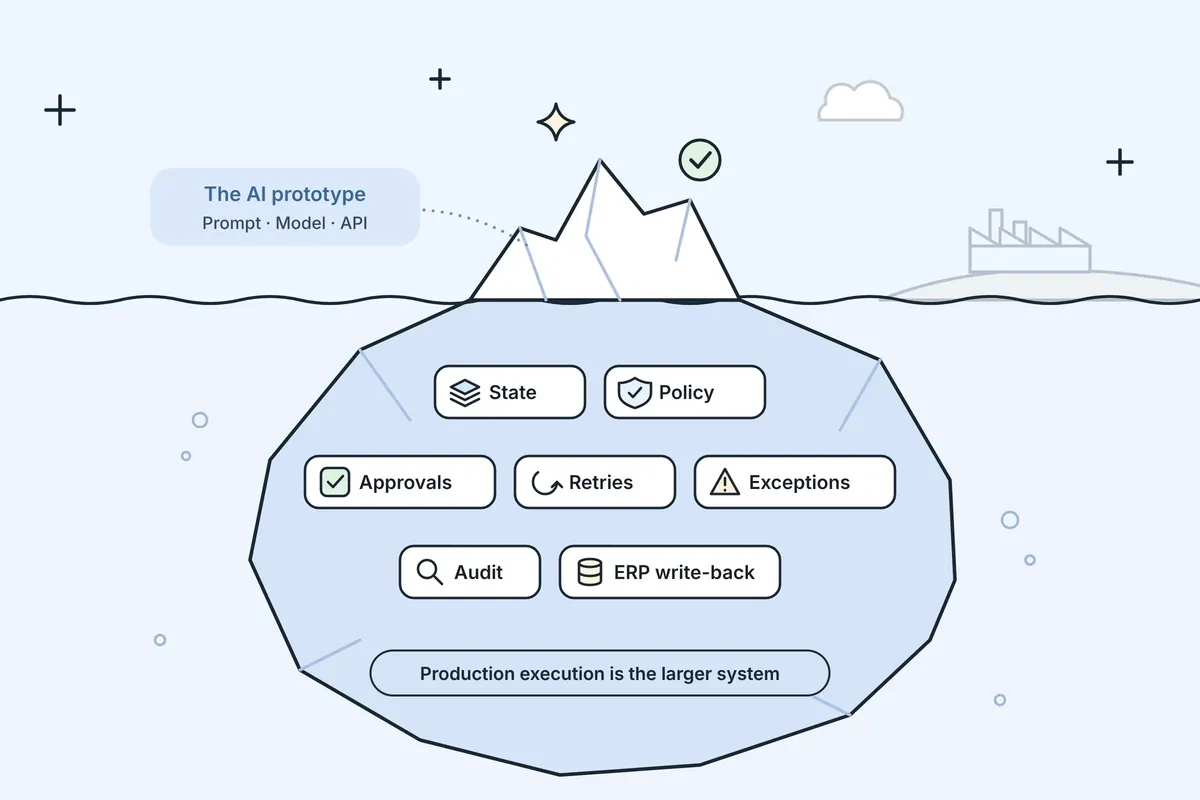
Many automation projects look successful because they automate the normal path.
If the supplier confirms exactly as expected, continue. If the carrier accepts, continue. If the invoice matches, continue.
But supply chains are rarely defined by their happy path.
Real operations contain supplier rejection, promise-date changes, quantity shortages, carrier rejection, no vehicle placement, delayed pickup, shipment delay, customs holds, document mismatches, damaged goods, short receipts, freight variance, invoice discrepancy and customer delivery risk.
Autonomy is therefore tested most clearly when reality deviates from the plan.
A transaction-centric execution system needs to preserve what was originally expected, what actually happened, what changed, why it changed, which policy applies, who has authority, what actions are permitted, what was attempted and what outcome is now required.
Without that context, AI may automate individual tasks but still depend on humans to understand the exception.
That is not transaction autonomy.
The Human Becomes the Integration Layer
Look closely at many supply-chain organizations and a consistent pattern appears.
A buyer receives an email from a supplier. The buyer updates a spreadsheet. The buyer tells planning that the date changed. Planning tells logistics. Logistics changes the booking. The forwarder sends another update. The warehouse changes the receiving plan. Finance later asks why the commercial documents no longer match.
Every system may be functioning correctly.
Yet the transaction moves forward because people carry its context.
This is the practical signature of Operational Fragmentation.
The employee is functioning as integration middleware, context memory, exception orchestrator, policy interpreter, approval router and workflow engine.
Enterprises often describe this as “manual work.” That understates the problem.
The deeper issue is that no system owns continuity across the transaction.
More local automation can reduce individual tasks without fixing that architecture.
Why Point AI Agents Can Recreate the Same Fragmentation
AI is now being embedded into procurement, logistics, finance and many other enterprise applications.
That is useful.
But it introduces a new risk: organizations may simply replace fragmented applications with fragmented agents.
A procurement agent knows procurement. A logistics agent knows logistics. A finance agent knows invoices.
If each agent has its own isolated state, the same coordination problem remains.
The supplier changes a promise date. The procurement agent understands it. But now someone - or another orchestration layer - must decide what the logistics agent should do. Then the freight change affects the invoice. Finance needs the execution history.
Without one shared transaction state, the enterprise has created a more intelligent collection of silos.
The interface changed. The architecture did not.
This is why Settyl’s position is not “deploy more AI agents.”
Agents are workers. The transaction is the unit of autonomy.
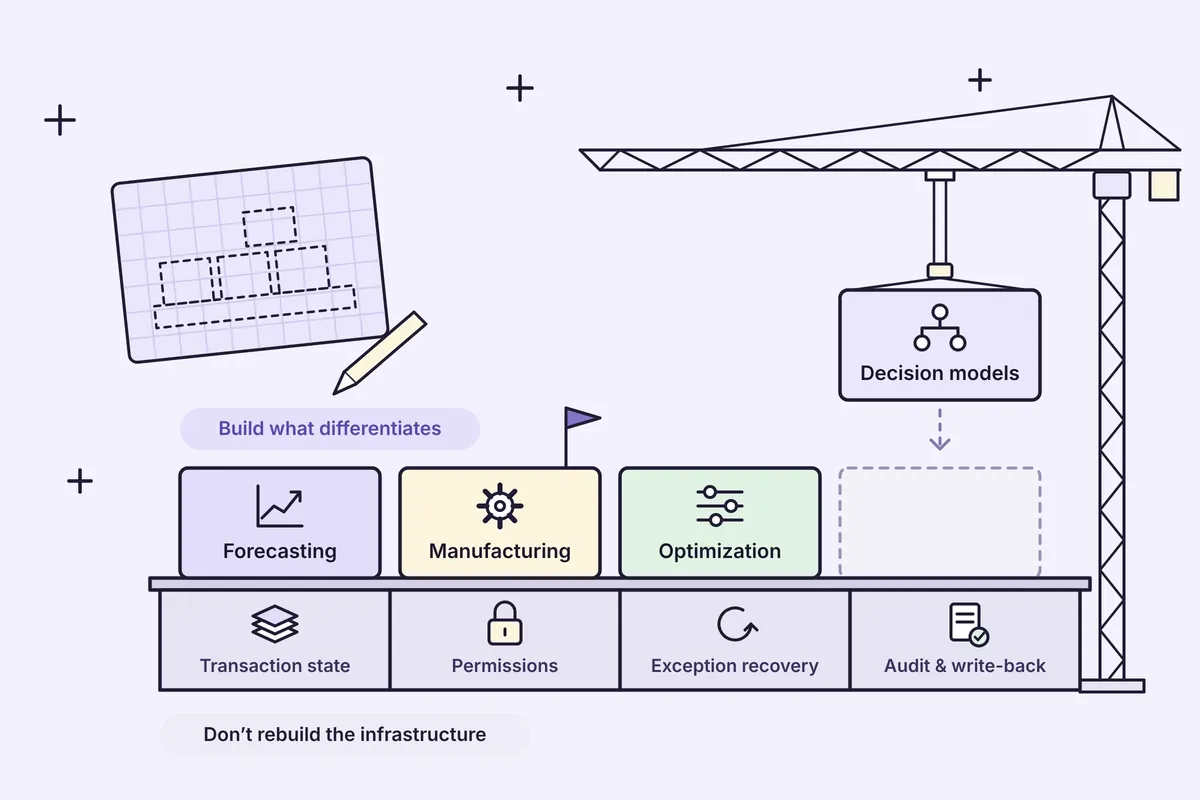
Agents should execute specialized work inside the context of the same governed transaction.
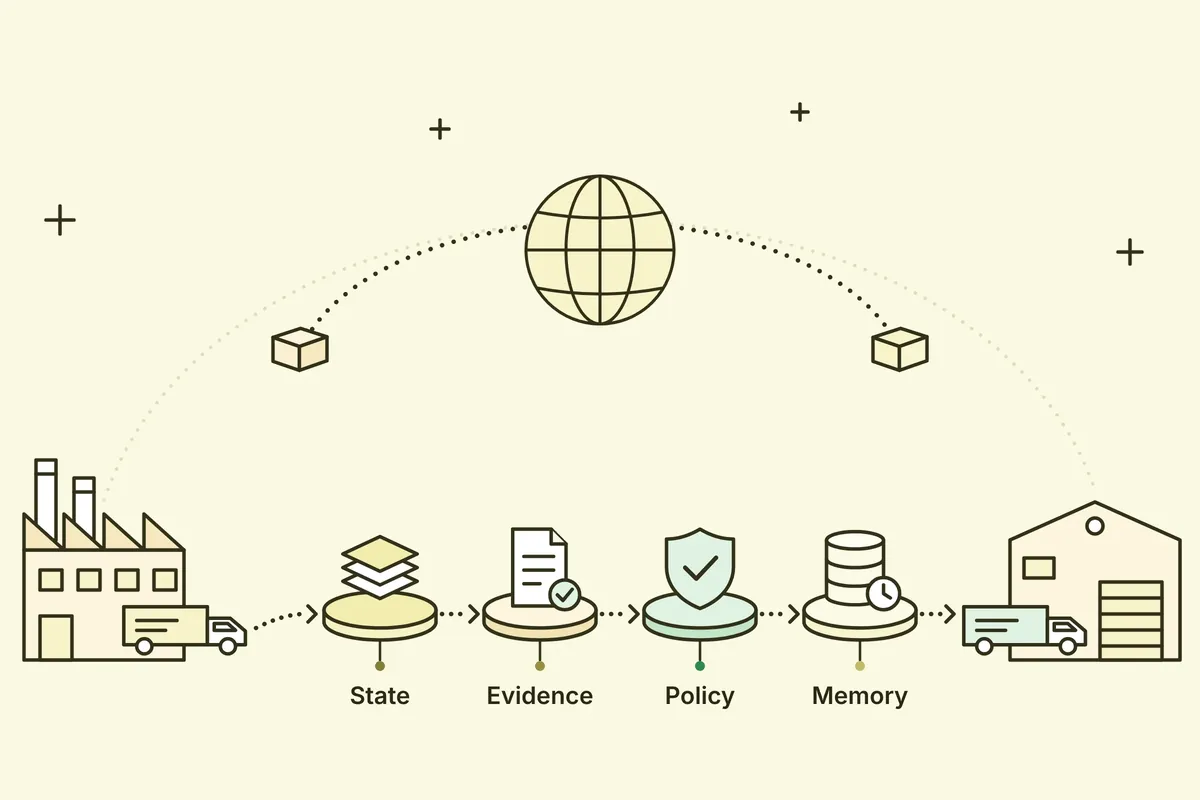
What a Transaction State Actually Needs to Remember
A transaction is not just a status such as Open, In Progress, Delivered or Closed.
For autonomous execution, the transaction needs a much richer operational memory.
Business intent
Why does the enterprise need this transaction? What demand, production plan, customer requirement or operational objective does it support?
Participants
Which buyer, supplier, carrier, forwarder, broker, warehouse and finance stakeholders are involved?
Commercial state
What quantity, price, terms, delivery conditions and contractual obligations apply?
Commitments
What did each participant promise? When? What changed later?
Physical state
What has actually moved? Where is it? What evidence supports the current milestone?
Documents and evidence
Which PO, invoice, packing list, transport document, customs document, POD or other evidence belongs to the transaction?
Policies and authority
Which rules determine whether a deviation is acceptable, and who can approve the next action?
Exceptions and recovery
What is currently preventing the transaction from reaching the intended outcome? What has already been attempted, and did the corrective action succeed?
Financial state and completion criteria
Does the final commercial claim match what actually executed, and what evidence is required before this transaction can truly close?
This accumulated transaction history becomes the foundation for operational learning.
Stage 5: Delivery Is Not Necessarily Transaction Closure
Supply-chain organizations often treat physical delivery as the finish line.
But the economic transaction may still be open.
Suppose goods were delivered, but quantity was short, material was damaged, freight changed, detention occurred, a claim remains unresolved, taxes differ, invoice quantities do not match receipt or the supplier billed against the original commitment rather than what actually executed.
Finance now needs more than an invoice. It needs execution context.
Traditional invoice matching often focuses on records: PO → Receipt → Invoice.
But true financial closure asks a broader question:
Does the financial claim accurately represent the transaction that actually executed?
That requires access to the commercial and physical history of the transaction.
Settyl’s Autonomous Finance Operations extends the same transaction into invoice processing, exceptions, approvals and verified financial closure.
Finance is not a separate automation island. It is another stage of the same transaction.
The Transaction Should Close Only When the Outcome Is Verified
This leads to a stricter definition of completion.
A transaction should not close merely because the PO was created, supplier confirmation arrived, the shipment was booked, tracking says delivered, a goods receipt exists or an invoice was entered.
The transaction should close when the required business outcome has been verified.
That may mean required quantity received, delivery condition accepted, exception resolved, financial claim reconciled, approvals complete and authoritative records updated.
The execution architecture should therefore treat completion as a governed business condition rather than an application status.
This shifts the question from “Did every application complete its task?” to “Did the enterprise achieve the intended outcome?”
ERP Should Remain Authoritative
None of this reduces the importance of ERP.
In fact, a clear separation between execution and record authority can strengthen ERP governance.
ERP should continue to own authoritative records such as approved purchase orders, material masters, financial postings, inventory movements, receipts, invoices and accounting entries.
The execution layer should not create a competing source of truth.
Instead, it should carry the operational work that occurs between those authoritative states.
Once the outcome is verified, the governed result should synchronize back to ERP.
ERP owns the record. The System of Execution owns the work required to move from one verified record state to the next.
That is a complementary architecture - not an ERP replacement strategy.
What Autonomous Supply-Chain Execution Actually Means
The phrase “autonomous supply chain” is often used loosely.
It can mean automation, prediction, AI recommendations or robotics.
Settyl uses a more operational definition.
Autonomous Supply Chain Execution is the outcome when supply-chain transactions can progress across systems, companies and communication channels with minimal human relay - including when exceptions occur.
That does not mean humans disappear.
Humans remain essential for policy, strategic judgment, approval, negotiation, exceptional authority and governance.
The difference is that humans should not have to manually carry routine transaction context from one application to another.
The system should know what the transaction is trying to achieve, what state it is in, what changed, what policy applies, what action is permitted, who has authority and whether the outcome has been verified.
The Architecture: System of Record + System of Execution
The emerging enterprise architecture is not ERP versus AI.
It is System of Record + System of Execution.
ERP remains authoritative. Planning determines what should happen. Specialized applications continue performing valuable domain functions. The System of Execution carries the transaction across them.
The architecture becomes:
Planning / Business Intent → System of Execution → Supplier Commitment → Physical Execution → Financial Closure → Verified Outcome → ERP Authoritative Record
This architecture acknowledges the reality of modern supply chains.
The transaction is distributed. The applications are heterogeneous. The companies are independent. The communication channels vary.
The transaction still needs one continuous execution state.
How to Identify Transaction-Completion Gaps in Your Own Supply Chain
A useful diagnostic exercise is to take one real transaction and follow it from beginning to end.
Do not start by mapping applications. Start by mapping ownership.
Where does the transaction begin?
What business intent created it?
When does it first leave the System of Record?
Does supplier communication move into email or another channel?
Where is context manually reconstructed?
Does someone re-enter quantities, dates or commercial terms?
Where does responsibility move through a human?
Does one person have to tell another team what changed?
Where are exceptions detected but not resolved?
Does a control tower raise an alert but depend on humans for recovery?
Where do external enterprises break continuity?
Can the supplier, carrier, forwarder or broker change transaction state without someone manually interpreting it?
Where does Finance reconstruct the past?
Does AP need to ask Procurement and Logistics what happened before it can close the invoice?
Every recurring manual relay is a clue.
It tells you where application ownership ended while transaction ownership remained unresolved.
What Enterprises Should Measure Instead of Task Automation
Traditional automation programs often measure number of tasks automated, time saved, headcount avoided, number of bots, number of workflows or number of API integrations.
These metrics can be useful. But they do not reveal whether the business transaction became autonomous.
Human-relay rate
How often must a person manually carry context between systems or companies?
Exception autonomy rate
What percentage of operational exceptions are resolved without manual coordination?
Transaction completion time
How long from approved intent to verified outcome?
Rework rate
How often is transaction context reconstructed or re-entered?
State continuity
How many transaction stages share the same governed execution context?
Verified completion rate
How many transactions reach closure with all required business evidence present?
These metrics shift attention from isolated automation to end-to-end execution.
From Application Automation to Transaction Autonomy
The enterprise software landscape is not disappearing.
ERP will remain. Planning systems will remain. TMS, WMS, procurement platforms and financial systems will remain where they create value.
Suppliers and logistics partners will continue using different systems and communication channels.
The opportunity is not to replace all of them with one giant platform.
The opportunity is to introduce an execution layer that connects their responsibilities around the transaction.
That is the core idea behind Lasya AI.
It treats sourcing, procurement, logistics, EXIM and finance not as isolated software categories, but as execution stages inside one supply-chain transaction.
The transaction carries its state across those stages. Agents perform specialized work. ERP remains authoritative. The transaction remains open until the outcome is verified.
One Transaction. One State. One System of Execution.
The fundamental problem in enterprise supply chains is not that organizations lack applications.
It is that the transaction frequently loses continuity between them.
A purchase order can be complete while supplier commitment is unresolved.
A booking can be complete while physical execution is at risk.
Tracking can be accurate while nobody owns recovery.
Delivery can be complete while financial closure remains unresolved.
Every one of those situations has the same underlying architecture:
The application finished. The transaction did not.
The next generation of supply-chain execution will therefore not be defined simply by how many tasks AI can automate.
It will be defined by whether the transaction can survive every system boundary, enterprise boundary and operational exception without repeatedly returning to a person for context.
That is the difference between task automation and autonomy.
That is the difference between visibility and execution.
And that is why the transaction - not the application - must become the unit of autonomous supply-chain execution.
Explore Settyl’s System of Execution for Supply Chains, the framework for Multi-Enterprise Execution, and the target outcome of Autonomous Supply Chain Execution.