
The Model Is Not the Moat. Execution Context Is.
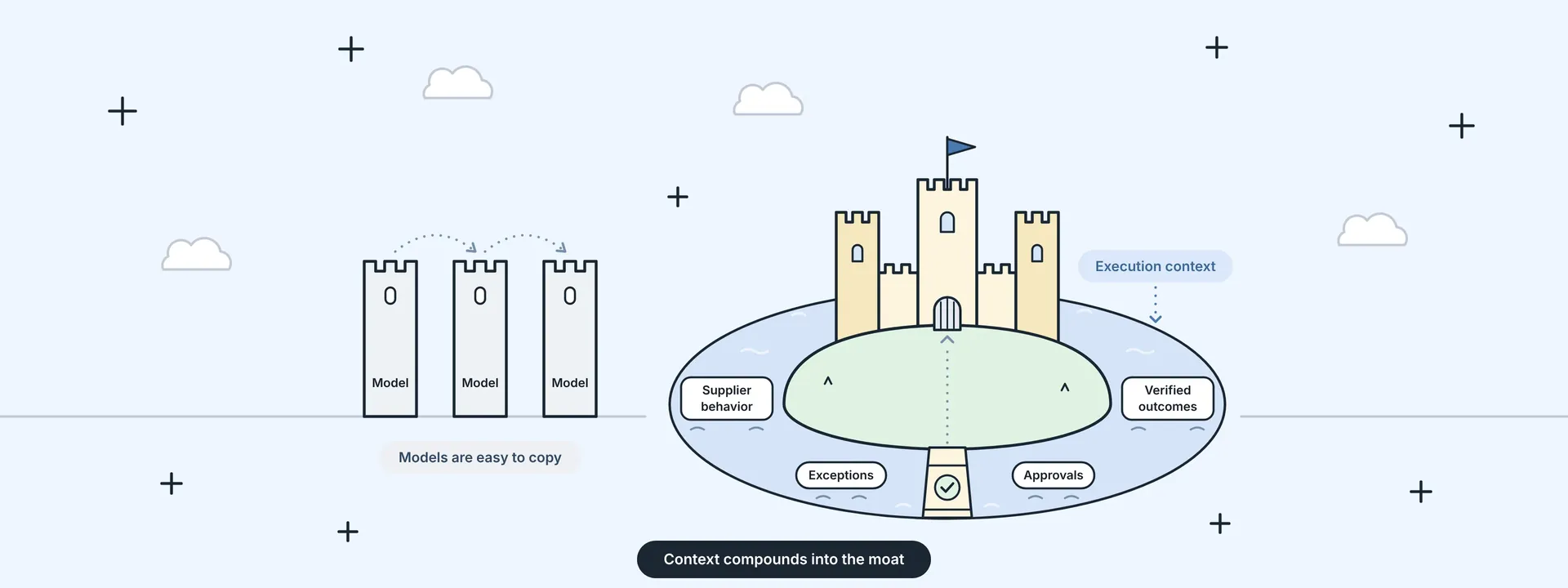
Expect today’s best model to be surpassed - and keep the model separate from the operating context around it.
Manufacturers should assume that today’s best AI model will not remain the best model forever.
That is not a weakness in an AI strategy. It is a reason to separate the model from the operating context around it.
A procurement agent can be rebuilt. A logistics copilot can move from one model provider to another. A document classifier can be replaced. The model layer will continue to improve and become more interchangeable.
What becomes harder to recreate is the execution context accumulated from real work.
The model provides intelligence. The operation provides evidence.
Consider a supplier that repeatedly confirms aggressively and then slips by two days. A carrier that performs well on one lane but poorly on another. An invoice exception that repeatedly resolves through the same approved tolerance. A customs document that fails whenever one specific certificate is missing.
None of those patterns is valuable merely because an LLM remembers a conversation about them.
The useful context comes from the completed loop: what was requested, what changed, which policy applied, what action was approved, what the partner actually did and whether the intended outcome was verified.
This is why Settyl distinguishes Operational Memory from generic model memory.
Execution context compounds transaction by transaction
A manufacturing transaction carries information that no generic model starts with:
- which supplier commitments were actually reliable;
- which exceptions were accepted under policy;
- which recovery actions worked;
- which approvals were required;
- how long each external party responded;
- which evidence was sufficient to close the transaction;
- what was finally written back to ERP.
Over time, this creates context that is specific to the enterprise and its operating network.
The model can change underneath it. The transaction history remains useful.
This changes the build-vs-buy discussion
If a manufacturer builds an internal AI agent, the most important architectural question is not whether the company can keep the original prompt or model forever.
It is whether the execution evidence created by that agent remains portable, governed and reusable when the model changes.
A strong architecture therefore keeps model choice flexible while preserving the transaction state and verified execution history outside any single model session.
That is the role of a System of Execution: specialized intelligence can change, while the execution layer maintains policy, state, authority, evidence and the history of verified outcomes.
The durable layer is not a smarter chatbot
The defensible layer is the growing record of how the operation actually behaves.
Which supplier is dependable under shortage? Which lane repeatedly creates detention? Which invoice exception is routine? Which approval path is required for a specific category? Which action produced the verified recovery?
Those answers are not created by selecting a better foundation model. They are earned by running transactions.
Models can be replaced. Execution history cannot be recreated on demand.
That is why the more durable AI architecture for manufacturing separates intelligence from execution context instead of binding the operating model to one agent or one model provider.