
Five Internal AI Agents Can Become Five New Operational Silos
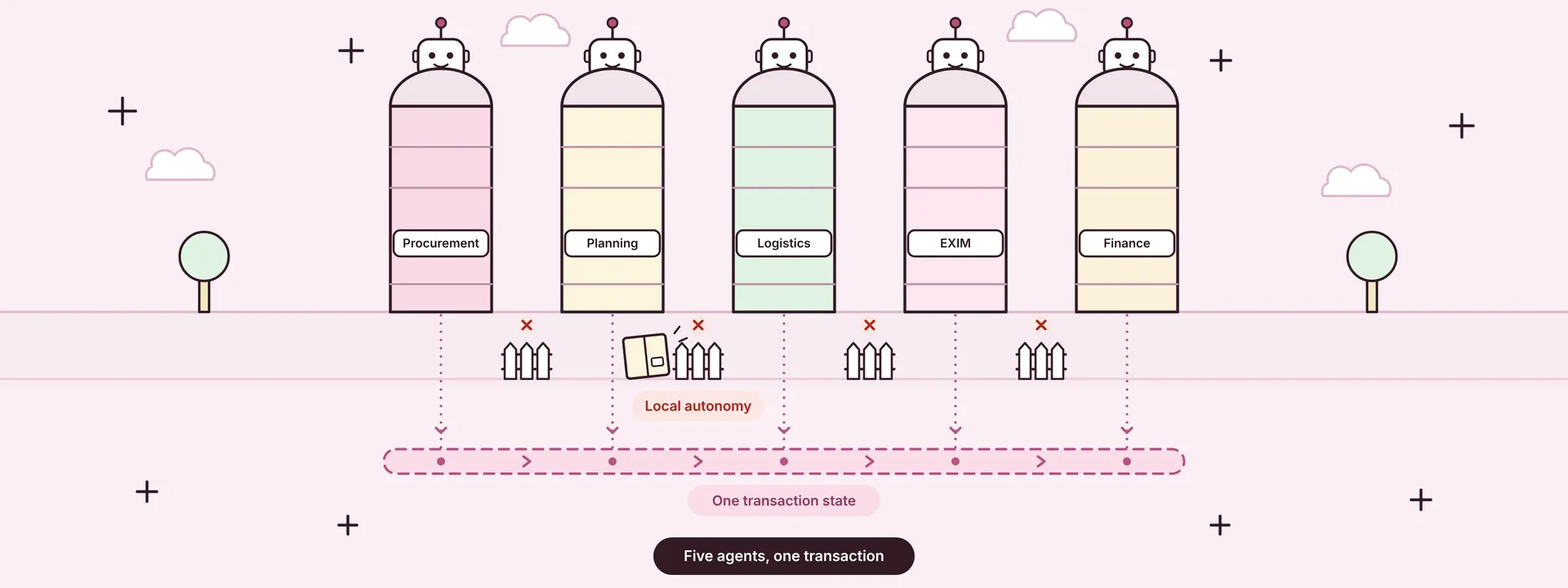
More agents without a shared transaction state rebuild the same integration problem enterprises spent years solving.
A manufacturer can build five useful AI agents and still leave the supply-chain transaction manual.
Procurement AI can run an RFQ. Planning AI can calculate impact. Logistics AI can propose transport. EXIM AI can inspect documents. Finance AI can investigate an invoice.
Each agent may work exactly as designed.
The transaction can still fail between them.
Local autonomy is not transaction autonomy.
One supplier delay exposes the architecture
Imagine a supplier changes its commitment from 10,000 units on Friday to 7,500 Friday and 2,500 Monday.
Procurement AI correctly interprets the supplier response.
Planning AI correctly identifies a production risk.
Logistics AI correctly sees that the original freight booking no longer fits.
EXIM AI correctly identifies that a document date may need revision.
Finance AI correctly predicts an accrual impact.
Five agents can all be correct and the operation can still need a person to decide which version of the transaction is current, which action should happen first, which policy applies and when the issue is actually resolved.
The handoff becomes the new silo
Enterprises spent years integrating procurement, planning, TMS, trade and finance applications because each system owned only part of the process.
Agentic AI can accidentally recreate that architecture at a new layer.
If every functional agent maintains its own context, triggers its own actions and declares completion using its own local definition, the business now has autonomous islands connected by human coordination.
The technology changed. The operating problem did not.
We spent twenty years integrating application silos. We should not spend the next five integrating agent silos.
One transaction needs one execution state
The alternative is not one giant universal agent.
Specialized agents are useful because procurement, logistics, trade and finance require different tools, policies and domain logic.
What they need in common is the transaction.
A shared execution state should preserve:
- the original business intent;
- current commitments;
- what changed;
- downstream dependencies;
- policy and authority;
- open exceptions;
- evidence and approvals;
- the verified completion condition.
Then each specialized agent acts against the same governed context instead of rebuilding its own version of reality.
This is the System of Execution distinction
A System of Execution does not eliminate specialized AI. It gives those agents a common transaction boundary.
ERP remains the System of Record. The agents retain their functional intelligence. The execution layer carries state and responsibility between them and across external suppliers, carriers, forwarders and brokers.
This is also why the transaction is the unit of autonomy. The important metric is not whether five agents completed five tasks. It is whether one transaction reached a verified outcome without a person acting as the relay layer.
More agents do not automatically create more autonomy. Sometimes they simply create more boundaries.