
ERP Isn't Going Away. A System of Execution Is Emerging
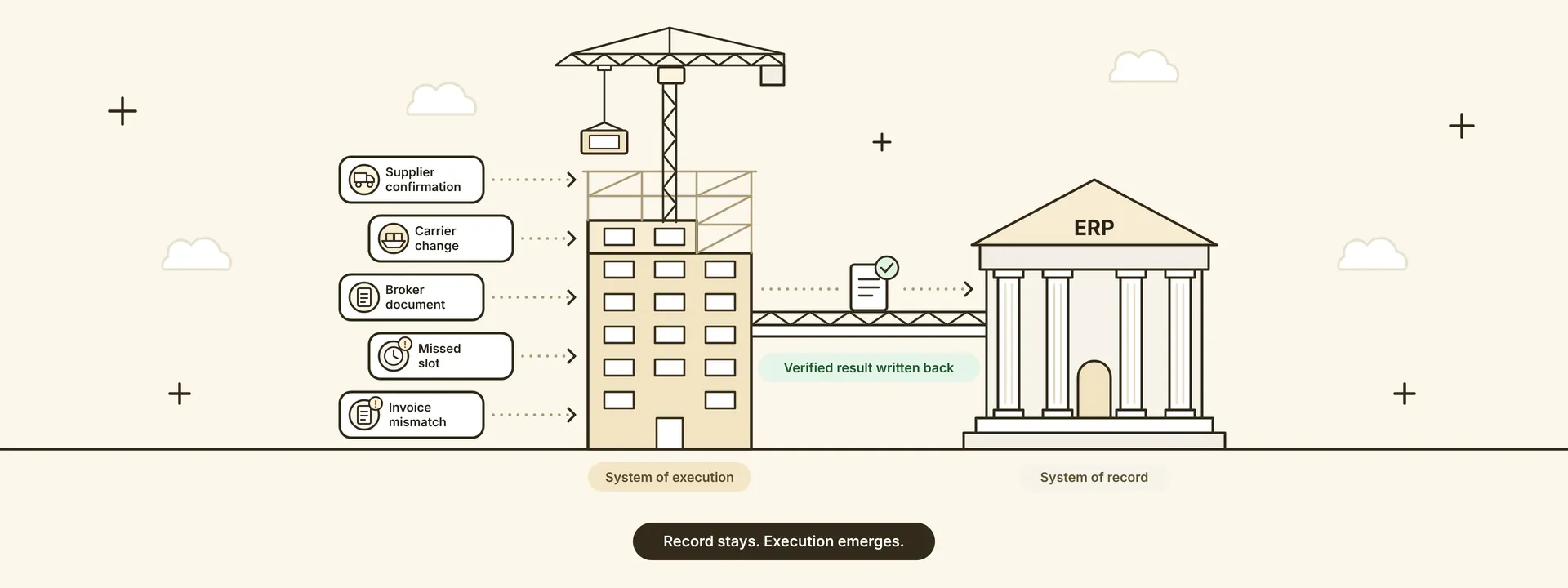
Delayed confirmations and missed slots shape outcomes long before ERP records the final state.
Every major enterprise technology cycle seems to produce the same prediction: this time, ERP will finally disappear.
Cloud was supposed to replace it. Best-of-breed SaaS was supposed to unbundle it. Now AI is supposed to make it irrelevant.
That is not the important shift.
ERP is exceptionally good at something enterprises cannot casually give up: preserving authoritative state. Master data. Financial integrity. Controls. Ledgers. Auditability. The governed record of what the business believes to be true.
The problem is not that ERP failed. The problem is that an enormous amount of enterprise work happens between ERP records.
The enterprise execution gap is not inside the record. It is the work required to move from one verified state to the next.
The work between records often determines the outcome
A supplier confirmation arrives by email. A carrier changes capacity. A broker asks for another document. A truck misses its slot. A shipment is partially delivered. An invoice conflicts with what physically occurred.
These are not merely new fields waiting to be written into a database. They are unfolding transactions. Each event changes what should happen next, who needs to act, which policy applies, what evidence is required and whether the intended business outcome is still achievable.
ERP may eventually contain the updated purchase order, shipment, receipt, invoice or journal entry. Before that final state exists, someone has to carry the transaction through the uncertainty in between.
For decades, people became the execution layer
A planner, buyer, logistics coordinator or finance analyst would read the new signal, reconstruct context from systems and messages, decide what the new state means, coordinate another function or company, follow up, handle the exception and finally update the System of Record when the transaction was settled.
That human coordination layer is why highly digitized enterprises can still feel operationally manual. They have systems for procurement, logistics, customs, warehouse operations and finance, yet people still preserve context and responsibility while transactions cross the gaps.
AI changes the division of labour - not the need for ERP
AI becomes architecturally interesting not because a model should become the new ledger, but because software can begin interpreting the signals between records, preserving transaction context, reasoning over policy, coordinating actions across channels and parties, managing exceptions, and verifying whether the intended outcome occurred.
Software can begin owning more of the work between the records.
System of Record preserves authoritative enterprise state: master data, controls, ledgers, auditability and governed records.
System of Execution carries the transaction from intent to verified outcome: decisions, actions, exceptions, external parties, evidence, verification and writeback.
The two layers are complementary
A strong System of Execution does not weaken the System of Record. It can make the record more accurate because what gets written back is the result of a completed and verified transaction rather than a partially understood intermediate event.
If a supplier changes a promise date, the execution layer should not simply extract the date and push it into ERP. It should determine what changed, assess downstream impact, coordinate required recovery, obtain approval or evidence, confirm the supplier commitment and only then return the verified state.
The same applies to carrier exceptions, customs-document issues and invoice mismatches. The useful outcome is not “AI detected something.” The useful outcome is that the transaction reached a governed resolution and the System of Record reflects what actually happened.
This matters most when the transaction leaves the enterprise
Supply-chain execution routinely crosses suppliers, carriers, forwarders, customs brokers, logistics partners and customers operating through different systems and channels.
Autonomous point solutions inside individual applications are therefore not enough. If procurement AI, logistics AI and finance AI each optimize a local task but a person still carries state between them, the enterprise has created autonomous islands connected by human coordination.
This is why the transaction is the unit of autonomy, why transaction completion must be verified, and why Autonomy Rate should measure completed outcomes rather than AI activity.
The architectural question becomes: who owns the transaction until the business outcome is verified?
System of Execution → System of Record
One runs the work. The other preserves the truth.
The next platform category may win by owning the work between records
ERP is not going away. That durability is precisely what creates room for a new layer to emerge around it.
The next enterprise platform category may not win by owning more records. It may win by owning the work required to create the next verified record.